• The move to the new server is done. There are some software and database maintenance updates in process. This has us passing the hat around to help out. We appreciate any donations. Seriously, even a dollar helps. The payment page may be found here - https://www.audiokarma.org/support.html

Sansui Oval Cap replacement concern

jpb6793

AK Member
Sansui AU-919 Oval Cap replacement concern/issue

Hello everyone...I'm one of the lucky owner's of a museum quality au 919. It's immaculate with very low hours of use. The glue itself is a tan/beige putty looking color...no corrosion whatsoever. I have another au 919 for parts (1976 model). In my parts inventory I've taken the two 7500uf caps out and unrolled them and to my surprise they were not dried out. Anyways...my concern is with replacing these caps. The replacement caps of today already have a metal casing. Should I put vent holes into the Sansui metal casing so the new caps have proper ventilation. I was considering running 3X5600uf in parallel. Lower ESR and higher ripple. Any thoughts to the many Gurus out there. I know enough about electronics so as not to electrocute myself. Thanks
 
Last edited:
Register to hide this ad
Interesting, I am in the middle of a re-cap on my G9000, and i have just today stripped my oval caps.....
I went back and looked through a few threads as to what has been used in the past.....
I have ordered today, these Panasonic T-HA (105˚)10,000µf 80V caps, a few guys here have used these....They are the maximum size that will fit in those cans 40 x 63mm.
They are higher voltage than what you need but you get the idea...They are perfectly ideal for the job.

Digikey Part Number P10646
http://www.digikey.co.nz/scripts/Dk...r=search_go&lang=en&keywords=p10646&x=12&y=19

Let us know how you get on......
 
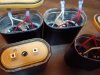
Here is a pic of what I do. I narrow the inside connector tab to 1/4 inch so a spade connector can be fitted. I use shorter 8200uf Panasonic replacement caps so there is room for the wiring and connectors to fit.
Scott T.

ps: poke a small hole in the rubber membrane located between the threaded lugs for a vent.
 

Attachments

  • DSC02777.jpg
    DSC02777.jpg
    72.8 KB · Views: 110
Here is a pic of what I do. I narrow the inside connector tab to 1/4 inch so a spade connector can be fitted. I use shorter 8200uf Panasonic replacement caps so there is room for the wiring and connectors to fit.
Scott T.

ps: poke a small hole in the rubber membrane located between the threaded lugs for a vent.

My primary objective was to get the caps I wanted in the cans, I specifically wanted to go for at least 20,000µf per can, I have another plan for the wiring, when I do it, I will post pics here and of course in my G9000 thread too...
 
Thanks to all

thank you for the input. I was going to insert inconspicuous slits around the can itself being heat has a tendacy to rise. The manufactures claim their cap life hours assume the cap is in open air. Well if the cap replacement fails within two years then it will confirm to me that the caps were subjected to additional heat. Has anyone used Cornell Dubilier caps before?
 
thank you for the input. I was going to insert inconspicuous slits around the can itself being heat has a tendacy to rise. The manufactures claim their cap life hours assume the cap is in open air. Well if the cap replacement fails within two years then it will confirm to me that the caps were subjected to additional heat. Has anyone used Cornell Dubilier caps before?

Have a look at my G9000 recap thread ( http://www.audiokarma.org/forums/showthread.php?t=441530&page=2 Scroll down the bottom), I have just posted a pic of how I am wiring them up, there will be three quite big holes in the bottom of my ovals.....
Cornell Dubilier caps are good, I have not used them personally, but I cant see why you wouldnt use them, definitely one of the better brands....
I dont think heat would be a concern unless you were running the amplifier at full power all the time.....Even then, I would think you would get enough heat conduction that they would be able to remain at a reasonable temp...
This however is part of the reason I am using 105˚ caps.....
 
Kevzep...I checked out your link. What smaller electrolytics are using on your tuner board?

I'm not doing the tuner board, the theory is that with electrolytics being 20% tolerance, re-capping a tuner could put it into a situation where it will need re-aligning, and as there are no options for tuner alignment where I live, I am going to leave it.
Will be interesting to see how long it lasts before an electro cap fails....could be many many years, lets hope so.

Was it one of the other boards you were looking at? The electrolytic caps which are made nowadays are much smaller due to advancements in construction and technology....Its actually surprising how much smaller they are now......
Most of the caps are Panansonic FM or FC with a few exceptions....

My main caps should be turning up very soon, so stay tuned to watch the progress on that.......
 
thank you for the input. I was going to insert inconspicuous slits around the can itself being heat has a tendacy to rise. The manufactures claim their cap life hours assume the cap is in open air. Well if the cap replacement fails within two years then it will confirm to me that the caps were subjected to additional heat. Has anyone used Cornell Dubilier caps before?
FYI, the big power supply caps in amps and receivers have a pretty easy life. Big current rush on start-up, then they sit and loaf.

So unless you are running test tones into dummy loads with the unit at 100+ watts for hours on end, I'd suggest that your concerns are unfounded.
 
The new capacitors will have little thermal connection to the oval cans, so I would venture to suggest they may actually be protected to an extent from the heat inside the receiver.
 
I dont think heat would be a concern unless you were running the amplifier at full power all the time.

Agreed, I mentioned this back in post 6..........

This put it in the fully conclusive category.....:thmbsp:
 
Thanks everyone...would have hated to have destroyed the cans with slits...they are so beautiful looking.

At least you had the sense to ask, I went ahead peeled the entire plastic sleeving of mine thinking I would just use heatshrink, now I have found the largest heatshrink size I can get here in New Zealand is not big enough :no:.......
I'm now going to have to come up with an elegant way of painting them black......:sigh:

Will keep you posted of the progress......:thmbsp:
 
The new capacitors will have little thermal connection to the oval cans, so I would venture to suggest they may actually be protected to an extent from the heat inside the receiver.
I believe self-heating was the concern here. ;)
 
I believe self-heating was the concern here. ;)

True, I know that is a concern - but they do "lead an easy life" as you said yourself - and in any case I couldn't think of anything better to convince our friend not to cut slots or holes in those cans !!! :smoke: (just a small hole needed for safety venting)

(other than to say, of course "DONT CUT HOLES IN THOSE CANS" :D)
 
Last edited:
Kevzep/...too bad your overseas....I have 4 spare oval empty cans from an au 919.

Echowars...And many thanks to you on your reply as well
 
Kevzep/...too bad your overseas....I have 4 spare oval empty cans from an au 919.

Echowars...And many thanks to you on your reply as well

Oh really, no way.......!!!

I will get in my canoe and start paddling.......

All good, I think I will be able to do something respectable with them, of course I retained the oval plastic top with Sansui oval dynamic capacitor or whatever it is they put on with the gold writing....
I will find a way......
 
Oh really, no way.......!!!

I will get in my canoe and start paddling.......

All good, I think I will be able to do something respectable with them, of course I retained the oval plastic top with Sansui oval dynamic capacitor or whatever it is they put on with the gold writing....
I will fond a way......

You know, you can stretch heatshrink quite a bit, and still have it work. Try putting a couple dowels or rods of some kind and pull them apart inside of the shrink tube.
 
Back
Top Bottom