• The move to the new server is done. There are some software and database maintenance updates in process. This has us passing the hat around to help out. We appreciate any donations. Seriously, even a dollar helps. The payment page may be found here - https://www.audiokarma.org/support.html

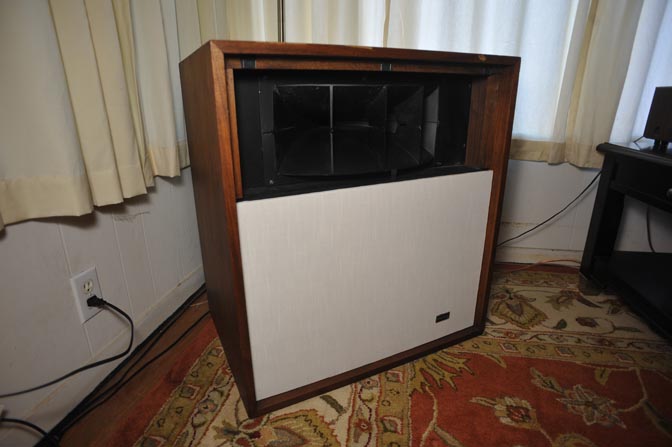
Sansui SP-3500 - An AK'er Gift and Restoration Project

Hadn't thought about that.

My last purchase for 2013 is a JVC A-X9 amp! :banana:
Getting it from another AKer! It will ship today, so I'm very excited starting next year with this rare amp, and starting the AR3 restoration.

Those Sansui's look great, and I love the simple crossovers. I also didn't know JBL made the drivers. Makes me look at them in a whole new light.

Glenn
 
Hadn't thought about that.

My last purchase for 2013 is a JVC A-X9 amp! :banana:
Getting it from another AKer! It will ship today, so I'm very excited starting next year with this rare amp, and starting the AR3 restoration.

Those Sansui's look great, and I love the simple crossovers. I also didn't know JBL made the drivers. Makes me look at them in a whole new light.

Glenn

My last purchase for this year is going to be a big fat stake for the BQ:banana:
 
Thanks for the post will have to go there and explore a bit, no comments it must have gotten buried.

I am running the big model just before yours. The SP-5000 same thick wall construction and size, a speaker not many have experienced.

IMG_1658_zps4c7499b9.jpg

Thanks for sharing that as I has never seen those speakers. Hard to find much history on these but I had a later post with pics after I finished them that got some responses. It's just no one knows much about them.

http://www.audiokarma.org/forums/showthread.php?t=525320
 
Hadn't thought about that.

My last purchase for 2013 is a JVC A-X9 amp! :banana:
Getting it from another AKer! It will ship today, so I'm very excited starting next year with this rare amp, and starting the AR3 restoration.

Those Sansui's look great, and I love the simple crossovers. I also didn't know JBL made the drivers. Makes me look at them in a whole new light.

Glenn

Congratulations on the A-X9! That right there? A real score.

xo, Biggles
 
I just love using a soldering iron, makes me giddy to watch the solder melt in to the wires. OH yeah baby.

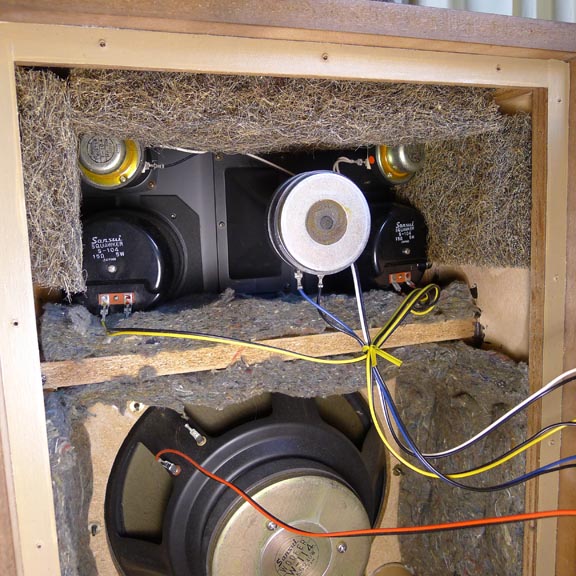
Here's the scoop. I cut out the notch in the insulation.

SP3500008.jpg


I took the notch and re-installed it underneath the tweeter/mid array.

SP3500009.jpg


Then cut up the old insulation I had on hand from the old console speakers. And installed it thusly:

SP3500010.jpg


Am ready to button this one back up and will do so now. But step-son is still sleeping ...
 
I just love using a soldering iron, makes me giddy to watch the solder melt in to the wires. OH yeah baby.

Here's the scoop. I cut out the notch in the insulation.

SP3500008.jpg


I took the notch and re-installed it underneath the tweeter/mid array.

SP3500009.jpg


Then cut up the old insulation I had on hand from the old console speakers. And installed it thusly:

SP3500010.jpg


Am ready to button this one back up and will do so now. But step-son is still sleeping ...

It will be interesting to hear the difference between toe two.
 
Boy stirred, receiver on.

Bingo! Cutting out the insulation did make a noticeable difference in the bass. Is it a lot? No, it isn't. Is it enough to warrant opening up the enclosures and doing it? Of course it is. I could hear and feel the difference between the two. Even jacking the bass controls they were still different. But the best most important difference? At low volumes the bass is a little fuller, deeper and just what you'd want at lower volumes. The other speaker's bass is a tad flat, lacking especially at lower volumes. Your speakers should be enjoyable at .5 of a watt and they are now just that, enjoyable.

Bingo!

xo, Biggles
 
MmMMmMM, stake.

I'm roasting a turkey breast with bacon stuffed under the skin, then gravy.

Biggles
 
I thought I read that *adding* insulation was the correct approach, not removing. Seems there have been many discussions that adding fill, for some reason, makes the cabinet larger in volume "mechanically". Not physically of course. I've never seen this adequately explained, but there are people who have confirmed this, but again most of those were subjective and not objective, that I recall.

The correct approach varies depending on a lot of variables. If the original design engineer designed the damping that way then there may be a good reason for the placement of the fiber. Adding insulation is usually worth a try with a sealed system. But on a ported speaker like these it gets complicated. Port size and placement and controlling reflections gets very complicated.
I wouldn't make any changes that couldn't be un-done.
 
I'm confused:scratch2:. Since if been here all I've ever heard is people bash 'Sui speakers.:thumbsdn: But now people like them?:dunno: We humans are a weird bunch. BTW, I own a pair of 1500's and like them. I must be kookoo:screwy:
 
I'm confused:scratch2:. Since if been here all I've ever heard is people bash 'Sui speakers.:thumbsdn: But now people like them?:dunno: We humans are a weird bunch. BTW, I own a pair of 1500's and like them. I must be kookoo:screwy:

Yep thats the consensus . Oh and that would come from individual that listened to every single Sansui speaker with all possibilities of gear going through them.

Well maybe 95% of them are followers of a popularity contest.
 
Dampening material in vented speakers usually is used to control the midbass/lower mirange reflections from bouncing back to the woofer cone. Even more important with mild 6db or 12db crossover slopes.
The problem in a vented enclosure is that it really doesn't increase the volume the woofer see's much (unlike a stuffed sealed box)-but the space it occupies can change the port/box tuning, and also (with some woofers in particuliar) how it "breath's in the enclosure" and it's transient response.
The most beneficial way to to have the dampening material directly behind the woofer.
Sometimes it is used to smooth a impedance peak, especially if the woofer was designed for a larger box.
Sometimes they design the ported enclosure as a leaky sealed box-and stuff it full (ESS).
If the woofer suspension is overly stiff from age, this could explain the improvement.
You could easily measure the internal volume, plug in the port size and length and figure out the box tuning.
The minimal amount of damping required to control reflections would be ideal.
If it's for impedance control, you may have to leave it-on the other hand if the suspension isn't up to what it should be-maybe leave it out till you can repair it.
I would highly doubt they used it to (fine) tune the box-as that's a poor way to use damping in a ported enclosure.
Be aware, many highly efficient speakers, aren't so efficient in the bass region, and need some power to really open up, especially in the bass region.
Drive them with a nice 150-200 wpc amp with good low end drive and you might be surprised.
 
Last edited:
I thought I read that *adding* insulation was the correct approach, not removing. Seems there have been many discussions that adding fill, for some reason, makes the cabinet larger in volume "mechanically". Not physically of course. I've never seen this adequately explained, but there are people who have confirmed this, but again most of those were subjective and not objective, that I recall.

The correct approach varies depending on a lot of variables. If the original design engineer designed the damping that way then there may be a good reason for the placement of the fiber. Adding insulation is usually worth a try with a sealed system. But on a ported speaker like these it gets complicated. Port size and placement and controlling reflections gets very complicated.
I wouldn't make any changes that couldn't be un-done.

Agreed. What I did can all be undone in a matter of moments.

I'm confused:scratch2:. Since if been here all I've ever heard is people bash 'Sui speakers.:thumbsdn: But now people like them?:dunno: We humans are a weird bunch. BTW, I own a pair of 1500's and like them. I must be kookoo:screwy:

Oh, everyone bashes pretty much everything if you wait long enough. I was bashed since the 70's for being keen on Radio Shack's offerings, laughed at and dismissed. Now the Mach 1 has a huge following and they sell off CL before noon. If you wait long enough, it'll all come back in to fashion.

Dampening material in vented speakers usually is used to control the midbass/lower mirange reflections from bouncing back to the woofer cone. Even more important with mild 6db or 12db crossover slopes.
The problem in a vented enclosure is that it really doesn't increase the volume the woofer see's much (unlike a stuffed sealed box)-but the space it occupies can change the port/box tuning, and also (with some woofers in particuliar) how it "breath's in the enclosure" and it's transient response.
The most beneficial way to to have the dampening material directly behind the woofer.
Sometimes it is used to smooth a impedance peak, especially if the woofer was designed for a larger box.
Sometimes they design the ported enclosure as a leaky sealed box-and stuff it full (ESS).
If the woofer suspension is overly stiff from age, this could explain the improvement.
You could easily measure the internal volume, plug in the port size and length and figure out the box tuning.
The minimal amount of damping required to control reflections would be ideal.
If it's for impedance control, you may have to leave it-on the other hand if the suspension isn't up to what it should be-maybe leave it out till you can repair it.
I would highly doubt they used it to (fine) tune the box-as that's a poor way to use damping in a ported enclosure.

I just read through your words, hit a few snags. But I'll figure it out. Thank you so much for stopping by and offering up the information, it's much appreciated!

I gently pushed in on the woofer in the enclosure that I modified, it didn't seem oddly stiff to me. But I don't have a "new" one to measure against, so I don't really know. At the moment I'm hesitant to use a solvent of any type at the moment to loosen things up. I would need to do more reading, maybe some guidance before I move in that direction. But from what I've read on the net, it could very well help things greatly by loosening it up.

Biggles

 
Dampening material in vented speakers usually is used to control the midbass/lower mirange reflections from bouncing back to the woofer cone. Even more important with mild 6db or 12db crossover slopes.
The problem in a vented enclosure is that it really doesn't increase the volume the woofer see's much (unlike a stuffed sealed box)-but the space it occupies can change the port/box tuning, and also (with some woofers in particuliar) how it "breath's in the enclosure" and it's transient response.
The most beneficial way to to have the dampening material directly behind the woofer.
Sometimes it is used to smooth a impedance peak, especially if the woofer was designed for a larger box.
Sometimes they design the ported enclosure as a leaky sealed box-and stuff it full (ESS).
If the woofer suspension is overly stiff from age, this could explain the improvement.
You could easily measure the internal volume, plug in the port size and length and figure out the box tuning.
The minimal amount of damping required to control reflections would be ideal.
If it's for impedance control, you may have to leave it-on the other hand if the suspension isn't up to what it should be-maybe leave it out till you can repair it.
I would highly doubt they used it to (fine) tune the box-as that's a poor way to use damping in a ported enclosure.
Be aware, many highly efficient speakers, aren't so efficient in the bass region, and need some power to really open up, especially in the bass region.
Drive them with a nice 150-200 wpc amp with good low end drive and you might be surprised.

Am piecing your words together. You mention measuring internal volume, plug in the port size and length ... Is there a formula or even better, a computer program I can use to determine this?

You state that many highly efficient speakers aren't so efficient in the bass region. This is EXACTLY what I'm feeling that I'm getting. At .5 to 1 watt, closer to 2, I'm not getting the bass I'm expecting. But after 2 and really begins to open up at 10 watts. At 15 watts I'm really enjoying myself.

I'm powering them with a Toshiba SA-7150, an oddball receiver. But if you're familiar with it, then you see it can push these speakers just where they need to be. It's rated at approximately 150 to 160 watts and is a dual mono design. The amplifier and pre-am section are really quite wonderful.

Biggles
 
Am piecing your words together. You mention measuring internal volume, plug in the port size and length ... Is there a formula or even better, a computer program I can use to determine this?

You state that many highly efficient speakers aren't so efficient in the bass region. This is EXACTLY what I'm feeling that I'm getting. At .5 to 1 watt, closer to 2, I'm not getting the bass I'm expecting. But after 2 and really begins to open up at 10 watts. At 15 watts I'm really enjoying myself.

I'm powering them with a Toshiba SA-7150, an oddball receiver. But if you're familiar with it, then you see it can push these speakers just where they need to be. It's rated at approximately 150 to 160 watts and is a dual mono design. The amplifier and pre-am section are really quite wonderful.

Biggles

I found with my 5000s they were soft and mushy with my SS 85w pushing them. They're rated a@ 90w, now with the two 275s in mono @ 180w tube power. Well lets just say they love it, they have long legs over the stated wattage. Much more responsive clear hard hitting bass with optimum tube power driving them.
 
Back
Top Bottom