• The move to the new server is done. There are some software and database maintenance updates in process. This has us passing the hat around to help out. We appreciate any donations. Seriously, even a dollar helps. The payment page may be found here - https://www.audiokarma.org/support.html

Scott 222C

Hey How's it's sounding ? I'm working on a LK72 Amp, Talk about resistors all 1/2 watt,
all these guy back then, was twist the wires around so tight I have to cut
them all off, but I'm getting there
 
Let's say I want to replace all the resistors for the fun of it--is there a way to tell the wattage of the old resistors based on their size? I've been digging around for a little bit but cannot find any concise reference for this vintage.

I'm hoping to replace all the carbon comps with metal film to help the little bit of (constant, independent of volume) white noise I can hear with my ear next to the woofer.

As far as the carbon resistors only two wattages used in the entire amp. The small ones peppered all over the place are 1/2 watt and the larger sizes are 1 watt. No need to dig up schematics but I do think the notes at the bottom of the Scott schematic say all resisotrs 1/2 watt unless noted.

I caution you in fact double caution you!!! STAY WITH CARBON TYPE RESISTORS or the sound will siffer... Again this is a technically better is not always better in the real world. Carbon film will do just fine. I personally like Stackpole brand.

I replace many resisotrs when I rebuild these amps. Namely all plate and cathode resistors on every tube socket. I also check and replace all out of spec resistors associated with the output tubes. If you go to replacing every resistor plan on being in the amp for the next couple weeks ;) and it will be a huge waste of time. Most of the other reistors in the amp never see a bit of voltage and are just along for the ride. Be careful on any connection on the controls its pretty easy to wreck those controls and then you are up the creek since they are very hard to source.

You'll find many of the plate and cathode resistors have drifted.
 
Ah, interesting, thanks for the pointers (as always!) Craig! I'll check 'em out when my tip jacks arrive. :thmbsp:
 
Good to hear you're making progress, Lou! I know what you mean about have to cut the leads and wires--they didn't fool around about making good connections.

So after hearing such a drammatic change in sound from a set of Sovtek tubes, to a set of noisy RCAs, and ultimately a set of very nice sounding RCAs, what tubes should I be looking for next to roll into the 12AX7 sockets? AFAIK the two on the right are global while the two on the left are phono. Is it a problem that I just leave two Sovteks in the phono to act as a load while I roll with the other two sockets?

I've got a pair of Matsushita (Mullard-tooling) 12AX7s on the way that I'm excited to try out!
 
Hi,
In my Scott I using these tubes,
Phono- RCA's
Line- MESA
Phase- 6U8A GE's
Power- 6p14P's Russian
Rectifier- Mullard GZ34
So far I like the sound I get with this combination. Now in my LK72
that's another story. Haven't got that far yet.

Tube
 
Last edited:
As mentioned above, most of what Scott used was 1/2 watt carbon. I don't know the manufacturer but they were excellent and after 50 years, if the amplifier was not abused or used in very damp conditions, those resistors are usually spot on value even though they are 10%. The few exceptions are the 100K ohms plate resistors. They were 1-watt. I have seen a very few 2-watt resistors in the power supply. But not many. Of course, you may find different situations than I have found...
 
As for tubes, in my first edition 299, I have Telefunken tubes before the outputs which are Soviet Military versions of the 7189 6pi14pi-ev (6П14П -ЕВ). And the rectifier is the old Mullard GZ34. I have had zero problems since restoration and the amp gets daily use. I used Orange Drop capacitors since that was all I had. Now I use the yellow axial capacitors from IC. They fit much better. I am not into boutique capacitors or their price. However, that is not a negative comment. One may use whatever he/she wishes. They work for me. And are good size, and excellent price...
 
Wow, rolled in some GE triple-mica, black plate 5751 tubes into the front end and this thing's downright holographic! There's some sizzling in one channel (plate and cathode resistors?) and I've got to go over the controls again with some cleaner fluid.

Wow wow wow wow!
 
Wow, rolled in some GE triple-mica, black plate 5751 tubes into the front end and this thing's downright holographic! There's some sizzling in one channel (plate and cathode resistors?) and I've got to go over the controls again with some cleaner fluid.

Wow wow wow wow!

Hi,
Did you change any resistors in the Phono and Line stage yet, in mine
When I first Got it and turn it on the phono was So So, but the line stage was
sounding really nice, I then changed all the resistors in the phono section, left
linestage alone and it sounded great, sizzle could be noisy tube's or Noisy
resistors,better if it the tubes you can pop them out, where did you put in
the 5751's in the phono or linestage there a slightly lower output than the
12AX7's so there's your bigger sound.

Tube
 
I just spent a couple hours listening to the amp--wow does the power traffo get hot! I've been reading that they're barely up for the job in the 222C and that others have got replacements made up by Heybower (spelling?). I'm thinking of going this route before I blow the original--put in a more capable part AND have the original for originalities' sake.

Or is it just my cool-running solid-state mindset getting in the way? It was boaderline uncomfortable to touch for more than a couple seconds.
 
I just spent a couple hours listening to the amp--wow does the power traffo get hot! I've been reading that they're barely up for the job in the 222C and that others have got replacements made up by Heybower (spelling?). I'm thinking of going this route before I blow the original--put in a more capable part AND have the original for originalities' sake.

Or is it just my cool-running solid-state mindset getting in the way? It was boaderline uncomfortable to touch for more than a couple seconds.

Yes, they do run warm, that is the nature of the beast. You also have the
GZ34/5AR4 nearby which contributes to the tranny's warmth.
 
Hi,
Did you change any resistors in the Phono and Line stage yet, in mine
When I first Got it and turn it on the phono was So So, but the line stage was
sounding really nice, I then changed all the resistors in the phono section, left
linestage alone and it sounded great, sizzle could be noisy tube's or Noisy
resistors,better if it the tubes you can pop them out, where did you put in
the 5751's in the phono or linestage there a slightly lower output than the
12AX7's so there's your bigger sound.

Tube

I'll try changing out some resistors--while I did test some, I didn't test all of them. I thought that it might've been a tube, but the sizzle stays with the amp. I know that one channel slowly drops out, but that's a dirty switch that I still have to clean, so maybe that might be where the sizzle comes from too.


Yes, they do run warm, that is the nature of the beast. You also have the
GZ34/5AR4 nearby which contributes to the tranny's warmth.

I guess that's true, the middle transformer gets warmer than the left one for the same reason, I suppose.
 
Are you running the amp through a variac or bucking transformer ?
Keeping the input voltage down around 110-117VAC will make a
difference. My 222B power transformer also runs very warm, but the
side toward the 5AR4 and output tubes gets warmer, so I think its
absorbing the heat from those tubes. The side away from those
tubes is cooler.
 
Are you running the amp through a variac or bucking transformer ?
Keeping the input voltage down around 110-117VAC will make a
difference. My 222B power transformer also runs very warm, but the
side toward the 5AR4 and output tubes gets warmer, so I think its
absorbing the heat from those tubes. The side away from those
tubes is cooler.

I was only touching the top bell of the traffo, and that part is full of air, so for that to be nearly untouchably hot, I'm a little worried.

I do run it through a VARIAC set to 116V. :scratch2:
 
I was only touching the top bell of the traffo, and that part is full of air, so for that to be nearly untouchably hot, I'm a little worried.

I do run it through a VARIAC set to 116V. :scratch2:

Mine after being on awhile does get hot, it's touchable but won't
want to leave my hand on it to long, Maybe our hand conducts the
heat like a heatsink. :scratch2: but next time I have it on
a few hours I'll try it out. But do replace the resistors there, last
two days I've been restoring the LK72 amp I got, I took out all the
resistor's in the power tube area and the Phase Splitter area, put in
new Caps and resistors. So I've been busy with that.
 
I was only touching the top bell of the traffo, and that part is full of air, so for that to be nearly untouchably hot, I'm a little worried.

I do run it through a VARIAC set to 116V. :scratch2:

My LK-72A power transformer gets really hot after a couple hours too. Like you, nearly untouchably hot.
 
Thanks all to the tip on Epoxying the JJ's to the wafers, JB Weld works great and
takes heat to 300 degrees, so

Thanks again
 
fragger, can you tell me or show me were you placed the extra pots for the bias ?
I am working on such a amp and it looks like a big improvement to me.

And some one re capt the amp and put all 0,15 uF instead of the 0,1 uF caps in it. should there be a big difference in sound when i recap it with the original value ?
It 's a difference of 50 % !!
 
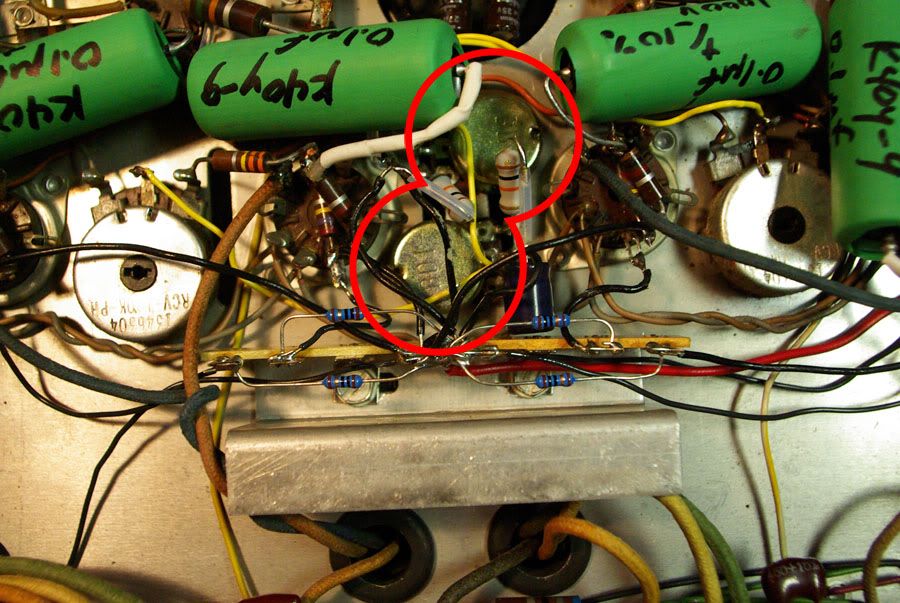
Here's a bunch of detail shots showing how I mounted the potentiometers for the bias trim. I opened up the ends of the two centre vents to accommodate the diameter of the mounting threads. Hope that helps ya, I can't comment on the capacitors though, but I think they'd be fine.

The first photo has the orientation pin detail circled.

2011-01-06-150132_POTS_sm.jpg


2011-01-06-150126_POTS_sm.jpg


2011-01-06-144220_POTS_sm.jpg


2011-01-03-210158_POTS_sm.jpg
 
Thanks for the photo's, now I now what to do.
Mine traffo isn"t hot at all, but it runs on 110 V with a very low neg. bias ( -7 ) That has to be fixed I suppose.
The 110V is because I have to use a step down traffo 220 V - 110 V , I am from Holland. ( that explains the writing )
 
Back
Top Bottom