

You are using an out of date browser. It may not display this or other websites correctly.
You should upgrade or use an alternative browser.
You should upgrade or use an alternative browser.
Servicing a SONY DAT machine (Pictorial)
- Thread starter SaSi
- Start date
ZA5ES playback problem
hi All,
I own a nice Sony ZA5ES that hasn't been used for a few years..
When I tried to playback some tapes yesterday, I noticed the dreaded "scratch noise" / digital noise / metallic sound (continuously, but in rhythm with the music) on top of the audio that's supposed to be on the tapes.
Because the machine hadn't been used for a long time, I used a cleaning tape before the actual playing-back audio tapes, but that didn't help much. All tapes I tried suffer the same playback problem. Subsequent running cleaning tape again didn't help either.
FFWD/RRWD is functioning properly, but the timecode display sometimes freezes / blinks during winding.
I suspect the RF amp may suffer from dried-out capacitors, but I can't find any references to my model ZA5ES of DAT recorder.
Could it be the same type RF amp module as is used in many other models of Sony DAT machines?
btw excellent thread!
tia
hi All,
I own a nice Sony ZA5ES that hasn't been used for a few years..
When I tried to playback some tapes yesterday, I noticed the dreaded "scratch noise" / digital noise / metallic sound (continuously, but in rhythm with the music) on top of the audio that's supposed to be on the tapes.
Because the machine hadn't been used for a long time, I used a cleaning tape before the actual playing-back audio tapes, but that didn't help much. All tapes I tried suffer the same playback problem. Subsequent running cleaning tape again didn't help either.
FFWD/RRWD is functioning properly, but the timecode display sometimes freezes / blinks during winding.
I suspect the RF amp may suffer from dried-out capacitors, but I can't find any references to my model ZA5ES of DAT recorder.
Could it be the same type RF amp module as is used in many other models of Sony DAT machines?
btw excellent thread!
tia
Last edited:
ZA5ES playback problem
Thanks Sasi,
Found a ZA5ES service manual (and many more) online here: http://www.davidsanders.me/documents/
including full schematics.
The RF Board layout is on page 69/70 and schematic on 71/72.
I noticed there are several 22uF/6.3v caps on the board and some others that might be suspects.
The machine is at least 10 years old so I wouldn't be too surprised if dried electrolytics are the culprit.
I'll try to remove the RF amp unit from the machine for further investigation.
Thanks Sasi,
Found a ZA5ES service manual (and many more) online here: http://www.davidsanders.me/documents/
including full schematics.
The RF Board layout is on page 69/70 and schematic on 71/72.
I noticed there are several 22uF/6.3v caps on the board and some others that might be suspects.
The machine is at least 10 years old so I wouldn't be too surprised if dried electrolytics are the culprit.
I'll try to remove the RF amp unit from the machine for further investigation.
ZA5ES playback problem
hdrobien,
sure, I've uploaded some more pics to my album here: http://www.audiokarma.org/forums/album.php?albumid=3503
hdrobien,
sure, I've uploaded some more pics to my album here: http://www.audiokarma.org/forums/album.php?albumid=3503
ZA5ES playback problem
hdrobien,
already posted some pics (not the best pics ever...) with tape fully loaded, machine playing:
http://www.audiokarma.org/forums/picture.php?pictureid=23596&albumid=3503
http://www.audiokarma.org/forums/picture.php?pictureid=23597&albumid=3503
Meanwhile, I've disassembled the RF amp unit and replaced the electrolytic capacitors:
before:

after:

Now I'm trying to put it all back together, and hope for a succesful repair.
For all pics see my ZA5ES album here.
hdrobien,
already posted some pics (not the best pics ever...) with tape fully loaded, machine playing:
http://www.audiokarma.org/forums/picture.php?pictureid=23596&albumid=3503
http://www.audiokarma.org/forums/picture.php?pictureid=23597&albumid=3503
Meanwhile, I've disassembled the RF amp unit and replaced the electrolytic capacitors:
before:
after:
Now I'm trying to put it all back together, and hope for a succesful repair.
For all pics see my ZA5ES album here.
ZA5ES playback problem
Will take some close-up pics under better light conditions tomorrow.
I just got the idea to try and make a new recording (via coaxial spdif from my CDJ1000 player) on a fresh tape.
Much to my surprise this worked really good and playback from the DAT sounds just perfectly the way it should.
Now what does this mean ?
Is my machine OK but all my old tapes have gone useless ?
Or is tracking way off and it just needs alignment (how could this happen just from not using the machine for many years?
Will take some close-up pics under better light conditions tomorrow.
I just got the idea to try and make a new recording (via coaxial spdif from my CDJ1000 player) on a fresh tape.
Much to my surprise this worked really good and playback from the DAT sounds just perfectly the way it should.
Now what does this mean ?
Is my machine OK but all my old tapes have gone useless ?
Or is tracking way off and it just needs alignment (how could this happen just from not using the machine for many years?

SaSi
Seriously Illogical
I am fairly certain that recording via analog inputs should be equally ok as with the digital inputs.
If your deck records and plays back fine these recordings but doesn't play back older recordings well, it means that these older recordings and the new ones are made with different head azimuth.
If you get sporadic jitter when playing back the older recordings it means that the adjustment is a tiny bit different.
As to which alignment is correct, if the older recordings were made with this deck when it was in top notch condition, I would guess that the older recordings are correct and the new ones are being made with the wrong azimuth.
BTW, since new recordings are behaving well, I would discard problems like incorrect tension and mechanical malfunctions (or electronic malfunctions) of any other kind as such problems would show up on the new recordings as well.
Azimuth on a DAT machine is adjusted by turning the S and T guide roller adjustment screws a tiny bit at a time. You normally need an osciloscope to adjust azimuth and the instructions are found in the service manuals but if you don't have an osciloscope, all is not lost (if you are not going for totally correct azimuth but adequate). But you do need a proper fork like flat screw driver to turn the screws or you will ruin the tolerances of the guides.
I would start with the right hand tension roller first (T). Considering there are 360 degrees to a full turn, turn 5 degrees or so every time. But before doing anything, mark the current locations of the screws. You should try +5 on the T, +10 then +15 but no more. If it improves you are on the right track. If not, try -5, then -10. If it still doesn't improve, return it to it's former position and try the left hand tension arm, again in 5 degrees increments.
Bear in mind that if you turn +5 degrees both the S and T arms on a perfectly adjusted deck, you still have a correct geometry against the tape direction but you are off against tape width (tape passes a tiny bit lower from the heads). You will get good results in recording and playing back your own tapes but not on tapes made with correct adjustment).
If your deck records and plays back fine these recordings but doesn't play back older recordings well, it means that these older recordings and the new ones are made with different head azimuth.
If you get sporadic jitter when playing back the older recordings it means that the adjustment is a tiny bit different.
As to which alignment is correct, if the older recordings were made with this deck when it was in top notch condition, I would guess that the older recordings are correct and the new ones are being made with the wrong azimuth.
BTW, since new recordings are behaving well, I would discard problems like incorrect tension and mechanical malfunctions (or electronic malfunctions) of any other kind as such problems would show up on the new recordings as well.
Azimuth on a DAT machine is adjusted by turning the S and T guide roller adjustment screws a tiny bit at a time. You normally need an osciloscope to adjust azimuth and the instructions are found in the service manuals but if you don't have an osciloscope, all is not lost (if you are not going for totally correct azimuth but adequate). But you do need a proper fork like flat screw driver to turn the screws or you will ruin the tolerances of the guides.
I would start with the right hand tension roller first (T). Considering there are 360 degrees to a full turn, turn 5 degrees or so every time. But before doing anything, mark the current locations of the screws. You should try +5 on the T, +10 then +15 but no more. If it improves you are on the right track. If not, try -5, then -10. If it still doesn't improve, return it to it's former position and try the left hand tension arm, again in 5 degrees increments.
Bear in mind that if you turn +5 degrees both the S and T arms on a perfectly adjusted deck, you still have a correct geometry against the tape direction but you are off against tape width (tape passes a tiny bit lower from the heads). You will get good results in recording and playing back your own tapes but not on tapes made with correct adjustment).
ZA5ES playback problem
thank you for answer, Sasi.
Indeed, the recording check on a new tape confirmed that there is nothing wrong electronically. That's what I wanted to confirm, electronics, head, ADC and DAC functions working properly.
I have included some close-ups, taken from the photo's I took yesterday, but zoomed in on the tape guides:

Not very good to see, but I think the left guide arm (as viewed from the front of the deck) (is this named S ?) is not being extracted completely to the end-stop. Could this cause azimuth difference you mentioned ?
The other one (T?) is fully end stop:

I own a good (2CH/120MHz) oscilloscope, but will have to study how to do the measurements on the DAT machine. Getting the right adjustment tool (fork screwdriver) is another matter. Maybe I can have one machined from a regular screwdriver.
A bit of history on my old recorded tapes: Oldest tapes were recorded on my previously owned DTC59ES (starting around 1993). Later tapes on my ZA5ES, from around 2000 - 2005.
I also have some tapes that were recorded on pro machines at radio-stations and studios. I have a mix of various length DAT tapes and DDS-1 (90meter) and DDS-2 (120meter) tapes.
Never had any problems using DDS-2 tapes btw (for continuous recording).
All of them now sound equally heavy distorted as described in my previous posts.
thank you for answer, Sasi.
Indeed, the recording check on a new tape confirmed that there is nothing wrong electronically. That's what I wanted to confirm, electronics, head, ADC and DAC functions working properly.
I have included some close-ups, taken from the photo's I took yesterday, but zoomed in on the tape guides:
Not very good to see, but I think the left guide arm (as viewed from the front of the deck) (is this named S ?) is not being extracted completely to the end-stop. Could this cause azimuth difference you mentioned ?
The other one (T?) is fully end stop:
I own a good (2CH/120MHz) oscilloscope, but will have to study how to do the measurements on the DAT machine. Getting the right adjustment tool (fork screwdriver) is another matter. Maybe I can have one machined from a regular screwdriver.
A bit of history on my old recorded tapes: Oldest tapes were recorded on my previously owned DTC59ES (starting around 1993). Later tapes on my ZA5ES, from around 2000 - 2005.
I also have some tapes that were recorded on pro machines at radio-stations and studios. I have a mix of various length DAT tapes and DDS-1 (90meter) and DDS-2 (120meter) tapes.
Never had any problems using DDS-2 tapes btw (for continuous recording).
All of them now sound equally heavy distorted as described in my previous posts.
Attachments


ZA5ES playback problem - solved ?
Update:
I've used a tip that was given in post #154 of this thread:
I left the machine overnight recording silence to a DDS2-120m tape.
This morning I let the machine playback the recording for a few hours.
After that, I tried to play back an older tape, and much to my surprise, it sounded perfect. Tried some different tapes, that sounded distorted yesterday, and they all play back nicely. A huge difference with yesterday.
It may be because the machine has gotten quite warm, so the lubrication / grease has become a bit more soft, or may be the head was "burned in".
I'll now switch off the machine to cool down and try again later.
Update:
I've used a tip that was given in post #154 of this thread:
I left the machine overnight recording silence to a DDS2-120m tape.
This morning I let the machine playback the recording for a few hours.
After that, I tried to play back an older tape, and much to my surprise, it sounded perfect. Tried some different tapes, that sounded distorted yesterday, and they all play back nicely. A huge difference with yesterday.
It may be because the machine has gotten quite warm, so the lubrication / grease has become a bit more soft, or may be the head was "burned in".
I'll now switch off the machine to cool down and try again later.
That is why I asked you close up pictures. To check guides relative positions.Not very good to see, but I think the left guide arm (as viewed from the front of the deck) (is this named S ?) is not being extracted completely to the end-stop. Could this cause azimuth difference you mentioned ?
I encountered this problem twice: left and right guides became unsynchronised. On this model each guide is driven by its own ring gear.
Sometimes one jumps a tooth so you have to resynchronize.
Your problem seems to be solved. Does the left guide fully extract now ?
ZA5ES playback problem - solved !
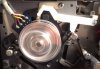
Yes! The S1 guide now fully extracts to the end position:

The difference between yesterday's position and now is at least 5mm, explaining the faulty azimuth then.
Now I can playback all my previously recorded tapes again :thmbsp:
I'm glad I never touched the guide adjustment screws.
Thanks for the great information in this thread !
Yes! The S1 guide now fully extracts to the end position:
The difference between yesterday's position and now is at least 5mm, explaining the faulty azimuth then.
Now I can playback all my previously recorded tapes again :thmbsp:
I'm glad I never touched the guide adjustment screws.
Thanks for the great information in this thread !
Attachments
SaSi
Seriously Illogical
So, Lesson here is:
A deck sitting idle for years will not lose it's azimuth adjustment but might lose it's agility in terms of tension arms extending fully.
Don't touch any adjustments before you are absolutely certain that the mechanical parts behave as they should, and that the tension arms reach the resting guides at the end of their travel.
Sometimes a few load/unload cycles will suffice. Don't lubricate anything on the transport - it doesn't need it. Lubricating will never improve things and almost always deteriorate the transport behavior.
A deck sitting idle for years will not lose it's azimuth adjustment but might lose it's agility in terms of tension arms extending fully.
Don't touch any adjustments before you are absolutely certain that the mechanical parts behave as they should, and that the tension arms reach the resting guides at the end of their travel.
Sometimes a few load/unload cycles will suffice. Don't lubricate anything on the transport - it doesn't need it. Lubricating will never improve things and almost always deteriorate the transport behavior.