
• The move to the new server is done. There are some software and database maintenance updates in process. This has us passing the hat around to help out. We appreciate any donations. Seriously, even a dollar helps. The payment page may be found here - https://www.audiokarma.org/support.html

Setting up an equalizer .....?

As I said I upgraded from a much simpler and smaller system.
Im not an audio engineer so my best answer as to what I am trying to achieve is that I want the sound to be as good as it can be.
"What is good" you are going to ask ... I dont know ... that is why I came here for some advice.

I have learned that the room will effect the sound from the speakers a lot.
When I bought this setup it was on a table out in the open of a large area and it sounded fantastic.
Bright, clear, with good bass.
But at home in my living room it sounds mushy and not as bright and clear.

I tried setting it flat using the sound meter and a test tone cd but that made it sound terrible.
Lack of knowledge of how to measure and adjust could account for that.

This equalizer / pre-amp does have a switch that bypasses the equalizer part.
So I can switch it in and out to hear the difference.
As it is set (smiley face) there is a small boost on the low end and just a touch of brightness to vocals.
Being 74 years old and a competition shooter in the 70's there are higher frequency's I wont hear no matter how much boost I use.
So far the difference simply does not justify the cost of the equalizer.
I am starting to think a nice straight up pre-amp with inputs for phono, CD, and tuner would suffice.

Another thing that puzzles me is that if the led lights on the amp are accurate then less than 15 watts per channel is adequate.
The amp is capable of 150 watts per channel so I feel like I wasted a lot of money if 15 watts is all I need.
Wish the Amp had A/B speaker outputs so I could compare speaker sets
Perhaps an outboard switch later on would do that for me.

Is being an audiophile like chasing the holy grail ... always seeking something better that you suspect exists?
Never completely sure you are satisfied with what you have.
Always looking at expensive equipment thinking it would sound better?
 
Is being an audiophile like chasing the holy grail ... always seeking something better that you suspect exists?
Never completely sure you are satisfied with what you have.
Always looking at expensive equipment thinking it would sound better?

An audiophile is what he wants to be.

As a former PA tech, Ive been to hundreds of dances, parties, small venue performances and some big concerts.

I strive to have a sound that brings me back to those moments. I have my idea of what a singer sounds like singing into a Shure microphone. I have memories of the sensation of sitting next to a bass guitar amplifier. Reproducing a sound that stirs emotions is marvelous. It like smelling the perfume or an old girlfriend, schawiiiiiing!

Now is that accurate? I dont know. I dont care. I am baking a cookie that Im going to eat. I dont really care if someone else says they dont like it.

I met a guy who strives to recreate the sound of his youth with tube gear and old Altec cabinets. I wouldnt own something like that, but I appreciated what he was doing and he got the sound right.

Think about what youre trying to do and go for it.

As for an EQ, I'd buy one if I needed to contour the sound of a fixed combination of gear to a room. I personally would do it another, and more involved way. But there is nothing wrong with using an EQ if thats what you wanna do. I use the tone control on my streaming app to bump up the bass 1db on certain tracks. Its fun that way. In general, I am in the flat sound camp.
 
Last edited:
A flat response would be perfect if your hearing and personal tastes were also flat, but in reality, I doubt anyone’s hearing is perfectly flat across the spectrum. Set it to how YOU like it, not how someone tells you it is supposed to be. You can read where some purists here go to great lengths creating a room with the ‘right’ sonic properties and a “listening” chair in just the right spot. I don’t know about you, but there is a point where some things are no longer enjoyable. Be true to yourself and set it the way it sounds good.
 
Is being an audiophile like chasing the holy grail ... always seeking something better that you suspect exists?
Never completely sure you are satisfied with what you have.
Always looking at expensive equipment thinking it would sound better?
Yep, sounds about right! ;)

A flat response would be perfect if your hearing and personal tastes were also flat, but in reality, I doubt anyone’s hearing is perfectly flat across the spectrum.
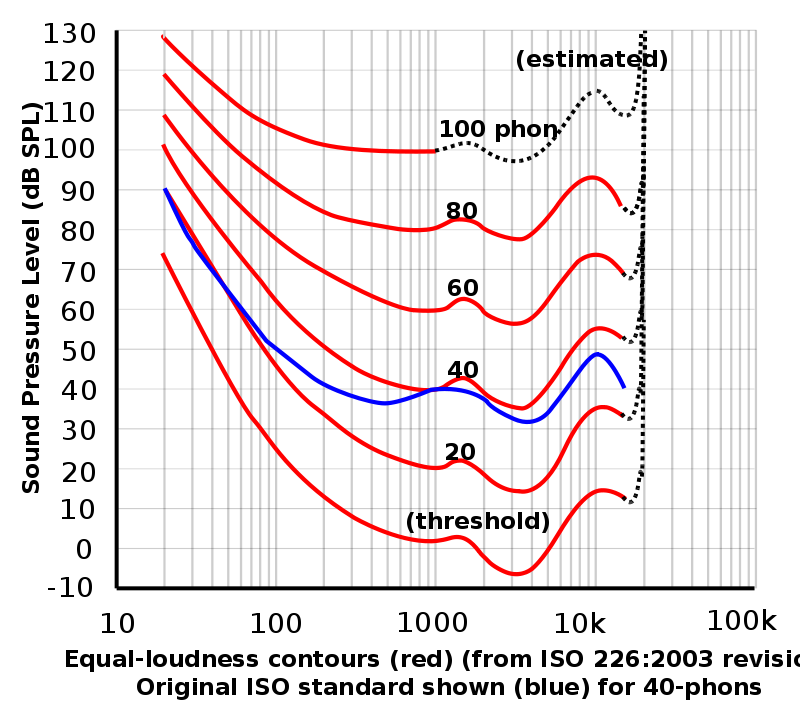
No, of course people's hearing isn't flat across the audio spectrum - a quick glance at the famous Fletcher-Munson curves will demonstrate that. However, that's irrelevant. We live with non-flat hearing 24/7 and hear everything that way. If a sound system was equalised to undo the Fletcher-Munson curves it would sound completely different to everything else we hear, including live music.
800px-Lindos1.svg.png

https://en.wikipedia.org/wiki/Equal-loudness_contour
 
Stereo power amplifiers do not have any built in loudness compensation. They are supposed to be "straight wires with gain". Only preamplifiers or integrated amplifiers are equipped with loudness switches or controls.

Unfortunately most loudness compensation circuits are a simple switch driven from a 50% tap on the volume control. That means once loudness is engaged there is progressively less compensation applied as the volume is advanced to 50% rotation. Little to no compensation is applied past that 50% rotation point.

The problem with simple loudness switches is that the compensation has nothing to do with how loud the sound is in the room.

For a pair of Klipsch or any high sensitivity speakers the volume may be call the cops loud at 9 O'clock. For a pair of lower sensitivity speakers such as any acoustic suspension speakers, that 9 O'clock position may be just waking them up. There is no way the same amount of compensation should be applied to both types of speakers. That same applies to any volume below a 50% rotation of the volume control.

The best way to implement loudness compensation is through the use of a continuously variable loudness control. With them the volume control is set to the highest volume the listener uses. The variable loudness control is then used to lower the volume to whatever level is desired. With this type of control the loudness has an actual reference to base its compensation on.

AFAIK, of current gear in production Yamaha is the only manufacturer with a variable loudness control. The AS integrated amplifier series has it.
 
Last edited:
As I said I upgraded from a much simpler and smaller system.
Im not an audio engineer so my best answer as to what I am trying to achieve is that I want the sound to be as good as it can be.
"What is good" you are going to ask ... I dont know ... that is why I came here for some advice.

What is good is the $64,000 question. What's good is whatever you think it is. For some that's enough.

For others like me, we require a reference. My reference is the sound of live unamplified music performed by an orchestra. I realize that recreating the sound of an orchestra in my room is an unreachable goal. However, what I've found is that the closer I get to the sound of the Philadelphia Orchestra at the Kimmel Center the better all musical types sound.

I also use the Wannamaker Organ as a reference. Pre-Covid there were free daily concerts from the Organ. The lunchtime ones were my favorite.
 
What you seem to be ignoring is that a simple switch has nothing to do with the listening level actually used. Every speaker does not need the same amount of compensation for a given position on the volume control.

Are you sure you understand how a variable loudness compensation control operates. If you are truly curious you should check the technical specs for just about any audio volume control. a 50% loudness tape is present on most.

I strongly suggest you study some schematics for any receiver or integrated amplifier. What I posted in my previous post is accurate and the truth.

IMO it is you who doesn't know how a loudness control either switched or variable operates.

I expect that others will be around sooner or later and support what I've posted.
 
Wanna bet you will set it all just right, in da sweet spot.
Then the next song will come on and......at it all over again!:)

At least that is what I found with one.
 
This is an excerpt from a NY Times article.

The prevalent confusion stems partly from a misnomer. The loudness control doesn't change the loudness of the music - it has nothing to do with loud and soft as such. Rather, it changes the strength of highs and lows relative to the middle range at different settings of the volume control. (It's the volume control that regulates how loudly the music plays). Or, to put this twisty matter in a different way: the loudness control changes the frequency response in accordance with volume.

Why, one wonders, is such a control needed in the first place? And how does it relate to our perception of the music?

The answer, oddly enough, lies within the ear and the brain. By a strange quirk of human hearing, the balance of highs and lows changes when the volume of the music is lowered. This is an inborn aspect of our sensory nature that normally goes quite unnoticed. In fact, nobody has been aware of it throughout all those millenniums of human existence when all sounds were heard directly when and where they occurred. Not until the age of electronics - which made it possible to transfer sounds from the time and place of their occurrence - did these aspects of hearing become apparent through their effect on reproduced sound.

After the invention of the radio and the electric phonograph, it was found that a natural sound balance could be achieved only when the music was played at the same relative volume as in the concert hall. This doesn't mean that the speakers must pump out as much sound as a whole orchestra. After all, living rooms are smaller than concert halls, so less sonic force is needed in domestic setting to reach the same intensity. What matters is that the level of the sound reaching the listener's ears should be the same as at a concert. If you could always play music at this volume, no loudness control would be needed.

But if you turn down the volume in deference to neighbors and housemates - or perhaps because you want the music merely as background - strange things begin to happen, acoustically speaking. The low notes vanish, leaving the sound texture thin and tinny. What's more, the sparkle of the highs is dulled. The orchestra suddenly sounds as if cellos and basses had gone on strike and the remaining instruments had crawled under a blanket.

This effect was systematically studied by Drs. Harvey Fletcher and Wilden Munson at Bell Telephone Laboratories about 50 years ago in a pioneer effort to relate the characteristics of human hearing to the design of sound equipment. Their data, expressed in the classic Fletcher-Munson curves, now form the basis of what is known as the loudness control in modern audio components.

The principle is simple: at low volume settings, the loudness control boosts the bass and treble by approximately the same amount that the human ear suppresses them. At higher volume levels, where the ear responds more evenly to all frequencies, the compensating effect peters out. Thus, when you activate the loudness control, your impression of the music remains natural and realistic, regardless of the volume at which it is played. In short, the action of the loudness control helps retain the tonal balance of the original performance at any playback volume.

That, at least, is the theory. In practice, the problem is that not everybody's hearing conforms to those Fletcher-Munson curves, which represent a statistical average. Control circuits designed in accordance with these curves therefore are something like trying to fit everyone with an average-size shoe.

Those whose hearing happens to conform to the statistical norm may find these controls quite satisfactory. But listeners whose personal hearing response is atypical (which doesn't imply that they have poor hearing) may find the effect unpleasant. That is why some manufacturers - notably Denon and Yamaha - provide what is called continuously variable loudness controls that permit their effect to be altered to fit individual preferences.

From a psychoacoustic viewpoint, the loudness control strikingly illustrates how subjectivity necessarily enters into everything we perceive. Philosophers and physiologists alike have struggled in vain to understand exactly what separates objective reality from our personal experience of it. But in this instance, the gap has been bridged by a cleverly engineered circuit.

Unfortunately the article doesn't address the problem of different speakers needing different positions on the volume control. With a standard "switch" the same amount of compensation is applied to all speakers regardless of how loud they are playing.

I don't think anyone believes that a very sensitive Klipsch speaker which is call the cops loud at 9 O'clock needs the same amount of compensation as an AR3 which is at just above conversational level.

That's what a loudness switch does.
 
Last edited:
Many stereos Are equalized to undo the Fletcher Munson curves

It's called a loudness compensation circuit and Sansui's have some of the best
most studied loudness compensation circuits that are very closely designed to undo (your picture of)
the Fletcher Munson equal loudness contour and and revert the sound.
No, that's a misunderstanding of what a loudness circuit does based on a misinterpretation of the Fletcher-Munson curves. A quick glance at the F-M diagram reveals a lot of lines that aren't straight and aren't flat, but a "loudness contour" has nothing to do with straightening or flattening those lines. A closer look at the diagram reveals that as the sound intensity goes up the lines stay roughly the same shape and same distance apart above about 500Hz, but below 500Hz the lines get closer together as the sound intensity goes up. That illustrates the ear's insensitivity to low frequencies at low volumes. A piece of music recorded to sound well-balanced when listen-to at a certain SPL will sound bass deficient at lower volumes, hence a "loudness contour" can be employed to compensate for the perceived lack of bass at low volumes. However, the loudness contour isn't about flattening out the lines on the F-M diagram, it's about keeping the lines evenly spaced at different SPLs.
 
We don't hear in a flat response

We are not going anywhere and hear live music in a flat response.

We all have the sound signature we are looking for.

I don't expect anyone to like what I like. I prefer a more bright sound and a somewhat reflective room as that is what live music sounds like.

Would I go thru 50 pairs of speakers to find a set in my home that lets me set my tone controls to neutral all the time, god no. Even if I did some music I like is grainy and harsh and I would still turn the treble down sometimes anyway.

Someday my ears seem to be much different than than last time I listened. Some nights I swear its the internet sounding different. Should I just suffer through these times? no, you can but I won't.

People have different systems for different sound they like, different turntables and cartridges so on, so on. This includes people with multiple systems.

Every part of the system is a tone control so I do not in any way see the obsession for having two or three knobs set in the straight up position just because its some sort of milestone for certain people when everything around you is a tone control you already fiddled with.

All it means to me is someone found the sound they are looking for with the knobs straight up, so what.

It doesn't mean I or someone else will love it, like it probably but love it probably not.
 
Unfortunately most loudness compensation circuits are a simple switch driven from a 50% tap on the volume control. That means once loudness is engaged there is progressively less compensation applied as the volume is advanced to 50% rotation. Little to no compensation is applied past that 50% rotation point.
The problem with simple loudness switches is that the compensation has nothing to do with how loud the sound is in the room.
^ This is absolutely true.
However, there are better circuits that don't have the same fundamental flaw.
 
^ This is absolutely true.
However, there are better circuits that don't have the same fundamental flaw.

Exactly! This is why I'm a fan of variable loudness controls. While they may not be completely accurate they are a damn sight better than a simple switch.
 
I still can't figure out why, if everyone's gear room and hearing is different why do most equalizers end up with the same old smiley face.

Set your equalizer and tone controls however you want. Just don't use the lame excuse about everything being different.

My thought is that is what most live music sounds like so its "natural" to many.
 
We don't hear in a flat response

We are not going anywhere and hear live music in a flat response.

We all have the sound signature we are looking for.

We do not hear a flat response. But the best way to hear a recording, is for it to be played back accurately, which is flat. That is the base point.

From there, depending on room, equipment synergy, the system might over compensate or insufficient in certain aspects.

Normally, that is in the highs, which are easily lost as they are low power signals, and bass, which a system may have a hard time reproducing fully.

I have nothing against tone controls and eqs. I dont use them as I prefer to have as little in the signal path as possible. Thats me though, doesnt mean the next guy should do the same.
 
I thought about putting moefuzz on ignore. However I shall enjoy reading other absolute nonsense that he posts.

FWIW: Yamaha is not the first or only manufacturer to include variable loudness controls. Nakamichi also included variable loudness controls. There is even a stand alone control My first exposure to one was an ARC SP-3 preamp i bought in the late 1970's.

BTW: I'm a retired EE and have considerable knowledge about electronics in general.

Here's a link to a stand alone variable loudness control. They do a good job explaining the how and why.
The Delicious One - Delicious Decibels
 
Back
Top Bottom