
JoeESP9
ESL's & tubes since 83
As soon as you do that to someone you start missing all the good laughs.
That's why I decided not to.



As soon as you do that to someone you start missing all the good laughs.
If bloated bass and icepick treble is what live music sounds like to some they're welcome to them. My reference has been live unamplified orchestral music since the late 1970's.
What I am saying is peoples’s hearing is not the same. Using a graph designed to equalize sound levels at various frequencies works of you can hear those frequencies as designed in the graph. Then, there are equipment responses at various volume levels, and personal taste. Some may like accentuated bass or highs. Nothing wrong with that at all.Yep, sounds about right!
No, of course people's hearing isn't flat across the audio spectrum - a quick glance at the famous Fletcher-Munson curves will demonstrate that. However, that's irrelevant. We live with non-flat hearing 24/7 and hear everything that way. If a sound system was equalised to undo the Fletcher-Munson curves it would sound completely different to everything else we hear, including live music.
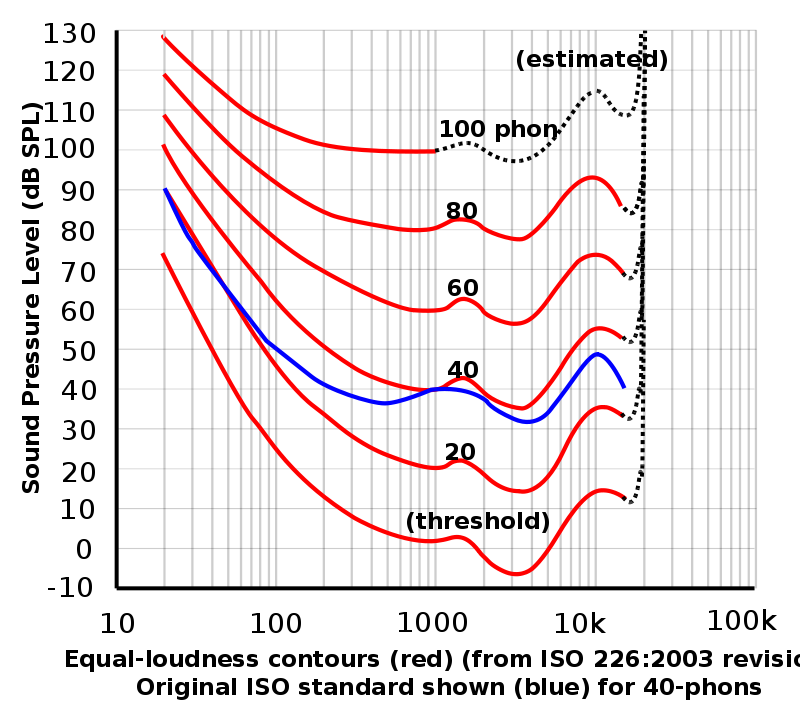
https://en.wikipedia.org/wiki/Equal-loudness_contour
your engineering degree is obviously not in sound engineering and has nothing to do with human auditory response .......
you may well be very good at engineering kitchen blenders though
Elon Musk hired people to engineer his concept.
He is not an engineer, he is a financier and an employer of those who could land rockets on pads in the ocean.
This only makes Elon a smart business man and not an engineer
and so you have missed the point entirely.
There is that, and that can take a whole set up. Rock and pop concerts, small and large, generally have some harshness to them. Ive been to rock and punk band practice sessions, and those are little less harsh, more whole, but the SPLs can really get to you.
Point being, its different depending on what you are trying to reproduce.
I love the sound of a big pipe organ. Omigawd, someone have a spare Depends?
What I am saying is peoples’s hearing is not the same. Using a graph designed to equalize sound levels at various frequencies works of you can hear those frequencies as designed in the graph. Then, there are equipment responses at various volume levels, and personal taste. Some may like accentuated bass or highs. Nothing wrong with that at all.
My opinion is that adjustments such as FMC are ideal for recordings, but as an individual, it may lack what I like. So, i believe that Fletcher-Munson is irrelevant in a personal listening area.
Many stereos Are equalized to undo the Fletcher Munson curves
It's called a loudness compensation circuit and Sansui's have some of the best
most studied loudness compensation circuits that are very closely designed to undo (your picture of)
the Fletcher Munson equal loudness contour and and revert the sound .
View attachment 2157257
(Below) This represent your actual (lack of) hearing
View attachment 2157256
The result when pressing the Loudness compensation circuit would be
that all red lines would now be flat lines and our hearing would be
corrected for the lack of sensitivity in the middle of the graph.
*No two sets of human ears are the same so the Fletcher Munson curves represent an
average of the ears deficiencies
.
Almost no modern stereos have time controls, much less loudness. Tone controls, loudness, and EQs are relics from a passed era where speakers typically had significant failings. Flat response is the widely agreed upon ideal.

The thing about the F-M diagram is that it's a family of curves. The fact that the curves aren't flat isn't important. What's important is that the bass end of the curves changes in relation to the rest of the curves as the SPL changes.Yes it is about flattening the lines of the Fletcher Munson Curves hence the bass and High Freq boost when the loudness circuit is engaged.
What does our hearing need to be compensated for? We use our hearing all the time in our everyday lives and manage perfectly well without any compensation. Why would we need compensation when listening to loudspeakers?It is about both, compensating for lack of hearing at all volumes and a correctly designed loudness compensation circuit takes into account increases and decreases in spl/volume.
I am wise enough to have consulted several sources on the matter and come to understand what F-M curves are all about. Initially, I was misguided and thought that because the LF end of the curves bends upwards, that indicates an insensitivity to bass which needs to be corrected. It's a misinterpretation that many people have made, but further reading showed me the error in my thinking and now I understand the meaning of the F-M curves and how they give rise to the loudness function found on some amplifiers.You would be wise to consult with someone who has studied sound engineering and the effects of spl at volume and at varying frequency on the human auditory system.
Perhaps this would help clear up your misconceptions of human hearing, Fletcher Munson curves and properly designed corrective Loudness circuits to compensate for the lack of human hearing at varying spl and frequencies.

Well this is quite sad really,
Back in the 70's you had fair flat speakers and very flat amps/preamps/receivers and the system
as a whole allowed you to compensate for the flatness built into the designs.
I guess it is no wonder why many believe that vintage gear rivals modern in sound reproduction ability.
and hence the original posters questions regarding setting eq's to the common "smiley face".


