
• The move to the new server is done. There are some software and database maintenance updates in process. This has us passing the hat around to help out. We appreciate any donations. Seriously, even a dollar helps. The payment page may be found here - https://www.audiokarma.org/support.html

Share your amp and speaker building projects with us!

Latest Horn Project

Hi there,
I just finished my round tractrix horns and I'm very happy with them:
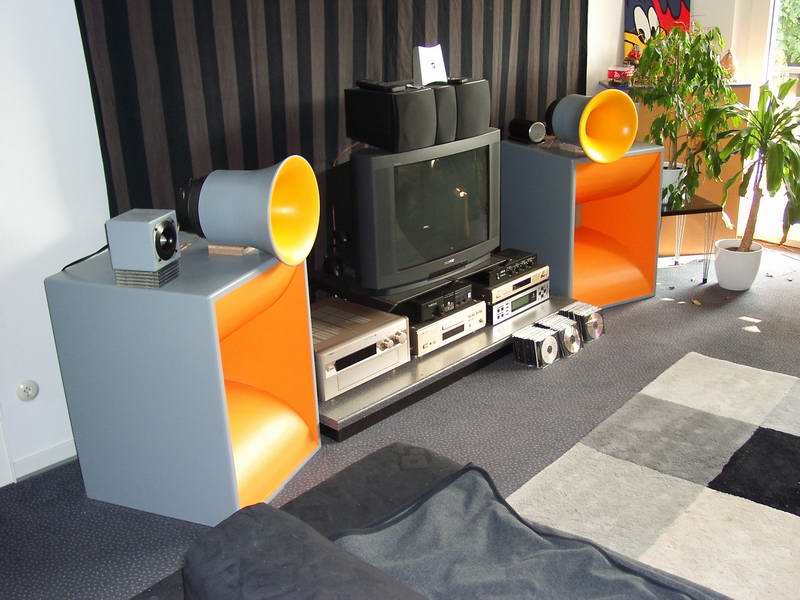
07310001.jpg


The round horns still need some stands to be able to move them further back, to be time aligned with the midbass.

All speaker systems are DIY:
- Kipschhorn sub (far right)
- 150Hz tractrix midbass with EVM12L
- 320Hz round Tractrix with 2" Fostex D582
- Fane ST5022 Tweeter

If you like to see more information/pictures go here: My Hornspeaker related Homepage


Erik
:DVolvotreter:D
 
Last edited:
NICE!

Erik,

Wow! Beautiful job. I enjoyed your well done website showing the building of these. Clever tool that lathe.

Did you try the midbass horn without a port on the rear chamber?

BTW, I love the color scheme on your speakers.

Rob
 
Very sweet indeed! I would LOVE to have some speakers like those. I also dig that color scheme! Great job, wish I could hear them. :thmbsp:
 
Re: NICE!

Hi Rob,

Originally posted by Rob
Erik,

Wow! Beautiful job. I enjoyed your well done website showing the building of these. Clever tool that lathe.

I thaught (very) long time about how it would be the best way to make precise manufactured round horns in an acceptable amount of time. A lathe was just a logic consequence.

I will most likely not only build a single pair of horns. I have an other pair of drivers to test and swapping horns takes too much time. When comparing speakers, I prefer to do this without large breaks.

If it makes sense to build a lathe on your own is a different storry ;)

But since I enjoy DIY, it was an additional challenge.

Did you try the midbass horn without a port on the rear chamber?

I never had them ported. It's a sealed backchamber, although a tractrix horn is too short to cancel out throat reactance with a tuned backchamber. Keeping them closed just avoids sound radiation from the back interfering with the sound radiated from the horn mouth.

In addition, I think porting a (tuned) backchamber makes no sense because the port will be always at least 5dB down compared to the mouth and it's also too far "away" from the mouth (delay => interference).

Erik
:)Volvotreter:)

Moderator's note: I didn't edit this post but accidentally hit the Edit Button instead of the Quote Button. Old fumble fingers tends to do this once in a while and when it is one of my forums it gets really confusing for a while. :(
 
Last edited by a moderator:
I love your speakers Erik, I saw your website a while ago and saved the link thinking “this” is the way I’m going to build something like an Edgar Titan someday – if I ever have the room. I especially like the way you built those curved side front horns for your midbass, the nicest implementation I’ve seen at doing this.

And that lathe! Fantastic, over the top stuff – very cool the way you incorporated that steel template arrangement to accurately reproduce the curve. When I saw that I thought how great that feature would be – I work a lot with CAD, sheet metal and NC turret presses – I can just imagine the fun you could have with that, drawing various flares, knocking out a template and spinning a horn.

Ever thought about a small tractrix flair that could be retrofitted to an Altec 604? :D

Billfort
 
Originally posted by Billfort

Ever thought about a small tractrix flair that could be retrofitted to an Altec 604? :D

You mean the 604 16" coax? Do you mean to replace the horn of the compression driver or to add a horn sourrounding the 16"?

Both shall be possible, however, if you want to add a horn to the 16" it must be quite huge to have a positive effect. For the compression driver it's more easy although I do not see how the horn is attached to the speaker. May be this could cause problems.

http://www.voiceofthetheatre.com/images/604E.SuperD.1.jpg

But it would be interesting to see if the sound of the compression driver will improve from the tractrix flare. Perhaps the round horn could be also of advantage in regards to reflections of the 16" to the back of the small round horn. It would be a smaller "obstacle" to the sound radiated by the 16" than the original rectangular one!?

I hope one can understand what I'm trying to say (I'm not native english).

Cheers

Erik
 
huh...replace the original Altec horn in a 604 with a little tractrix...huh...interesting idea!

Volvotreter...wards put a pic of your speakers in the gallery...hope you don't mind. here's a link to them.
 
Re: NICE!

Originally posted by Volvotreter
Hi Rob,


I thaught (very) long time about how it would be the best way to make precise manufactured round horns in an acceptable amount of time. A lathe was just a logic consequence.

I will most likely not only build a single pair of horns. I have an other pair of drivers to test and swapping horns takes too much time. When comparing speakers, I prefer to do this without large breaks.

If it makes sense to build a lathe on your own is a different storry ;)

But since I enjoy DIY, it was an additional challenge.


I never had them ported. It's a sealed backchamber, although a tractrix horn is too short to cancel out throat reactance with a tuned backchamber. Keeping them closed just avoids sound radiation from the back interfering with the sound radiated from the horn mouth.

In addition, I think porting a (tuned) backchamber makes no sense because the port will be always at least 5dB down compared to the mouth and it's also too far "away" from the mouth (delay => interference).

Erik
:)Volvotreter:)

Erik,

Your english is very good. I had no problem following your thoughts about the Altec 604 coaxial loudspeaker.

When I looked at your website pictures of the midbass horn I thought the round black item on the rear of the cabinet might be a port. I did not look at an enlarged version of that picture. While it is true that this back radiation would be much lower in amplitude, bass reflex design has been combined to extend the low frequency response of a compact front horn system. For good example is the Altec A-7 Voice of the theater, although the reflex port is in the front.

I am still in the steep vertical part of my learning curve when it comes to horn speakers. About a year ago I built a large pair of 50 Hz full range bi-radial horns using the Selenium 12" coaxial loudspeaker which has a 2" titanium diaphragm compression driver firing through the woofer magnet for my home theater. They turned out quite nice but one thing I have to correct yet is bad energy storage around 375 Hz. This gives a horn colored sound in this region. I believe it is a standing wave from the driver to the horn mouth. I may try to correct this with absorber on the inside surface of the flat vertical inside walls.

I am going to have fun reading that material you have posted on your website. Thank you.

Rob
 
Spare Parts - What do we do with them

Well, with so much time spent with the Jolida gear, I seem to have a good number of spare parts lying around.

Below is a picture of what was originally a gutted Jolida 302A from 1996. Started out as a bored rainy Sunday project when the family was out of town (again). I took the chassis and threw on a quick gloss black paint job, moved the main circuit board up top and installed a few upgraded parts (more than it may appear from the photo), upgraded the power supply and installed HEXFRED "Ultra Fast - Soft Recovery" diodes in the rectifying bridge. I think I will use this piece to try out some new circuit changes for the Jolida 302 and 502 amps. It is currently running as an EL34 based 302 running in triode.

It is obviously not finished and still needs some cosmetic improvements but all that needs to be done to fire it up is install the power switch. Afterwards, it will get a custom made 1/4" Cherry wood face plate. The two holes near the volume knob will soon house toggle switches, one for the source selection and the other to turn of the Blue LED power indicator light. It is wired in Cryo treated 22 awg stranded copper
 
Last edited:
Here is another one in the works. This may end up in my personal system as I am looking to add some airbrushing to it also. Being an automotive painter for so many years, I have to do at least one tricked out paint job on an amplifier chassis. The base coat you see here is Candy Apple Red Metal Flake and the chassis is a brand new Jolida 302/502B.

I won't get into too many details of what this amp will have for modification but I am doing a step-by-step construction of this amp on my website.
 
airbrushed amp eh. sounds cool. what would you airbrush on it though? flames wouldnt work. thats just bad luck already. what would be cool is a Pink Floyd collage amp. O yea!
 
Funny you mention the flames, I was thinking the same thing also in regard to being a bad Omen but still considering it. Kinda like my own Hotrod version.
I was thinking of doing the graphics in Green Candy Metalic (anybody follow Jessie James - Mortorcycle Mania) with another top coat of the Candy Red followed by several coats of clear, this is all laquer paint, for a very subtle appearance.
I know it sounds a bit out there but it would truly be done in good taste and not like some 50's hotrod Ford coupe.
I was also considering a spider web, actually a real one (I can explain later). I did this on a custom 4 foot remote control racing boat a few years ago and had everybody and their brother asking me to do it on their boats. Yes, I use to race remote control gas boats. You ever see a RC boat flying across a lake at 70 mph. It's a blast!!
But anyways, I don't know. I haven't decided how to proceed yet. I have a few other chassis now in primer and also some new ones still in the box that I can paint up also.

I know, you're probably wondering how I can run a business if I keep so many projects for personal use. My answer is: I started out with the same passion and interest in this hobby as everybody else here. Business is business and my hobby is my own.
 
34,

On that amp you have placed the PCB on top of the chassis I note you have wired the 6CA7's in triode. Those babies are gonna put out mucho radiant heat and that will not do kind things to the circuit board and the components mounted thereon nearest the output tubes. Just a cautionary observation from someone who recently went triode with P-P 6CA7's, had to up the bias to just fringe detectable red plates in the dark to get the 'tone' (I'm within tube specs) and now suffer a heat issue.

That automotive painting talent sure brings a new perspective to amplifier building here. We're looking forward to seeing more!
 
Those babies are gonna put out mucho radiant heat and that will not do kind things to the circuit board and the components mounted thereon nearest the output tubes.

Hi Rob,
Actually, there is more space between the power tubes and PC board than may appear from the photo plus I have custom heat shields that will be placed between the tubes and board. I did consider this when putting it together. I will obviously keep an eye on things.
What kind of heat are you getting from your amp? This unit does not generate much more heat in triode than PP.
 
Originally posted by Response34
Hi Rob,
..... What kind of heat are you getting from your amp? This unit does not generate much more heat in triode than PP.

Quite a bit, but its a dry heat! :D

In P-P UL pentode mode I had the tubes biased at about 60 mA for the pair. This put the amp into class AB mode. Everything ran really cool. When I switched to PP triode I upped the cathode current by reducing the negative grid bias so that the pair of tubes pulls 116 mA at idle and about 148 mA at full output. I also swapped out the 5V4 rectifier to a 5U4 which gave me ~25 volts more B+ where I needed it to recover some output power lost to the switch to triode. I am therefore now running class A since I almost never tax this amplifier. I am at the rated dissipation of the 6CA7's which is 25 watts per tube. Plus the heater power of 10 watts so that is 35 watts x 4 = 140 watts of heat in the space where the output tubes live, compared to half that previously in UL PP.

I went from 24 watts/ch to 14 watts/ch but boy did I get TONE! :)
I also got better damping factor as a result of the lower plate Z in triode mode and the fact that my xfmer was 3400 ohms, a little low for pentode but a better match for triode since I'm loading it to under 2K reflected Z. This amp now drives a pair of large, efficient ~3.5 ohm loudspeakers on the 8 ohm taps like a champion!
 
Last edited:
Hey Rob...Ya know, I am thinking about swapping a few wires here and there, tossing in a few resistors to change my Dyna ST 70 from PP pentode to PP triode. I have detailed instructions on how to do this from Ned at Triode Electronics. Real simple to do but is there anything you can add here? There is a 1K feedback resistor per EL34 that people remove too due to the higher inherent damping factor and low plate resistance of triodes and tubes wired as triodes. Should I try removing that resistor? What's your take here? Thanks bud! :)
 
Triode wiring 6CA7's

WW,

You shud put a 1K ohm 1 or 2 watt carbon resistor between the plate and grid 2 of each EL34. This isn't FB, it is a current limiting resistor to help your EL34 live longer. Grid 3 goes straight to the cathode like the suppressor normally is internally wired in 6L6's, KT-88's and such, at least that is how I wired mine. I was tempted to try true triode with all 3 grids tied together as the control grid (you can do this on an EL34) but haven't had the time or ambition. Perhaps if anyone else has tried this mode of triode wiring an EL34 they could chime in here? :)

You may have to adjust your bias to draw more tube current. I found that I got noticeably better tone when I went heavy towards class-A PP. I increased my no-signal cathode current to 118 mA per pair of Mullard 6CA7's from about 60 mA before in ultralinear AB1. Full signal current climbs to almost 150 mA. I have about 420 volts on the plates. More heat, less tube life, less output power, more tone. It's all about tone! :thmbsp:
 
Back
Top Bottom