• The move to the new server is done. There are some software and database maintenance updates in process. This has us passing the hat around to help out. We appreciate any donations. Seriously, even a dollar helps. The payment page may be found here - https://www.audiokarma.org/support.html

Sherwood S-7100A Receiver

Yes, it seems like a lot. I think these are custom made for the Sherwood OFF/ON/VOLUME feature, so they're not off the shelf. That said, if you had a cherished piece and didn't feel like screwing around, trying to find a fix for an obsolete part, I could see pulling the trigger. I have a Scott 380R that I love but it's power switch is horrendous; no way to service it but taking it out, then apart--tiny little nuts and washers, etc. I get tired of doing that; if someone made a drop-in replacement I could see myself purchasing such a thing. I got this Sherwood for $100, shipped, so yeah, expensive!
 
I usually use film caps below 3.3 uF, at that value I have gone either way (electrolytic or film) depending on my budget, mood, and view of the model. By the time you get to 3.3 uF they get expensive and also will they fit in the spot of cap they are replacing. Small caps like tantalum or solid aluminum seem to develop high esr (equivalent series resistance) as they age which should throw the circuit off. Have used the WIMA MKS2 (popular choice) but more often go with the Kemet R82 if you watch part # can get them with long leads. If cut tape (not common) the WIMA have long legs, if not like some Kemet they will only have 5 mm long legs. Supposed to be more stable long term than electrolytics.

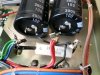
Here are pictures of the S-7200 interior layout. The transistors are on the back panel under a cover. Two resistors in the power supply circuit tended to run in the 250-270 F range when running, replaced them with 25 W chassis fuses thermal pasted to a metal plate (for joining joists found at the local HD). The new resistors and plate (works as heat sink) stay about 140 F so it no longer smells like something was burning if it is on for a while. The old resistors would cause an area of the wooden top to get really hot, only gets mildly warm now.

View attachment 1412978 View attachment 1412979 View attachment 1412980
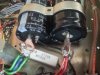
Sorry to resurrect an old thread dly66 but I'm replacing the big caps (3300uf) on the power supply board of my Sherwood S-7200, as in your picture to the left The old caps have terminals with a hole through which wires can be passed and soldered. The new caps (LGU2A392MELC) have 2 small somewhat pointed/curved terminals. Should I just solder the wires to the new terminals or is there a better way to attach them? See pics below of old and new cap (a terminal has been clipped off old cap). Thanks in advance for any help.

cap pics.jpg
 
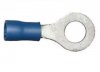
I just soldered them to the pins in the S-7200. If you need more room for attachment you could crimp and then solder on one of those crimp loops to the new cap and have a similar effect to the solder tabs. Have done that before when a number of wires attach at the filter cap. If insulated is handy just pop the insulator off:

crimp loop.jpg
 
Last edited:
I just soldered them to the pins in the S-7200. If you need more room for attachment you could crimp and then solder on one of those crimp loops to the new cap and have a similar effect to the solder tabs. Have done that before when a number of wires attach at the filter cap. If insulated is handy just pop the insulator off:

View attachment 1781707
Thanks dly!
 
Like @dly66 - I just solder to the pins.
cap wires.jpg
Thanks Speakerbox and dly. Can those terminals on the new caps be bent to form a hook so wires could be wrapped around more them more easily before soldering? Or might they snap if I bend them? Also, I'm having a trouble desoldering the ends of the green, red, and black wires that attach to the terminals. I'm using the NTE braided copper desoldering wick and a 25 watt Weller solder iron. Would a higher wattage iron work better? I appreciate your help!
 
View attachment 1781888
Thanks Speakerbox and dly. Can those terminals on the new caps be bent to form a hook so wires could be wrapped around more them more easily before soldering? Or might they snap if I bend them? Also, I'm having a trouble desoldering the ends of the green, red, and black wires that attach to the terminals. I'm using the NTE braided copper desoldering wick and a 25 watt Weller solder iron. Would a higher wattage iron work better? I appreciate your help!

I don't think I would risk bending them. What I usually do is if there is a little slack in the wire I just cut them off at the old capacitor and re-strip. Then I bend and crimp each wire around the pins prior to soldering. Real tight so they don't slip off while soldering.
 
I'm going to add a general caveat. The terminals of a 'snap-in' capacitor are not as substantial as the terminals on your old caps. Be sure there is some slack in the wires and strain relieve them so that they are not putting stress on the cap terminals.
 
I'm going to add a general caveat. The terminals of a 'snap-in' capacitor are not as substantial as the terminals on your old caps. Be sure there is some slack in the wires and strain relieve them so that they are not putting stress on the cap terminals.
Thanks speakerbox and Ylli. Rather than desoldering the wires from the old terminals or cutting and stripping the wire ends I think I might trim off the edges of the old cap terminals and just solder the whole "wad of wires" and remainder of terminals that they're wrapped around to the new terminals. I know if won't be pretty but that would work wouldn't it?
 
If you have some slack in the wire you could cut the wires at the terminals but I remember in the S-7200 there is not much slack. Easier to de-solder terminals while still on the cap, gets a bit tricky with that setup. Have to wick out the worst of the solder, I guess hold the old terminal with pliers, use the tip of the iron to get the solder flowing to tease the end of the wire straight so it can be pulled out of the terminal.

You need to be careful bending the pins on those type caps, too aggressive or bend one way and back can break them.

You might can use the wires sticking off the tabs to wrap around the pins on the new cap. Worth a try. Try to establish a mechanical connection first, then solder.
 
If you have some slack in the wire you could cut the wires at the terminals but I remember in the S-7200 there is not much slack. Easier to de-solder terminals while still on the cap, gets a bit tricky with that setup. Have to wick out the worst of the solder, I guess hold the old terminal with pliers, use the tip of the iron to get the solder flowing to tease the end of the wire straight so it can be pulled out of the terminal.

You need to be careful bending the pins on those type caps, too aggressive or bend one way and back can break them.

You might can use the wires sticking off the tabs to wrap around the pins on the new cap. Worth a try. Try to establish a mechanical connection first, then solder.
Thanks again dly. I've tried like crazy to desolder but for some reason it ain't working. I cut off the terminals cause I thought maybe they were acting as a heat sink and preventing the wires from heating up (just my uneducated guess). Might an iron with higher wattage work? Mine is a 25 watt.
 
Trying to un-solder those is not an easy one. Needed to do it while the tabs were still attached to the old cap. Once tabs cut off will likely end up cutting the wire. Need something solidly holding the tab but also not drawing much heat away. Tall order for that situation.
 
cap pic.jpg
I ended up soldering terminals to caps and then wires to terminals. I realize my soldering skills need improvement but it works. Thanks to all for your help!
 
  • Like
Reactions: T68
Just for the record, I have bent the leads on many new Nichicon and Kemerovo filter caps with needle nose pliers and haven’t ever had a problem with the leads snapping. When I de-solder, I use a 40-watt iron with a BIG chisel tip. I wouldn’t use this on boards or next to components I plan to use, but for huge blobs of solder on clipped leads, etc., it’s always worked for me. With pencil tips and lower power, I can get the solder to melt but it’s simply not enough heat for the wick to work properly on huge blobs of old solder. Obviously you don’t want to hold a big iron on anything too long, but you get a feel for it. You can practice on some junk boards or something else you don’t care about. I totally understand what you’re saying and it used to drive me nuts. Also, make sure your soldering iron tip is clean and well-tinned, and that you have the maximum contact area between the tip and the old solder—-that will give you the maximum heat transfer and make things go quicker.. Congrats on owning a wonderful Sherwood product from a very special time in audio history. Dly66’s tip about the ring terminals is an excellent one—I’ve done that several times with good results, too.
 
Just for the record, I have bent the leads on many new Nichicon and Kemerovo filter caps with needle nose pliers and haven’t ever had a problem with the leads snapping. When I de-solder, I use a 40-watt iron with a BIG chisel tip. I wouldn’t use this on boards or next to components I plan to use, but for huge blobs of solder on clipped leads, etc., it’s always worked for me. With pencil tips and lower power, I can get the solder to melt but it’s simply not enough heat for the wick to work properly on huge blobs of old solder. Obviously you don’t want to hold a big iron on anything too long, but you get a feel for it. You can practice on some junk boards or something else you don’t care about. I totally understand what you’re saying and it used to drive me nuts. Also, make sure your soldering iron tip is clean and well-tinned, and that you have the maximum contact area between the tip and the old solder—-that will give you the maximum heat transfer and make things go quicker.. Congrats on owning a wonderful Sherwood product from a very special time in audio history. Dly66’s tip about the ring terminals is an excellent one—I’ve done that several times with good results, too.
Thanks birchoak. I ended up using an old Kmart Weller iron to desolder. Not great but it worked well enough. Unit sounds good, glad it survived my noob work!
 
Update on the Sherwood S7100A, during global pandemic: For 99% of my listening, I haven’t found anything that looks or sounds better. I moved it onto my desk setup in an attempt to open up space and also to look at something more attractive than a stack of black components. The tiny ‘Woody is powering a pair of Totem Acoustic Dreamcatchers and they’re playing very well together. I don’t think the 7100A is a DX monster, but it pulls in my favorite local station well enough with a 300Ω dipole antenna that I sometimes forget it’s FM and not an MP3.

The 7100A was formerly powering a large pair of ADS L620’s and nothing I’ve put in the Sherwood’s place can match the bass and overall wall of sound except a Fisher 202. I tried a 65 watt Toshiba SC-665 power amp, a Scott 380R, and a Proton D1200. While those amps will certainly go louder ultimately, they cannot touch the first ten watts that the Sherwood presents. The Marantz 2230 is close, but still doesn’t have quite the bass synergy that the Sherwood has and is a much more complicated machine for humble DIYers like myself.

The 7100A remains one of the easiest to work on classic receivers, with no dial pointer lights or tiny wires to worry about (they just painted it fluorescent orange!) and a face that pops off quickly and simply. Plenty of space inside for ventilation and to work on boards. So far, I haven’t noticed any unobtanium parts.

Where doesn’t this receiver shine? Well, the screw terminals aren’t a lot of fun to deal with and you have to be careful about the speaker post layout—it’s a bit different from other I’ve had and I hooked it up wrong once by sheer force of habit. It’s not going to power a dance party, not with 14 watts. You probably won’t get into bidding wars for it because it’s a humble little thing. But most of my listening is at low to moderate, and with this Sherwood it’s more than enough—it gets real loud and full, real fast. And it’s still working! I don’t care how great a receiver might be; if I can’t keep it working it’s not a great receiver for me to own. Like many of you, I cannot afford to pay someone to fix my equipment, not if I want more than one or two.

 
Update on the Sherwood S7100A, during global pandemic: For 99% of my listening, I haven’t found anything that looks or sounds better. I moved it onto my desk setup in an attempt to open up space and also to look at something more attractive than a stack of black components. The tiny ‘Woody is powering a pair of Totem Acoustic Dreamcatchers and they’re playing very well together. I don’t think the 7100A is a DX monster, but it pulls in my favorite local station well enough with a 300Ω dipole antenna that I sometimes forget it’s FM and not an MP3.

The 7100A was formerly powering a large pair of ADS L620’s and nothing I’ve put in the Sherwood’s place can match the bass and overall wall of sound except a Fisher 202. I tried a 65 watt Toshiba SC-665 power amp, a Scott 380R, and a Proton D1200. While those amps will certainly go louder ultimately, they cannot touch the first ten watts that the Sherwood presents. The Marantz 2230 is close, but still doesn’t have quite the bass synergy that the Sherwood has and is a much more complicated machine for humble DIYers like myself.

The 7100A remains one of the easiest to work on classic receivers, with no dial pointer lights or tiny wires to worry about (they just painted it fluorescent orange!) and a face that pops off quickly and simply. Plenty of space inside for ventilation and to work on boards. So far, I haven’t noticed any unobtanium parts.

Where doesn’t this receiver shine? Well, the screw terminals aren’t a lot of fun to deal with and you have to be careful about the speaker post layout—it’s a bit different from other I’ve had and I hooked it up wrong once by sheer force of habit. It’s not going to power a dance party, not with 14 watts. You probably won’t get into bidding wars for it because it’s a humble little thing. But most of my listening is at low to moderate, and with this Sherwood it’s more than enough—it gets real loud and full, real fast. And it’s still working! I don’t care how great a receiver might be; if I can’t keep it working it’s not a great receiver for me to own. Like many of you, I cannot afford to pay someone to fix my equipment, not if I want more than one or two.

I have a question in response to your comment.

There is an s-7100a for sale in my area for $125. The posting says it works great. I definitely like the look of it and if it sounds as good as you say it does, I may want to add it to my system.

Is this a good price, or should I try and talk him down?
 
I have a question in response to your comment.

There is an s-7100a for sale in my area for $125. The posting says it works great. I definitely like the look of it and if it sounds as good as you say it does, I may want to add it to my system.

Is this a good price, or should I try and talk him down?

Ask if it’s been serviced recently. If it has, good. Offer $100. If not, let seller know it will need to be looked at and that’s a minimum $75 and offer him $75.
 
Thanks for the advice. I’ll see if I can pick it up for $75.

FYI, when questions about pricing are asked, you run the risk of the thread being kicked to the Dollars and Sense forum. It's in the rules, take a look.

And WELCOME to AK, jvanroo!
 
Back
Top Bottom