• The move to the new server is done. There are some software and database maintenance updates in process. This has us passing the hat around to help out. We appreciate any donations. Seriously, even a dollar helps. The payment page may be found here - https://www.audiokarma.org/support.html

Shouldn't every DAC by design sound pretty much identical?

When I do listen to something I listen to the entire album, which makes computer-based solution not much more useful than typical CD player.
Another useful feature for those with multiple systems is having access to a common library including high Rez content.

I remember the bad old days when I maintained a large set of duplicate CDRs.
 
Any commercial product sold via normal retail channels is going to be inferior to the Objective DAC, guaranteed. That's the nature of retail markup.

I'd never heard of the ODAC but have spent the last several hours reading about it. It sounds pretty amazing and I'm about to order one.
I'm looking forward to trying it out.
 
I'd never heard of the ODAC but have spent the last several hours reading about it. It sounds pretty amazing and I'm about to order one.
I'm looking forward to trying it out.

Amazing little box, isn't it?

Why pay retail for cheap (as in shoddy) commodity gear engineered to sell in a big-box store when for the same amount one can purchase boutique gear with world-class better engineering?
 
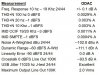
I think for a few hundred dollars, it (the Objective DAC) appears to be a competent product, however its specifications are far from SOTA. There isn't a single parameter that isn't bettered by any number of vintage upper range CD players from 25-30 years ago.

And note, all the specifications are tailored in level to give 'ideal' results. Something real manufacturers simply don't do. i.e. Let's spec our FR from 10Hz-19KHz instead of 20KHz or above. Let's do our THD at -1dB instead of 0dB to keep it around the (poor) 0.003%. Let's do IMD at -3dB instead of 0dB. And crosstalk- is it a worst case or best case and at what frequency (the A-weighting curve was never intended for cross-talk)?

odac.JPG

In fact, many of those ODAC specifications were bettered (in actual testing- not just numbers on a page) by any number of 1st generation CD players in 1983. Bear in mind, they did it with 16/44, not using 24bit either!

If your sources are other than 16/44 and not from CD, I can see how there may be an attraction for many of you, but for anyone who loves playing the silver discs (like me) and has a decent CD player, they will gain nothing and potentially be a lot worse off.

That said, those CD players may have cost at least ten times the cost of the ODAC D/A converter back then, so it is a current value proposition for many I am sure. :)
 
Last edited:
I don't care about a bunch of DAC specs that have absolutely nothing to do with how it actually sounds? The first and second generation players and all later ones have good to excellent specs. It's a given that stand alone DAC's have good to excellent specs. However, IME the quality of the analog output stage is far more important than the actual DAC chipset and its implementation.

FWIW: Replacing the op-amp in my Topping D10 with a discrete op-amp resulted in IMO a significant improvement in its sound.
 
Should these two sound the same? I use a Fubar III in my desktop system. I will be getting a chance to hear the Lampi in October at a gathering in Princeton NJ with other nice gear.
llp7tyvifv5x6o5yv1xq.jpg

and this
4cd27e6160165fa20f1526654678b807.jpg
 
Yes, every DAC should sound the same. As should every power amp, speaker, cartridge, etc..

Not all devices are able to perform ideally. Generally speaking, higher quality (and more expensive) devices get closer to the 'ideal', lower quality devices fall short.

Of course, some manufacturers deliberately 'voice' their components to achieve what is probably their interpretation of what that ideal is.

bs
 
I don't care about a bunch of DAC specs that have absolutely nothing to do with how it actually sounds?
Word. :thumbsup:

I get tired of having specs thrown in my face, as if it determines why something sounds good or bad. If I went by published specs, then my amp and preamp must sound like dog doo since they don't measure 1-100,000Hz, 0.0000000000001% THD, noise at -180db, 50,000 watts/channel, etc. (Similarly, those who compare vinyl to digital on specs alone just don't get it, IMHO--if the end result sounds better to them, that is all that counts.)

Don't get me wrong, though--specs may explain why something sounds different from another component, but they are not the be all, end all of listening to music. I remember the late 70s through the 80s, when the big race was on over output power and the THD and IMD specs. Then there was "digital-ready" which was more a marketing term than anything else. ;) I'm of the mindset that if it sounds good, it is good. :)

One DAC I am really interested in doesn't even use traditional DAC chips--it uses a FPGA (field programmable gate array), which allows the manufacturer to write new DAC routines in software, vs. using DAC chips. It is future-proofed, also--if new sampling rates or bitrates come along, or new digital formats, all they have to do is write the code for it and send out a firmware update online or mailed on an SD card.
 
That’s funny....

Should every tuner, amp or speakers sound the same even if the technical design is totally different ????
 
If you took two of the same receivers and replaced all the internal components soldered to the circuit board with components of the highest possible quality....would the two receivers sound the same ???
 
That’s funny....

Should every tuner, amp or speakers sound the same even if the technical design is totally different ????

It really depends on how we are using the word "should"

If we are going with "used to indicate obligation, duty, or correctness" then it would stand to reason that they ought to sound the same because they are designed to do the same thing: reproduce sound as close as possible to the original.

If we go with "used to indicate what is probable." then no they aren't likely to sound the same due to many factors in the design and implementation.

Thus even if the 1's and 0's are all lined up in the exact same order and timing they can sound different based on the analog output circuit used, type of parts, quality of parts or even distance between parts in some cases.
And that doesn't even get into bshorey point of manufactures intentionally making theirs sound different.
 
...I'm of the mindset that if it sounds good, it is good...

That's fine and wonderful until someone asks for a definition or comparative specification of 'good'. Then it all falls in a meaningless heap.

Measurements allow actual unbiased comparisons of all the key parameters important to audio reproduction equipment.

Digital is so good, that SOTA analyzers such as an Audio Precision APX555 are needed to get down to the limits of what modern D/As can achieve. We are talking US$28,000 before options. These devices achieve resolutions so far in advance of what our ears can resolve, it's amazing.

Trouble is, we have many so-called manufacturers 'designing' D/A converters with no decent test gear, they don't measure much at all, and they copy the DAC datasheets onto their spec sheet and call it a day. There is much deception in the D/A converter market.
 
Chord and PS Audio (some), I believe, both use FPGA

Trying to make sense of that video.

Clearly, they are using the FPGA to implement a custom, oversampling filter. That's still entirely digital, so I'm trying to figure out where the conversion to analogue takes place, and what is performing it.

They discuss the use of flip-flops outside the FPGA. Again, these are digital. I assume they're using external FFs, rather than some of the 41,600 FFs in the Xilinx Artix 7A35 device, because they hope that the external FFs will be quieter than those in the FPGA (they're re-clocking the FPGA o/p with a quiet/clean clock).. I'm not sure why they chose the Artix over the Spartan; it's unlikely they will be using the GTP transceivers that the Artix provides (and for which use that family is specialised). Maybe the 7A35 device just fits their required logic complexity, and the nearest 7S50 Spartan device is more expensive.

Since there do not seem to be enough external FFs to support a high data width, and there is no obvious external DAC mentioned, I can only assume that they are using some bitstream conversion system, with conversion performed using a summing filter on the output of one (or more) of the flip-flops. If they are using a multi-bit bitstream approach, that would require very highly toleranced resistances in the summing filter, or some cunning scheme to correct for tolerance errors; this might be the 'pulse array' system they mention.

Any bitstream conversion system relies on the accuracy of the pulses injected into the summing filter, both in terms of pulse width, and in terms of magnitude. If they are using the external FF output directly into the summing filter, they're relying on the FF clocking and output stage repeatability. It would be interesting to see what logic family FFs they are using; 104MHz is pretty fast for old skool logic families available in 'discrete' IC packages.

I'll have a bit more of a think and see if I can figure out what they're doing.

 
Last edited:
Back
Top Bottom