
• The move to the new server is done. There are some software and database maintenance updates in process. This has us passing the hat around to help out. We appreciate any donations. Seriously, even a dollar helps. The payment page may be found here - https://www.audiokarma.org/support.html

Shure 1985 catalog ... why bother?

Don Gillies

Member
https://www.vinylengine.com/library/shure/1985-products.shtml

I notice a commonality across the first NINE cartridges in this ^^ 1985 Shure Catalogue ...

Frequency Response 20-20 Khz ("essentially flat" - wtf? Okay some are 18 Khz, 22 Khz) (***)
Channel Separation 25 dB
Channel Balance within 2dB
Tracking Force 1.0 gram or maybe 1.25 gram if it's not hyper-elliptical
Trackability - who gives a crap? If it's a Shure it's gonna track well...

(***) My hearing according to YouTube test-tone playback is 20 Hz - 13.5 Khz so I need not worry about the difference between 18 Khz and 22 Khz cartridges!

So why did people buy a V15 Type IV-MR? Was it a status thing?
Why not just get an M75ED and laugh all the way to the bank?
Do you buy a higher-end cartridge mere to gain access to higher-end styluses?

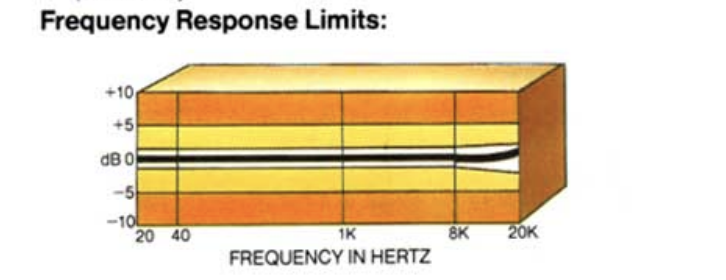
Did Shure NOT use +/- 3dB standard frequency response bands for its frequency reponse ratings? I understand that m97xE (which I own) has a treble roll-off much higher than some other cartridges, but it does NOT seem to be reflected in the published specs ...

Is there an expectation that higher-output cartridges have a better S/N rating? In that case I win because I most often play an M55e which is essentially equivalent to M80 with a 9 mV output....
 
Register to hide this ad
Why? Refinement.

Yes, the quick specs all showed similar ratings, but they didn't include such things as cantilever resonance points, polish of the diamond,cantilever material, laminated cores and the other things that bring out more detail, contributed to a neutral sound, enhanced soundstaging and...yeah...trackability.

(Sorry but I do give a crap about trackability. Shure's lower end cartridges did track well, but the V15 V-MR tracks superbly. I've heard many a lower end Shure or Pickering cart that while technically didn't mistrtack, still, the sound was a bit sharp or let you know you were getting close to the edge.)

The M75ED might look as good as a V15 V-MR, on paper, but what about the higher mass of the cantilever that put it's resonance point in the audioband that necessitated a capacitance loading of over 400pF to flatten out the response? And even then, as flat as it made it, there is some consequence to the sound.

If you like the M75ED...great! It's a classic cartridge. But there were reasons.
 
We all know specs are numbers.

Regardless of the “numbers”, these different carts *sound* different! They are constructed differently!

The M75 is very different from an M95. 95 is different from the 97, which is different from the V15-4, which is different from the V, which is different from the V-MR, which is different from the later VxMR.

“Shurely”you’ve learned by now that specs don’t tell you how something sounds?

If you were to listen to the M75, then the M55E, then the M95, then the M97-E4, then the V15-IV, then the V15V, then the V15V-MR, then the V15VxMR, then the M97xE, you’d fully understand that specs don’t tell you how something sounds. (I have all of those carts mentioned, plus many more Shure carts, with original styli. In fact, you’ve only barely scratched the surface with the M75 and M55; those are both the same cartridge!)
 
Last edited:
Frequency response and tracking force don't tell the whole story - https://audiokarma.org/forums/index.php?threads/vintage-shure-stylus-tip-shapes.783833/

And there are more differences than just the stylus tip profile - the resultant weight reduction in the tip plays a part, plus different cantilever materials and improvements to the suspension over the years to allow lower tracking forces and reduce wear while maintaining the same (or improved) trackability. The Shure N140HE stylus, for instance, has a beryllium cantilever.
 
Though Shure carts look the same on paper, I have found the stylus makes a difference. JIco makes a knockoff of Shure M44. Has a conical stylus. Been running comparisons with different Shure carts/stylus. On older mono LPs that JIco sounded good. Put on a new 180 gram LP by Enya. You definitely don’t want to run conicals later issued records. Switched out the JICO for a Shure M91/EVG. The bass is much better here. Tracking is much better. The JICO reminded me of a stylus going bad. There was some scratch /noise with the conical. Gone on the M91ED. Switched the 91 for my V15 type 3. Had only time to play one cut off a 2017 Huey Lewis Greatest Hits LP. The has a VN35HE stylus. Seems the bass is slightly less here. All have been tried on my Dual built Perpetuum Epner 3048 turntable using BEST Sleds. Have an cart on a Dual 1019. With a N55 stylus on a Shure M44 there is lots of bass, midrange and highs. These are very forgiving on less than perfect records.

Have never trusted what’s on paper or specs. Trust my hearing to how it sounds. Will play the V15 for now. May end up with M91ED. Stay tuned.

Eric
 
If you want to really experiment with minimal variables, you can get say an M93 body and try all the styli that fit it. That's at least the m75, m93, and m91 line plus I think there are a few others. Just swapping the nail can make a big difference despite the electronics being identical.

Cartridges are about as difficult to quantify as speakers are.
 
Back
Top Bottom