• The move to the new server is done. There are some software and database maintenance updates in process. This has us passing the hat around to help out. We appreciate any donations. Seriously, even a dollar helps. The payment page may be found here - https://www.audiokarma.org/support.html

*silent screams of help*

TaoofPu

New Member
Hello all and happy weekend,

I am a teacher and woodworker with an audiophile friend who lightheartedly suggested I build my own speakers from some spalted shagbark hickory I recently acquired. Two weeks later and I have spent more time up in the middle of the night and in class (when they're taking exams), trying to figure out what I need for drivers (I now know "speakers" are called drivers), so that I can actually build the damn cabinet! *takes deep breath*

So here's what I know for certain:

- I'd like to get away with around a few hundred dollars for drivers/crossovers, but am also fine spacing it out if it means overall better quality.

- I have a beautiful, old Fisher RS-1015 (15w, 8ohm, I believe) amp

- The speakers will primarily be playing classical piano/symphony, Philip Glass, Django Reinhardt, and music of the Mumford and Sons ilk.

- The room they're going into is roughly 15ft x 20 ft.

- I am in so far over my head and my beard has greyed substantially from this, yet somehow I'm still enjoying learning.

Here's what I THINK I know:

- I want to build a passive, 2-way system with sealed cabinets.

- This means I want a tweeter and woofer/midrange?

- I need high sensitivity drivers (93dB+) in order to utilize my amp efficiently

- The drivers need to be under 50w?

- Parts Express needs a better filtering database for speakers

Thank you all in advance,
Danny
 
Register to hide this ad
I know very little on the subject but I have read a lot on the forum about the econowaves. As a horn speaker fan they are interesting to me. Have you given that design a thought?
 
I'll look into the econowaves! Thanks.

15 watts is not a lot of power. So,an econowave might be your best bet.

So I know by today's standards that's not too powerful, but from what I can tell, that used to be more than enough power. Any thoughts on perhaps my case design isn't the right combination? Thanks again.
 
Now there's a big can of worms.
I too am a woodworker and have built a couple of DIY speakers. The 2 sets that I have built were designed by Curt Campbell. He has a Web site which he has plans for many different designs http://speakerdesignworks.com/NS6project_1.html. My first was the stentorian, then the Statement monitors which are displayed in my profile pic. He has some great articles to read as well.
I'm no expert in diy speaker building, I simply followed his design. There's many other designs you can follow. There's also speaker building software you can get to help you with your build. With the software you would have to find the spec sheet on the drivers you want to use and enter all the values into the program and it will come up with the volume of space you need in your cabinet to produce the sound you want. I'm planing on doing this for a sub next winter. Speaker building is one of the funnest projects Ive done. I wish you the best of luck! Sorry I cant be of much help.
 
I'm not sure that solid wood is a good material for speaker cabinets.
It isn't generally the best choice, which is why most commercial (or serious DIY) are made of void-free, high-quality plywood or MDF.
That said, it's not like one can't build enclosures out of board wood.

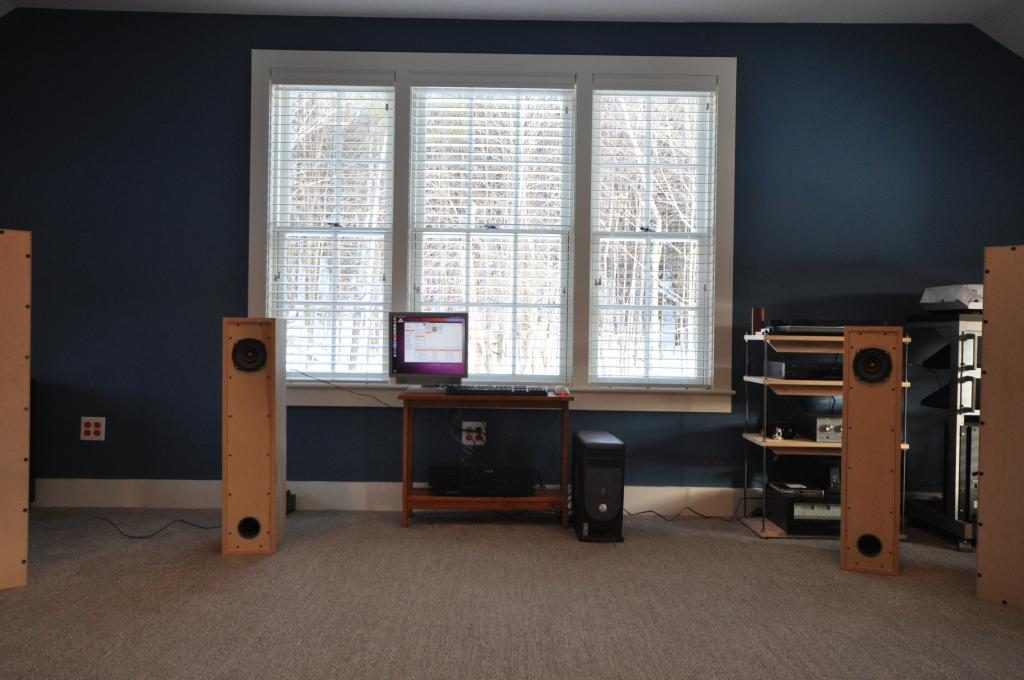
One could also consider open baffles.
Do a search here at AK to find more than you'd ever want to know.
xovn59bouoie.jpg

and/or take a look at this.
http://www.cbc.ca/news/canada/british-columbia/wood-speaker-resonator-1.4541537

wood-loud-speakers.jpg
 
"Parts Express needs a better filtering database for speakers"

Amen to that. Others here will fill in the blanks on the technicals, I'm more curious about the wood stock you'll be using. Hickory is heavy and hard, so while it may suffer from the peril of solid wood (the tendency to resonate), might be less than other species. How thick will the stock be?
 
The above posters are correct: solid wood is among the worst materials for a cabinet.

Solid wood has resonance, is not dimensionally stable (expands across the grain, not with it), cannot easily be braced or stiffened, does not properly damp because it is not as dense as plywood. As the solid baffle expands and contracts it will distort the speaker frames, warping and ruining them. Building a box out of solid wood is an invitation to have it crack as the humidity changes.

For those interested in this issue the magic phrase for wood dimensional stability is "unit tangential movement”:

I suggest resawing the wood into a thick veneer for a cabinet built out of 3/4 or 1" birch (American or Canadian) plywood. Stiff and stable.

I always suggest going to a lumber yard and purchasing American or Canadian plywood, as the big-box stores use Chinese garbage which is very poorly made has voids. High quality plywood runs about $20 more per 4x8 sheet. I just bought some for a fishtank cabinet I am building.

As far as drivers, I would suggest a three-way as the combination woofer-midrange will likely not deliver the sound you want.

If you want clear sound of amazing clarity, try building a Bozak B-302. The drivers are not only inexpensive, but can be purchased for less than the inferior modern ones made in China. The aluminum cone B-209B, BC, or C is a vastly superior midrange. (The B-209A should not be used as it has ringing issues.) Bozak Cult has been using soft-dome or other tweeters as the Bozak cone tweeters are inferior to modern ones. This is an infinite baffle cabinet, so it is larger, but the base will go very low. Easy to build: a big box lines with thick cotton batting and a hanging cotton curtain.
 
There are a number of websites.. giving excellent information for first time DIY, they elaborate on materials, reproduction considerations, acoustic principle, and even supply you with links to software for calculating dynamics!

Perhaps you will also learn there are plenty of "myths" relating to good speaker design and great resulting "sound".

Two protos sit in my garage right now I thought would "sound" good... But they are just louder speakers : o...!
 
Back in college, before I realized that speakers were veneered, I decided to build myself a set of speakers using Lafayette drivers. It took me half of my first year to save the money for the drivers. I decided to make the speakers out of mahogany. It took me till the beginning of sophomore year and cutting lots of lawns to get the mahogany. I think the wood alone was in the 3 hundred dollar range. To say the least, I was an idiot. The speakers were 3' X 2' with no backs. They were driven by a 20 watt Lafayette amp. They sounded like **** and my system only sounded OK if I ran my Criterion 10As at the same time. They did have some bass.

I sold them for $20 about 4 years later. What a waste.
 
designing speakers, crossovers, cabinets from scratch is a huge undertaking. Adding to the above comments that solid wood is not the best material.. same why you don't use solid wood for drawers and cabinets: it is unstable...

however if you still wish to make something yourself may I suggest 2 approaches:
1: find some name brand used speakers with really beat up cabinets.. and make new cabinets to the same dimensions as the old ones.
2: Find a speaker kit that already has matched drivers and crossover and a plan/cabinet dimensions.
 
If I'm not mistaken, Parts Express has a section about different speaker systems their customers have "invented". Parts Express may even sell "Flat Packs" for some of them. Saves you the time and worry of cutting wood yourself.
 
If I'm not mistaken, Parts Express has a section about different speaker systems their customers have "invented". Parts Express may even sell "Flat Packs" for some of them. Saves you the time and worry of cutting wood yourself.
I think cutting wood is the least of the worries.
From the sound of it, you might find the Open baffle designs interesting - Once you get the right drivers for such a project.
The idea there is the wood baffle is the visible point of interest, and you are not building a box around the drivers with all the resulting issues
of building boxes from planks instead of particle-board with veneeers.

With Open baffles- the driver gets screwed to the back of your spalted hickory board,
the front of which which would be sanded and finished into a beautiful slab of wood.

http://diyaudioprojects.com/Speakers/Cobies/

https://www.google.com/search?q=open+baffle+speakers&ie=utf-8&oe=utf-8
 
Last edited:
Oops! I plumb forgot he had the wood already.

Sorry.

Back to your regularly scheduled programming.
 
Back
Top Bottom