• The move to the new server is done. There are some software and database maintenance updates in process. This has us passing the hat around to help out. We appreciate any donations. Seriously, even a dollar helps. The payment page may be found here - https://www.audiokarma.org/support.html

Silly question? Stacking tuner and amp heat concerns.

egarzelloni

New Member
Hello all,

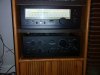
Long time lurker, first time post. I'm a big fan of vintage gear, but somewhat of a novice in many ways. I've just had one of my Sansui au717 amps serviced and ready for reintroduction into use. I've always had the tu717 sitting on top of it (rarely used, but looks great), but was just wondering about space for cooling. I'm driving a pair of Polk model 10b and sp 2500 speakers. There isn't much room between the amp and tuner with the tuner sitting directly on top. Is that enough room? I've never noticed serious heat, but it doesn't seem logical to stack them that way.

By the way, I've always loved my Sansui amps. I know there are better, but the au717's sound great!

Eric

Current stock:
Sansui au 717 (x2)
Sansui tu 717
Sansui tu 217
Sansui qr6500
Pioneer sx939
Pioneer qx949
Pioneer sx1500td
Akai aa r40 (don't laugh, it's not bad for the spare room!)
Pioneer tx 9100
Luxman t88v
Sherwood s7100a
Sherwood s8000iv
Polk model 10b
Sansui sp2500
Sansui sp3500 (need repair)
Sansui so x8000 (project)
Bunch of other stuff
 
Register to hide this ad
If at all possible I'd leave the top of the amp open rather than stacking anything on top. Unless you run it wide open all the time you probably won't outright hurt anything by keeping the tuner on top but the raised temps will shorten the life of the capacitors and keep it running warmer than it would otherwise. I know some of my warmer running amps will heat up the shelf above them even though it's about 5 inches up.

I keep a laser temp gun to shoot my heat sinks after a rebuild (to make sure one channel isn't running hot for whatever reason). Maybe grab one of those and compare running temperatures with and without the tuner on top to see what the difference is?
 
There may be half an inch between them with only the tuner feet giving the separation. I may just put them on separate shelves based on the first reply. The direct stacking is only for looks anyway.
 
Any reason you can't put the amp on top of the tuner, instead of the other way 'round?

My office setup has a cassette deck and CD player on top of my receiver, which runs hot. I've added a small computer fan over the receiver's heatsinks, and used some prescription bottle caps under the CD player's feet to give me a bigger gap - not the prettiest, but I think it helps to have some air in between.

Cheers,
Larry B.
 
You want at least 2" of space above the amp for proper ventillation. I use wood blocks.
 
Ventilation and air circulation can do wonders for any electronics. That said, most are designed to work better with SOME heat so they stabilize. I wouldn't be concerned if the equipment just gets warm to the touch during a hard session.

If you like, and have the room, might want to "stretch" the gaps a bit with some spacers under the legs. I've used nylon spacers and longer screws between the legs and body with good results. Should be readily available at your local hardware store.

PS - is the back of the cabinet open? I've also got a couple sections in my home brew rack that have holes drilled through the overhead shelves for extra ventilation. Especially handy for my MC2205, which tends to run a bit hot.
 
You might have more then heat concerns with an amp and tuner, that would be hum. Big transformers in amplifiers not usually friendly to FM/AM tuner. Best to separate by as much distance as possible.
 
What is that, an inch of air space above the amp?
Looking at the pic I'd remove the shelf and use the extra space for open air with the amp on top of the tuner.
I have one amp with that much space above it and I run a small fan to move the warm air away.
 
There's actually a couple of inches there, the shelf has a lip on the front that makes it look smaller. I could easily remove that shelf and increase that space with something else, though. I may do that just to be safe.
 
There's actually a couple of inches there, the shelf has a lip on the front that makes it look smaller. I could easily remove that shelf and increase that space with something else, though. I may do that just to be safe.

FWIW, Owner's Manuals often have recommendations for clearance. It's usually a fair amount of space so right, wrong, or indifferent, those recommendations often go unheeded.
 
Random question, but I really do want an answer (although I suspect I'm not going to actually get one)

Why is it that components such as CD players, cassette decks, tuners, etc. are often shallower than the matching amplifier/integrated? One would think that this would encourage stacking "the right way" when not using a rack.

One notable exception to this is Luxman. I have a R-113, DZ-111, and I forget the model of the cassette deck. I actually can stack them all up with the receiver on top. Good job, Lux!
 
I have never understood why anyone needs to stack components, It's easy enough to make a flexy rack and give each component It's own shelf.
 
the demise of the bush brand et al stereo cabinets from the 70's/80's has been the bane of us all.

1 shelf per component or worst case, tape and EQ stacked.

then you take stuff like the 80's fishers and the 90's onkyo R1's and you get machines that eat themselves...the myth of safe stacking brought on by the 'monolith' era - sony, pioneer, kenwood, sansui etc where amp, tuner, eq, tape, cd etc were in a case that LOOKED like they were stacked separates, but in reality a hollow metal box with boom box electronics feeding a 100w rated STK.

If you must stack, embed a brushless DC fan and vent the cabinet. I looked hard for, and found a 300+lb empty real cherry wood cabinet with a glass front...I cut holes, installed filters and a switched set of fans that come on with receiver power to not only pull upwards on the amp, but also blow outwards from the top back of the cabinet. I can run it fairly heartily all day, open the door and it be room temp inside.

cool = longevity

heat = a trip to one of our benches
 
Back
Top Bottom