• The move to the new server is done. There are some software and database maintenance updates in process. This has us passing the hat around to help out. We appreciate any donations. Seriously, even a dollar helps. The payment page may be found here - https://www.audiokarma.org/support.html

Silver Mica Disease

preacherJohn

Active Member
I've been watching some videos lately on FM stages that I run across as I'm interested in learning more about the repair, and alignment of it. Maybe I'm a little late to this game, but I've been introduced to silver mica disease. I have a few receivers laying around that need FM and multiplex work. And I'm beginning to believe they may be a victim of it. I like to talk about this, and hear some experiences you may have had with this and solutions you've come up with. One receiver I have, a Nikko 8085, seemed to have a multiplex issue as the stereo didn't work in the FM. I've watched ebay for about a year now searching for another multiplex filter and haven't had any luck, so I bypassed that filter and got the stereo back. I also have a beautiful Marantz 2285B that has one side of the FM not working, but all other input stages work and sound fine. I have acquired a couple of RF generators and a frequency counter this year to add to my bench, and have been experimenting with them and their learning curves. I actually started remodeling my bench as of yesterday to get all this gear to fit on it. In the meantime I liked to hear more about this problem. Thanks.
 
Register to hide this ad
I am not aware of any "silver mica disease". Usually these are not found in vintage gear and if they are they usually are stable. Some other caps are not like the notorious black flag caps in Sansuis. Some tubular ceramic C's found in IF cans can be bad as well. That's pretty much it. MPX filters fail because of inductors with broken wires. They almost always contain polystyrene caps. They never go bad.
 
I am not aware of any "silver mica disease". Usually these are not found in vintage gear and if they are they usually are stable. Some other caps are not like the notorious black flag caps in Sansuis. Some tubular ceramic C's found in IF cans can be bad as well. That's pretty much it. MPX filters fail because of inductors with broken wires. They almost always contain polystyrene caps. They never go bad.
The last video I watched spoke about the multiplex filter. The vid was about how he replaced the multiplex because the stereo wasn't working properly, and that didn't fix his problem. He visited his schematic and looked closer at the circuit, and found the mica cap in one of the IF, or RF cans that was bad, and it was silver mica disease. He replaced that cap and it fixed all his problems. After I watched that video, the algorithms started showing more of these videos, with the same issues with silver mica disease. This is more of a problem than I ever knew of.
 
Never ever seen a silver mica cap used in any Japanese tuner sections. I confirm what PE9ZZ has said.
The only way you kill a polystyrene cap is with chemicals and heat.
I never watch videos on fixing stereos. The few that have, I get a chuckle out of. I learn by doing myself, reading the service manuals, studying the schematics and device data sheets. Sometimes simulations. A very select few on AK, know what they are talking about, it's very obvious, if you know anything about electronics.
 
Last edited:
Never ever seen a silver mica cap used in any Japanese tuner sections. I confirm what PE9ZZ has said.
The only way you kill a polystyrene cap is with chemicals and heat.
I never watch videos on fixing stereos. The few that have, I get a chuckle out of. I learn by doing myself, reading the service manuals, studying the schematics and device data sheets. Sometimes simulations. A very select few on AK, know what they are talking about, it's very obvious, if you know anything about electronics.
I am a hobbyist and learning about RF now and tuners. I've been trouble shooting and rebuilding 70s era receivers and amps with success, but always avoided the tuners except for a capacitor replacement here and there; which 8 out of 10 times improve receptions greatly. This is a retirement hobby for me to keep my mind busy and something I can do besides build houses or play guitar in clubs since the arthritis has taken over. The bench is pretty comfortable. I've been at it since about 2014. Here's the video that started my research on this if you care to view it:
 
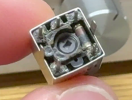
Silver mica disease is pretty much limited to the larger IF cans that had silver deposited on either side of a piece of mica, which was then riveted to the bottom of the IF can. Tube AM radios, and Hammarlund shortwave radios seem to be the larger victims, as well as older McIntosh and Marantz tube tuners.

I've never seen this in the sub miniature transformers that usually have a small ceramic capacitor embedded in the base. That said, mica caps can go bad although they are usually not a first suspect.

In any event proper troubleshooting to isolate the stage and component is a much better repair strategy than shotgunning after reading internet lore.
 
Silver mica disease is pretty much limited to the larger IF cans that had silver deposited on either side of a piece of mica, which was then riveted to the bottom of the IF can. Tube AM radios, and Hammarlund shortwave radios seem to be the larger victims, as well as older McIntosh and Marantz tube tuners.

I've never seen this in the sub miniature transformers that usually have a small ceramic capacitor embedded in the base. That said, mica caps can go bad although they are usually not a first suspect.

In any event proper troubleshooting to isolate the stage and component is a much better repair strategy than shotgunning after reading internet lore.
I wasn't suggesting "shotgunning" anything. Did you see the video I posted? The tech isolated the circuit and identified the issue. He replaced the mica cap and it was a successful repair. I didn't read this on the internet, I viewed this video. After that others started popping up as they always do. But I wasn't aware of this issue before and found it useful. You guys sure seem to have a lot of hate for the internet. A proven picture (or video in this case) to me is worth 1000 words. Not trying to start a crap storm with anybody, just trying to learn.
 
Apologize if I implied that; it's just that this issue has been going around antique and ham radio forums forever and it's really not that common, apart from a few select radios. The capacitor he replaced looks like a ceramic tubular cap and thus it's not failed due to "silver mica disease" which applies mainly to the built-in silver plated mica sheets integral to some IF transformers. It's just a cap that's gone bad.

And I apologize since I have no idea of your troubleshooting skills and experience, but we get a LOT of folks in here that see a video like this and attribute their similar problems to what was presented in a video. It seemed to me you might have been heading that direction since you seemed to couple "no stereo" in a Marantz with SMD. Could indeed be the case there's a bad cap, but in my experience it's more likely an alignment issue.

And finally, apart from him mis-identifying the capacitor type it's a good video. Many are. But some really put forth incorrect info, so I can certainly see RCS16's point.
 
I watched the clip too and his diagnosis is correct. It's just not a silvered mica capacitor but a ceramic tubular one as @w3jn rightly states. Just shows how important it is to keep the terminolory straight as the wrong term may lead the unaware in a wrong direction. Note that the bad cap has nothing to do with MPX at all, it just provides the mono/stereo switchover level:
vlcsnap-00001.png

Also note that the L107 circuit is not present in your 2285. It uses a totally different circuit. The stereo switchover even has a control at its rear.
 
Last edited:
I used a lot of axial leaded dipped silver mica caps in my RF designs. They were trouble free with one exception.

If the lead-to-body seal was cracked or broken then contaminants from the board cleaning process could migrate into the cap and cause it to degrade or fail.

Inspect the lead to body seal on SM caps and if it is intact they probably don’t need to be replaced.

The same might be true with other dipped capacitors but I don’t have any background with those so can’t say for sure.

Tom
 
I've had bad ceramics and bad mica, not specifically the ones inside of transformers, but general through-hole types. Its rare, but it does happen. Usually its just going way off value but its been a thing as far back as the 1930s. Why it happens I don't know but when dealing with things that old, frankly anything is possible.
 
Apologize if I implied that; it's just that this issue has been going around antique and ham radio forums forever and it's really not that common, apart from a few select radios. The capacitor he replaced looks like a ceramic tubular cap and thus it's not failed due to "silver mica disease" which applies mainly to the built-in silver plated mica sheets integral to some IF transformers. It's just a cap that's gone bad.

And I apologize since I have no idea of your troubleshooting skills and experience, but we get a LOT of folks in here that see a video like this and attribute their similar problems to what was presented in a video. It seemed to me you might have been heading that direction since you seemed to couple "no stereo" in a Marantz with SMD. Could indeed be the case there's a bad cap, but in my experience it's more likely an alignment issue.

And finally, apart from him mis-identifying the capacitor type it's a good video. Many are. But some really put forth incorrect info, so I can certainly see RCS16's point.
I appreciate you explaining yourself; as this type repair is new to me and I haven't disassembled any IF cans yet. Through a few other videos I've watched lately, I seen the silver mica that you speak of now, being more of a "wafer" type element. In the first video which the silver mica was ID'd wrong and was just some tubular cap, I think he did replace it on the bottom side of that board with a silver mica type cap. I may be mistaken, it's been a week or so since I viewed it.
 
I watched the clip too and his diagnosis is correct. It's just not a silvered mica capacitor but a ceramic tubular one as @w3jn rightly states. Just shows how important it is to keep the terminolory straight as the wrong term may lead the unaware in a wrong direction. Note that the bad cap has nothing to do with MPX at all, it just provides the mono/stereo switchover level:
View attachment 3823837

Also note that the L107 circuit is not present in your 2285. It uses a totally different circuit. The stereo switchover even has a control at its rear.
Thanks for the feedback, that is my video, I will correct the title. I should have known better since mica only exists in flat sheets.
 
I watched the clip too and his diagnosis is correct. It's just not a silvered mica capacitor but a ceramic tubular one as @w3jn rightly states. Just shows how important it is to keep the terminolory straight as the wrong term may lead the unaware in a wrong direction. Note that the bad cap has nothing to do with MPX at all, it just provides the mono/stereo switchover level:
View attachment 3823837

Also note that the L107 circuit is not present in your 2285. It uses a totally different circuit. The stereo switchover even has a control at its rear.
Yes, I seen the other post commenting that this cap was mis-identified. Excuse my ignorance for not knowing the difference. I appreciate you explaining this terminology though; also, I haven't looked at the schematic of the 2285B yet or the tuning circuit. It's on my list of units to repair. I'm right in the middle of rearranging my bench now, as some test equipment is a little larger (mostly in depth) than my shelfs. The HP 8657A is one of them!
 
Thanks for the feedback, that is my video, I will correct the title. I should have known better since mica only exists in flat sheets.

Not necessarily. There are discrete silver mica capacitors. Older ones look like a little domino; newer ones are usually maroon.

1787574465487.png
 
Not necessarily. There are discrete silver mica capacitors. Older ones look like a little domino; newer ones are usually maroon.

View attachment 3823886
yeah I'm familiar with those but aren't they still flat sheets stacked inside of the epoxy? Same with the old mica mold / domino style caps? Since the actual mica sheets would fracture if they were attempted to be bent into a cylinder (like the tiny one inside the transformer in my video).
 
Back
Top Bottom