• The move to the new server is done. There are some software and database maintenance updates in process. This has us passing the hat around to help out. We appreciate any donations. Seriously, even a dollar helps. The payment page may be found here - https://www.audiokarma.org/support.html

Simple crossover for 3-way

Wigwam Jones

Caesar non supra grammati
Speakers are vintage Allied-Knight 3-way speakers, bass reflex design, with Utah drivers. 12 inch woofer, 8 inch mid, 3 inch tweeter. 8 ohm nominal.

The crossover is extraordinarily simple, but I'm having trouble figuring out how it works.

It consists of two capacitors and an L-Pad.

The incoming connections go straight to the woofer, so that's running full-range, I guess.

From the woofer, there is a straight wire to one side of the L-Pad. From the other woofer terminal, there is a wire to the other side of the L-Pad, with a 4 uf 50v cap. The middle terminal on the L-Pad goes to the tweeter. The other side of the tweeter goes to the midrange, which is also connected back to the woofer. The other side of the midrange goes back to the woofer, with an 8 uf 50v cap.

No inductors of any kind are present.

If I just look at this logically, it looks like a typical 1st-order Butterworth network for a 2-way speaker design, but modified for 3-way. The 8 uf cap indicates that the mid is crossed at 2500 hz and it runs full-range from there. The tweeter is crossed at 5000 hz. I think.

I must be missing something. This design makes no sense to me.

Anyone?
 
Last edited:
Register to hide this ad
A 1st order crossover for a 3-way would be inductor and 2 capacitors. If they were just letting the woofer roll off naturally without a stop (inductor), you would just have the 2 caps.

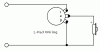
Here is typical L-pad wiring arrangement showing it used for a tweeter in a 2-way. The mid is usually padded in a 3-way with just a cap on the tweeter. Usually anyway.

Not sure what you got going on there exactly.


RC
 

Attachments

  • lpad-wiring-map.gif
    lpad-wiring-map.gif
    2.3 KB · Views: 143
A 1st order crossover for a 3-way would be inductor and 2 capacitors. If they were just letting the woofer roll off naturally without a stop (inductor), you would just have the 2 caps.

Here is typical L-pad wiring arrangement showing it used for a tweeter in a 2-way. The mid is usually padded in a 3-way with just a cap on the tweeter. Usually anyway.


RC

That's kind of what I was thinking, thanks for the diagram! It almost looks like two 1st-order crossovers superimposed on top of each other. One for woofer-mid, and the other for woofer-tweet. However, I think this means the mid is running full-range from its crossover point (2500hz) on up, while the tweeter is running from 5000hz up. The woofer, as you said is just rolling off naturally. Does that make sense?
 
That's kind of what I was thinking, thanks for the diagram! It almost looks like two 1st-order crossovers superimposed on top of each other. One for woofer-mid, and the other for woofer-tweet. However, I think this means the mid is running full-range from its crossover point (2500hz) on up, while the tweeter is running from 5000hz up. The woofer, as you said is just rolling off naturally. Does that make sense?

Yes, but I'm not sure why they would do it that way. That's not to say there isn't a good and rational reason for doing so but it escapes me. Do you have a photo showing the whole wiring deal? You provided a good explanation for whats going on but I'm a bit out of gas tonight and pictures (if they show everything) might help.

RC
 
Yes, but I'm not sure why they would do it that way. That's not to say there isn't a good and rational reason for doing so but it escapes me. Do you have a photo showing the whole wiring deal? You provided a good explanation for whats going on but I'm a bit out of gas tonight and pictures (if they show everything) might help.

RC

I can maybe post a photo tomorrow, sorry for that. It will be hard to see anyway, there's no crossover board. Just the two caps in line on the wires. If it was a two way speaker, it would look just like your diagram. It just includes a mid, which has the same kind of single-cap crossover as the tweeter, but without the L-Pad in the circuit.
 
I can maybe post a photo tomorrow, sorry for that. It will be hard to see anyway, there's no crossover board. Just the two caps in line on the wires. If it was a two way speaker, it would look just like your diagram. It just includes a mid, which has the same kind of single-cap crossover as the tweeter, but without the L-Pad in the circuit.


No problem Wiggy, and I wouldn't go to too much trouble to do so. I'm just feeling lazy tonight and would probably work better with a photo than read and decipher ;)

I'm sure some speaker maniac will stop by soon and have an automatic answer for ya anyway :thmbsp:

They sound interesting!

RC
 
I can maybe post a photo tomorrow, sorry for that. It will be hard to see anyway, there's no crossover board. Just the two caps in line on the wires. If it was a two way speaker, it would look just like your diagram. It just includes a mid, which has the same kind of single-cap crossover as the tweeter, but without the L-Pad in the circuit.

Well, they would be (in line caps) in any event I would imagine. It just sounds like the L-pad is wired in oddly because of the explaination. Like I said though, it's probably just me and not the explanation ;)

RC
 
They sound interesting!

Oh, indeed they do! I got them from a friend here locally, and they sound quite nice. That 8 inch midrange is rather odd. Sealed unit, looks like a pie-pan in the cab. Originally a kit like Heathkit sort of thing, they date back to maybe 1970 or so. Pretty efficient, I suspect. Good bass, midrange appears to be excellent with male vocals (all I've heard on them so far). Someone painted them black; but I believe the cabs underneath are in good nick, so I will be stripping and refinishing them. I have them in mind for my tube amp if I get it built and it actually works.

The gentleman I got them from did a little research and found that they were apparently well-regarded 'sleepers' by a man who was well-known in audio circles and whose opinion is often respected concerning such matters. So...we'll see!
 
Well, they would be (in line caps) in any event I would imagine. It just sounds like the L-pad is wired in oddly because of the explaination. Like I said though, it's probably just me and not the explanation ;)

RC

Oh definitely, and I'm in good shape to do it. I've got the caps on hand, and as it happens, I even have a set of L-Pads I bought on sale at PE back at Christmas time that I wasn't able to use on the project I intended them for, should work a treat here - these L-Pad are covered in some kind of orange oxidized dust-like substance. If they don't clean up nicely, out they go. Speakers are all accordion-pleat surrounds, so no worries there.

And I've heard rumor that the 3 inch tweeter can be replaced with a drop-in horn (Pioneer from PE, which I also just happen to have on hand) and it really wakes them up in terms of opening up the high end. No change in crossover required.
 
Oh, indeed they do! I got them from a friend here locally, and they sound quite nice. That 8 inch midrange is rather odd. Sealed unit, looks like a pie-pan in the cab. Originally a kit like Heathkit sort of thing, they date back to maybe 1970 or so. Pretty efficient, I suspect. Good bass, midrange appears to be excellent with male vocals (all I've heard on them so far). Someone painted them black; but I believe the cabs underneath are in good nick, so I will be stripping and refinishing them. I have them in mind for my tube amp if I get it built and it actually works.

The gentleman I got them from did a little research and found that they were apparently well-regarded 'sleepers' by a man who was well-known in audio circles and whose opinion is often respected concerning such matters. So...we'll see!

I take that back then, Pictures please when you get a chance :D

Many of those Heathkit or Heathkit like "kit's" were well thought out and used some pretty impressive drivers. 1st order if well thought out and using the right drivers can be a thing of beauty.

Sounds like you might be onto a nice one there.
 
That's kind of what I was thinking, thanks for the diagram! It almost looks like two 1st-order crossovers superimposed on top of each other. One for woofer-mid, and the other for woofer-tweet. However, I think this means the mid is running full-range from its crossover point (2500hz) on up, while the tweeter is running from 5000hz up. The woofer, as you said is just rolling off naturally. Does that make sense?

I've seen another speaker that has this type of crossover. Just series caps on the midrange and tweeter. It certainly is a pretty inexpensive solution.
 
Alrighty, then, here are the photos. Did my best with a compact camera, so have mercy. These are the 'before' photos. I hope the 'after' photos are a lot better!


100_3962 by Wigwam Jones, on Flickr


100_3963 by Wigwam Jones, on Flickr

You can just make out the crossover design in this shot.

1) Both wires come in from the speaker and both connect straight to the woofer.

2) From the woofer, both terminals send wires to either side of the L-Pad. The white wire has an 8 uf cap on it.

3) From the L-Pad, the white center wire goes to the tweeter. The other terminal of the tweeter goes to the midrange.

4) From the midrange, both terminals go to the woofer. One wire has a 4 uf cap on it.


100_3964 by Wigwam Jones, on Flickr


100_3965 by Wigwam Jones, on Flickr


100_3966 by Wigwam Jones, on Flickr


100_3967 by Wigwam Jones, on Flickr

Here you can see how the L-Pad is covered in some sort of dusty weird crap. Oxidation, I presume.


100_3968 by Wigwam Jones, on Flickr
 
Very interesting. Cheap is the word for it, caps are cheaper than inductors. I am trying to draw a schematic to help my own learning process, but I can't scan and post the result right now. It usuallly helps if I start with a literal drawing of what's connected to what. Then redraw into a more conventional crossover schematic. Connections can be moved around during that process as long as they don't move across a component, if you know what I mean. For example, a wire connected to woofer (-) is also connected to the back panel input if woofer (-) is connected to that input.

Doing this, it does appear odd to me that, from the input:

- From the input, the woofer, 4 and 8 uf caps for the mid and tweet are all in parallel.

- The 4 uF cap on the mid and 8 uf cap on the tweeter would put more bass into the tweeter than the midrange, which seems odd.

- The midrange is connected out of phase with the other drivers.

An odd beast.
 
Very interesting. Cheap is the word for it, caps are cheaper than inductors. I am trying to draw a schematic to help my own learning process, but I can't scan and post the result right now. It usuallly helps if I start with a literal drawing of what's connected to what. Then redraw into a more conventional crossover schematic. Connections can be moved around during that process as long as they don't move across a component, if you know what I mean. For example, a wire connected to woofer (-) is also connected to the back panel input if woofer (-) is connected to that input.

Doing this, it does appear odd to me that, from the input:

- From the input, the woofer, 4 and 8 uf caps for the mid and tweet are all in parallel.

- The 4 uF cap on the mid and 8 uf cap on the tweeter would put more bass into the tweeter than the midrange, which seems odd.

- The midrange is connected out of phase with the other drivers.

An odd beast.

Yes. I am confused. I 'think' it is this:


crossover_maybe by Wigwam Jones, on Flickr

But perhaps I am not understanding it correctly.
 
In the second last picture, it looks like the 8uF cap is going to the mid. Is that correct or is the schematic?
It would also help to show the polarity of the speaker connections because the mid is wired out of phase but the bass and tweeter are in phase.
 
Last edited:
In the second last picture, it looks like the 8uF cap is going to the mid. Is that correct or is the schematic?
It would also help to show the polarity of the speaker connections because the mid is wired out of phase but the bass and tweeter are in phase.

Yes, sorry, old eyes. The photo is correct, not my half-ass schematic.

The polarity on the drivers is indicated by a paint dot, which I presume is red (I'm color-blind). Can you see them in the photos? Thanks!
 
I think that's substantially what I sketched out but I've already lost the chit from yesterday.

I think kyle was suggesting to add + and - for each driver to the schematic. In any case that mid being out of phase is quite interesting, and was probably done to flatten the response at the crossover points.
 
I think that's substantially what I sketched out but I've already lost the chit from yesterday.

I think kyle was suggesting to add + and - for each driver to the schematic. In any case that mid being out of phase is quite interesting, and was probably done to flatten the response at the crossover points.

Ah, I gotcha. I'll fix it up and repost. Thanks!
 
I believe what you have is a bass driver running full range, a mid with a first order high pass and reversed phase and a tweeter with a first order high pass with an attenuator. It's a cheap solution.
In another thread I mentioned L pads having a sound and possibly being improved by replacing with fixed resistors. That pad in your photos would be better replaced. It looks oxidized on the outside and the inside probably looks similar. Resistors don't get dirty.
 
I believe what you have is a bass driver running full range, a mid with a first order high pass and reversed phase and a tweeter with a first order high pass with an attenuator. It's a cheap solution.
In another thread I mentioned L pads having a sound and possibly being improved by replacing with fixed resistors. That pad in your photos would be better replaced. It looks oxidized on the outside and the inside probably looks similar. Resistors don't get dirty.

True enough on the existing L-Pad, it does look horrible and I'm sure the inside is just as bad. However, I'll give them some deoxit and see how they clean up; if I don't see them cleaning up well, I happen to have a nice set of brand-new PE L-Pads just sitting around that I could place there instead.

And if I was certain on the correct value for the resistor instead of an L-Pad, I might consider doing that, but at the moment, I just got the speakers and haven't figured exactly what do with them yet. The guy whom I got the speakers from did some research and found an interesting article about them, seems there is a suggestion to replace the one weak spot - the tweeter - with a cheap Pioneer horn tweeter to essentially convert the speaker into a model that was also sold later by the same company. I kind of like that idea - I happen to have those tweeters here at my house, I could just use them without spending any money. But of course, I'd have to dial in the L-Pad setting first to get the sound right before figuring what the resistance value was and then replacing the L-Pad with a resistor.

Check this out:

http://www.audioasylum.com/forums/vintage/messages/6/60081.html

A variation on this theme was the ported version--bigger box, the same drivers. The best known is the HSI-C. 15 x 25 x 14 When you see the HS prefix you know its ported. Allied sold this speaker as the Knight 2330 (later with A or AK suffix (59.95 Kit, 79.95 assembled).

On any of the 12 inch 3-ways low bass is actually very very good. The rap on the big woofer models is that the ones with the cone tweets tend to sound somewhat dull and bass heavy. Swapping out the cone tweet for a horn similar to the ones used in the upgraded models greatly improves the highs but the overall balance as well. My current recommendation is to try Parts Express 270-050, a Pioneer tweeter horn very similar to what Utah would have made. It should be a drop in replacement from inside. In fact you would be converting a Utah WD-90 to an A-501 which used the combination of the 8-inch cone mid with a horn tweet.

So essentially, my Allied Knight 2330K is in fact a rebadged Utah HSI-C. Kind of cool information. And I also noticed that the bass is quite nice on this speaker - much better than the cheap stamped frame and OEM type construction (accordion pleat surrounds) would suggest. Deep and still tight, not flabby at all. Mids sound great with male vocalists that I've heard so far. Highs are eh. So yeah, horn tweeter. I can at least experiment with it while I refinish the cabs.
 
Back
Top Bottom