• The move to the new server is done. There are some software and database maintenance updates in process. This has us passing the hat around to help out. We appreciate any donations. Seriously, even a dollar helps. The payment page may be found here - https://www.audiokarma.org/support.html

Simple SE 845 Class A Stereo Amp

I still mulling over if DC really effects the final sound of a DHT.
My in-depth, hands-on experience with DHTs is limited to the 211. It's not clear to me whether this effect is present with other tube types, although I have heard the same said by 845 users. It has been suggested that this could be due to the voltage gradient that occurs across the filament when it's powered by DC. From that perspective, maybe this is also related to the unusually long filament structure of these particular tubes. This is all conjecture as to the cause, of course. I only know the 211 sounded dead and uninviting to my ears with DC on the filament. That's why I went to so much trouble to build a hum-free AC supply.

Jack
 
I remember trying AC filaments on the 845. Noise aside, to me the amp sounded "heavy" and slow. I used a DC supply but with a common mode choke that seemed to smooth the DC supply out and make it sound "warmer." It still sounds good. I know because the ones I built 25 years ago are sitting here now. ;-)
 
Not to derail this thread into a DHT heating discussion, but I have a pair of Rod Coleman regulators here that I'm eager to try in the 845 amp I'm building. They're a favorite among Bartola and many other DHT enthusiasts over at DIYaudio. They're priced quite reasonably but do require the provision of a substantial heatsink for the regulator power transistor. Unfortunately don't think I have time to do a direct shootout between standard DC and the Rod Coleman regs -- no way I'm breadboarding a stereo pair of these with and without to A/B them.
 
Unfortunately don't think I have time to do a direct shootout between standard DC and the Rod Coleman regs -- no way I'm breadboarding a stereo pair of these with and without to A/B them.
Yes, that's one of the problems with these types of reports, including mine. It should all probably be taken with a grain of salt. I did what I did. You do what you do. :)

Jack
 
A lot of the Japanese 211/845 filament designs use a full wave rectifier with center tap transformer and lots of capacitance (CRC or just C) and a humdinger pot. The Japanese are very particular about their designs and usually have a good reason to go a certain direction when implementing a circuit.

I'm quite happy with the DC humdinger filament circuit. It measures great and sounds great, but we all know there is more than that, but it is hard to quantify.
 
I still mulling over if DC really effects the final sound of a DHT. AC in a 2A3 amp sounds good but it is still modulating the music signal albeit at a low level. When I compare my 2A3 amp with AC filament to a 2A3 amp with DC filament, I can't really say I hear a difference except for the lack of "hum".

I'm not deaf by any means and have good hearing although I do have a hard time hearing a lot of what people say they can hear.:oops:
Ya, I don't notice a difference in how an amp sounds between AC or DC heaters. Other than the sight hum with AC heaters. The first 300B I built I started with AC heaters. There was a slight hum. So I went with filtered regulated DC heaters. The amp was quiet, but otherwise sounded to same to me. My hearing halls only gone up as high as 14khz for for years now. So maybe I am missing something? :dunno:
 
Perhaps a reason this particular design sounds good is because it is fixed bias and the cathode is going to ground thru a low value resistor instead of a high value resistor bypassed with a large electrolytic capacitor.
 
Here is one of many ad nauseam threads on DHT heater discussions from our other favorite forum:


For me, if the solution is to eliminate AC hum and a DC solution (or other solution) addresses the goal with measurement data to back-up that the solution was successful and it sounds good, mission accomplished.

The key word is "sounds good". Everyone will have a personal preference regarding that and that is OK.
 
An umbilical won't remove all the noise from the output of a standard SMPS. The problem is that they're pulse-width modulated, and that produces a mish-mash of frequencies that extend into the audio range. A good LC network will be required to clean this up.

Well, the supply I used wasn't DC, and it wasn't regulated, so not pulse-width modulated. It was a modified halogen lighting unit that oscillates at a fixed frequency well above the audio band. The output is an ultrasonic square wave that heats the filament. This eliminates hum, but retains what I believe are the superior audio qualities of AC heating. Definitely not something you can buy off the shelf. The description of what I built is in a thread that starts here:

Ultrasonic Heater Supply (at HiFi Haven)

This is the finished project. I built two of these, one for each monoblock. They convert 120VAC to 10V RMS equivalent at 80kHz, good for heating one 211 or 845 each.

View attachment 3567573

Jack
Hello Jack very nice solution. Audibly speaking, is this an advantage over traditional solutions?
 
Hello Jack very nice solution. Audibly speaking, is this an advantage over traditional solutions?
I think this depends on the specific tube type being used. In my work with the 211, AC heating was beneficial. It's subjective though, and I admit to not performing A-B testing at the time. Many people have built large SETs with DC heaters and have been pleased with the results.

Jack
 
I've have been listening and comparing my 2A3 and 300B amps to this Simple 845 amp... If you want to experience the DHT sound but Supercharged/Turbocharged (pick your favorite positive displacement mechanism), then this 845 amp is the way to go.

It is uncanny how accurately it reproduces music with extreme detail. I can hear sustained notes in the background, hanging there, buried in the music at least 20 or 30dB down.

The 2A3 and 300B's might have to go to finance my next project.
 
A simple 845 SE amp is a great thing. Joe Roberts didn't call it "the Mighty 845" for nothing. ;-)
 
I've have been listening and comparing my 2A3 and 300B amps to this Simple 845 amp... If you want to experience the DHT sound but Supercharged/Turbocharged (pick your favorite positive displacement mechanism), then this 845 amp is the way to go.

It is uncanny how accurately it reproduces music with extreme detail. I can hear sustained notes in the background, hanging there, buried in the music at least 20 or 30dB down.

The 2A3 and 300B's might have to go to finance my next project.
It would be interesting to know if the 300B "opens up" sonically with a 10K load. That sacrifices a large percentage of the power that's otherwise available, but the tube becomes more linear.

Jack
 
It would be interesting to know if the 300B "opens up" sonically with a 10K load. That sacrifices a large percentage of the power that's otherwise available, but the tube becomes more linear.

Jack
In my experience, the 2A3 & 300B perform best (power output vs THD) with 3.5k~5k primary impedance. The 2A3 is usually shown using a 2.5k primary, but that is to maximize power output.

I've never tried anything higher than 5k with a 2A3 or 300B.

According to the RDH, a 2~3 multiplier (plate resistance/primary impedance) should be used for max power output, but I find a shallower load line improves distortion while only requiring slightly more drive.
 
Last edited:
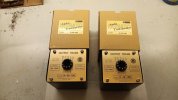
I sold a stereo 2A3 amp to help finance a pair of Hashimoto Output Transformer H-40-10S 40W SE OPT's. These are made specifically for 211 & 845 tubes.

I should have them in the next few weeks and will post some measurement data of them in my 211/845 amps. I hope they are not duds.
 
Here is the Simple 845 with the Hashimoto H-40-10S 10k OPT's installed:

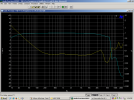
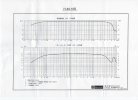
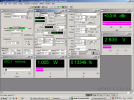
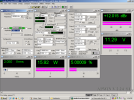
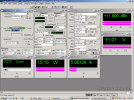
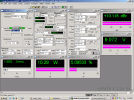
Excellent bandwidth from 20Hz~20kHz. -3dB is 62kHz. Very impressive for a 10k primary wind. Now as to be expected, it is rated at 40W@40Hz, but we all knew this was not going to be a reality given the weight of the core at 4.2kG or 9.25lbs. Power out at 40Hz@5% THD+N is only 12.3W/8 Ohms.


The sound quality of these OPT's is all the audiophile adjectives you can think of and more. Seriously though, they sound amazing. Despite the roll off in power at low frequencies, you cannot tell when listening to music. They music is full, dynamic and smooth as silk.

Hashimoto uses Orient Core Hi-B (high permeability) laminations which always sound great.

These OPT's are slightly north of $1kUSD, but they are definitely worth the price of admission.

Next, I'll install these in my other 211/845 amps which are rated for 25W (211)~30W (845) power output and collect some data.

1W Frequency Response
1W Frequency Response 8 Ohm.png

Hashimoto H-40-10S Spec Sheet
h-40-10s.jpg

1W, 8 Ohm
1W, 1kHz, 8 Ohm, Analyzer Panel.png

Rated Power 1kHz, 8 Ohm
Rated Power 16W, 1kHz, 8 Ohm, Analyzer Panel.png

Rated Power 20kHz, 8 Ohm
Rated Power 15.5W, 20kHz, 8 Ohm, Analyzer Panel.png

Rated Power 30Hz, 8 Ohm
Rated Power 10.3W, 30Hz, 8 Ohm, Analyzer Panel.png

Rated Power 40Hz, 8 Ohm
Rated Power 12.3W, 40Hz, 8 Ohm, Analyzer Panel.png
 
Last edited:
These H-40's are very sweet. Nice balanced presentation and plenty of low-end. The build quality and performance are worth the money if you want a great 211 or 845 amp.

Unfortunately, there are not many offerings left for 211/845 10k OPT's. Lundahl has a few, but not with the high frequency extension of the H-40's. They few they (Lundahl) have just cover 20Hz~20kHz and then roll-off fairly quickly.
 
Back
Top Bottom