• The move to the new server is done. There are some software and database maintenance updates in process. This has us passing the hat around to help out. We appreciate any donations. Seriously, even a dollar helps. The payment page may be found here - https://www.audiokarma.org/support.html

Single ended triode strapped pentode amplifiers.

I might also mention that in amps that only have a spare 5VAC winding, the single damper downstream of the SS diodes will run on 5V if the load isn't near max. I did this on a pair of Heath W4's and Dynaco Mk2's.

Where 5AR4's are running on the ragged edge the 6CG3 is rated at 350mA. I think there are some dampers rated at 400mA as well. If you don't mind a top cap the EY500A is rated 440mA. These are easier to work with in a scratch build but they can be worked into restorations too.
There isn't a 5V winding on this transformer. Just two 6.3v windings. Only one needs to be used for filiments.
 
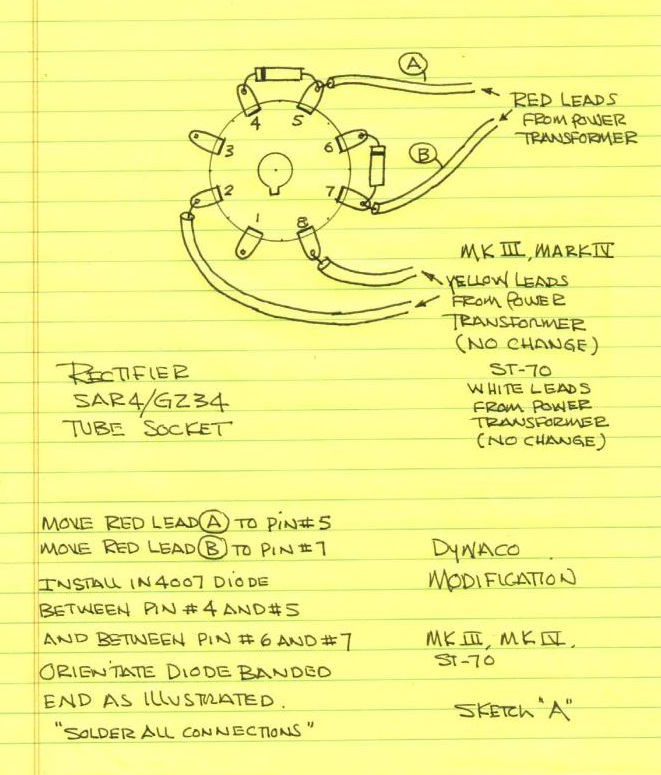
You can always use the "yellow sheet mod". Even a crappy JJ will last forever with a couple of sil. diodes in front of it. ;)

jeff

TubeRectifier-DiodeMod.jpg
I've done the yellow sheet mod to three of my amps. I don't have a 5v winding to begin with and I really just don't want to use a rectifier tube.
 
The two amps I've built with solid state rectification and direct coupled phase inverters got neon bulbs from grid to cathode on the PI tube to limit the voltage. It stays about 80v worst case, where its closer to 300 without the neon. Not sure how much risk that actually is since the tubes aren't conducting but it makes me feel better. Once the tubes start to conduct it drops the voltage well below where the neon conducts so it turns into a tiny value vacuum capacitor.
Intresting. I may just try that.
 
Thing with the yellow sheet mod is that it only addresses peak inverse voltage failures. It does nothing for forward current limitations, and a 5AR4 is rated for 250mA. If you need more than that, you need multiples, or you need something else.
 
I'm finishing up this thread and want to thank everyone for your help and suggestions. I'm going to build the Cascode Spalding 6L6 amp around thhe Antek Toroidal power trany. I've started a parts list and bookmarked several things as well. I'll be paralleling the the two HV secondary windings and use a bridge rectifier instead of a tube rectifier. I used an Antek SA-1T250 for my sweep tube amp that had a 115V primary as well. I checked the heater voltage in that amp and it's right at 6.6V, so I should be OK with this other Toroidal.
Since it doesn't have a center tap I'll just tack on a couple 100 ohm resistors.
I'll put together a bridge rectifier to see what the unloaded HV is and double check the 6.3V winding in the near future.
I'll start gathering everything I need in a few months. I still have a couple other projects to finish up first.
I have a couple different pairs of 6L6GC's, some Tungsol 5881's, and a pair of 6P3S-E's to try in this amp. I might even try a couple KT-77's I have also.
 
I've done the yellow sheet mod to three of my amps. I don't have a 5v winding to begin with and I really just don't want to use a rectifier tube.
In my opinion, for DIY, if you want a trouble-free power supply — one you won't have to worry about for 25-30 years — stick with quality solid-state diode bridges. PLUS, the PT runs much cooler than with tube rectifiers. It's a win-win.

I have a nice stock of Fairchild and Vishay UF diodes.
 
Last edited:
In my opinion, for DIY, if you want a trouble-free power supply — one you won't have to worry about for 25-30 years — stick with quality solid-state diode bridges. PLUS, the PT runs much cooler in the long run compared to tube rectifiers. It's a win-win.

I have a nice stock of Fairchild and Vishay UF diodes.
I'm well stocked for UF and other diodes. They're cheap enough to buy by the 100 count. Plus using a bridge should get me very close to the B+ I need from this transformer. I'll have to use a bigger chassis platw because of the size of the thing unless I mount it vertical.
 
I'm well stocked for UF and other diodes. They're cheap enough to buy by the 100 count. Plus using a bridge should get me very close to the B+ I need from this transformer. I'll have to use a bigger chassis platw because of the size of the thing unless I mount it vertical.
Do understand some transformers like Hammond have a rated ma based on being used with a full wave rectifier with capacitor input. Any other use requires the current rating to be recalculated.

If for example you use the full winding with a bridge rectifier using a capacitor input, they have to be downrated by multiplying the rated ma X 0.62.

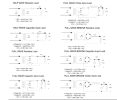
See attached for all the variations.
Hammond_Transformer_Loading_Chart.png
 
Do understand some transformers like Hammond have a rated ma based on being used with a full wave rectifier with capacitor input. Any other use requires the current rating to be recalculated.

If for example you use the full winding with a bridge rectifier using a capacitor input, they have to be downrated by multiplying the rated ma X 0.62.

See attached for all the variations.
View attachment 3853991
Thanks. I'll look at those.
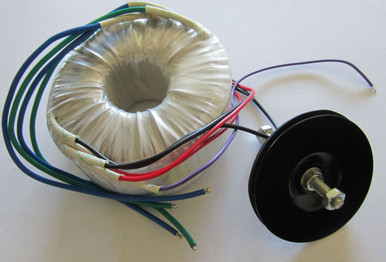
The Toroidal I'm using has .63A HV windings.
 
You might want to ask them how they rate that ma spec or do the VA math.
Good point. It's rated for 400VA according to the specs. And supposedly,
"In most cases this transformer can be output 20% more power from its rating at 60hz power source without any problem." What ever that sentence really means? Its not written quite right.
 
400VA means that if the plate voltage is around 400 VDC, the current output would be 1 A.

I believe the plate voltage you desired was 300 VDC, so the continuous current is 1.3 A. I believe that is more than enough for a two-tube 6L6GC push-pull amp. Probably 250 VA is overkill.
 
Last edited:
It actually has two 320V 0.63A windings and two 6.3V 4A windings.

Straight math means that's about 454VA fully loaded. Would still be in their safe zone of 400VA +20% (480VA).

Seems like your use case is nowhere near pulling on it that hard.
 
It actually has two 320V 0.63A windings and two 6.3V 4A windings.

Straight math means that's about 454VA fully loaded. Would still be in their safe zone of 400VA +20% (480VA).

Seems like your use case is nowhere near pulling on it that hard.
The problem with too much current on tap is that you may need to be careful about the power supply's current ratings and build. A 454 VA PT can pass a lot of current on demand (or in near-short situations).

You might need to go to a 3-amp diode-rated bridge (like a 1N5408). Just to have a good margin of safety in the PSU.

For sure, I would use a fast-blow fuse.
 
Last edited:
The problem with too much current on tap is that you may need to be careful about the power supply's current ratings and build. A 454 VA PT can pass a lot of current on demand (or in near-short situations).

You might need to go to a 3-amp diode-rated bridge (like a 1N5408). Just to have a good margin of safety in the PSU.

For sure, I would use a fast-blow fuse.
I use fast blow fuses in almost everything. At the moment the only equipment I have with slow blow fuses is my VTA ST-70. I haven't had a fast blow fuse pop in a long time. For one thing I never fast cycle power switches.
 
Back
Top Bottom