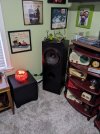
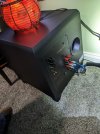
Passive radiator subs do put out a ton of bass. But I've yet to hear one that puts out what I'd consider "musical" bass. HT and 2-channel music are usually two different subwoofer disciplines.
I don't need a bass guitar to rattle the floors and that's what most passive radiator subs do. They also don't really "punch" like a sealed sub does.
I've had the opposite experience.
Sealed subs- in order to get sufficient low-end extension- require very heavy cone mass on the driver itself. Especially, if the box volume mus also not be large.
Also, a sealed enclosure, will inherently require MUCH more cone excursion from the driver, than any sort of reflex enclosure.
This cone mass leads to several problems, in producing upper bass properly- the additional cone mass leads to weird suspension anomalies (rocking motion and such), breakup modes that occur at much lower frequencies than normal (limiting useful bandwidth), and a very low efficiency (which increases needed power, and therefore increases power compression effects from the heat generated in the coil).
Also- the extra excursion needed, stresses the suspension. Spiders don't deal with huge excursion well, in general. Neither do surrounds. The larger the excursion, the more linearity (stiffness vs, excursion) issues raise their nasty heads. The surrounds needed to move this far, also have issues with breakup and "doubling" modes themselves.
The effect, is that the sealed sub is frequently usable over a very small bandwidth, compared to the lighter cone mass of a reflex driver. They don't go as low- unless, as I mentioned, the enclosure is very large, or there's lots of EQ involved (which gets right back into the power compression effect- more EQ, more power, more compression).
OTOH- due to the reinforcement of the bottom octave by a reflex enclosure (ported or PR), the cone mass can be much lower- even with a lower f3 than a similarly-size sealed enclosure. And the excursion can be lower, too, for the same output level (as the port or PR makes up the rest of the excursion at the lowest frequencies- where excursion is the greatest). This makes for a much easier job for the magnetic motor- leading to higher bandwidth on both the low and high ends of the response.
This greater bandwidth, makes reflex subs frequently "faster"- and therefore, more punchy, and realistic sounding than subs with lower bandwidth. Even if it's filtered by a lowpass- the fact that the response isn't doing weird phase and frequency response things in the upper part of its response, makes it easier to integrate.
So, if you're willing to have a very large sealed enclosure, with multiple drivers to take up the excursion (a la the dual 15" bass drivers in the VSA Ultra 11, or the large SVS or Hsu subs), then you can get good response sealed. BUT- if you insist on small size- which most people do- then a reflex enclosure makes the most sense. You give up less in terms of transient response and bandwidth, that way.
What's interesting- it's not a sub, but it is indicative of the behaviors mentioned here- that Von Schweikert Audio- long a proponent of sealed low bass enclosures in their flagship models (Ultra 11, Ultra 9), is NOW going with more vented enclosures (reflex), such as in the Ultra 7. And many people have found the bass on the Ultra 7, to be better...
Regards,
Gordon.