• The move to the new server is done. There are some software and database maintenance updates in process. This has us passing the hat around to help out. We appreciate any donations. Seriously, even a dollar helps. The payment page may be found here - https://www.audiokarma.org/support.html

So, anybody ever get physical with an Ohm Walsh?

Opinions..

Here's a link you might want to peruse. It can give you a little basic info on the Walsh series and what upgrades are available for each version.

Cool. I can see that the Ohm Walsh's I would LIKE are near the price of the Eminents. Now, can anyone here quantify how the Ohms sound compared to other speakers? I've read the reviewers' comments, but most of them live in the stratosphere and only listen to classical music...:nono:

...OK, I listen to it too, but I like to listen to everything, all the way from Classical to pop to Classic Rock, Jazz and you-name-it. The speakers have to be good all-rounders (no pun intended) like my Carvers; the Ohms LOOK like they might just fit the bill, but I can find no one here within 200 miles that owns a set I could listen to (kind of a pain trying to buy speakers like that, eh?). :no:

Anyway, Ohm listeners, what am I in for compared to even a planar or hybrid? Hey, you AKers are a great, trustworthy lot, hence my entreaty. (That having been said, if anyone has a working set they'd like to trade, puh-leease feel free to email me at cmk59@yahoo.com!!!) :banana::music::tresbon::D

Chuck
 
I can say with all honesty that my yet-to-be-upgraded Walsh2's sound awesome. They do require some real wattage (I'd want to use a good 75WPC or better Amp) to come alive and they also present a 4 ohm load (something to consider) to the source so if you can feed them properly and put them in an adequate listening space, you probably won't be disappointed.

Ohm Walsh series speakers need power and an amp that can drive a 4 ohm load. If you've got that covered, you're all set.
 
What's interesting is that, going by the DC resistance at the molex connector between the can and the crossover, the drivers in the walsh 3 present DC resistances of 8 and 10 ohms. Almost precisely 8 and 10. one of them was even 8.0 ohms.

I don't doubt that the AC impedance dips toward 4 ohms at some frequencies, but I wonder how big of a part the crossover + 'aspect' + EQ circuits play in the nominal 4 ohm impedance.

Or rather, I'd be slightly shocked if the drivers were simply hooked up in parallel, so I expect that the unusually complex circuit in the bottom of the box is arguably solely responsible for it - but i don't know why or how. yet.
 
Well the Ohm site has the Walsh 3's listed at 4 Ohms (Typical) whatever the heck typical means. Have you measured the load from the speaker terminals?
 
As far as what they sound like, the omnidirectional part may be an aquired taste, since must of us are used to axis listening. The bass in mine is so deep and well-integrated into the musical program that I think I got used to the other differences while I was listening to side after side of loud organ music. I have a feeling they would make a knock-down drag-out rear speaker, but my TV is two channel + sub. I'm using Sansui SF-2's which are also omnidirectional, and they are fantastic.
 
Thanks for the great feedback, folks...I'm now more anxious than ever about a pair of Ohm Walsh's! As to amps, I'm running a McIntosh MC2205 and a Carver M500t with a Pioneer SPEC-4 on deck (in for repair), so I'm not worried about power requirements (the Carver Amazings I run also have a 4-ohm impedance).

Chuck
 
Well the Ohm site has the Walsh 3's listed at 4 Ohms (Typical) whatever the heck typical means. Have you measured the load from the speaker terminals?

Well, 'typical' is probably referring to the fact that moving-coil dynamic drivers have an AC impedance that varies across the audible frequency range.

less-inductive designs like maggies have a more flat AC impedance.

I haven't tried measuring the DC resistance at the input terminals, but with a crossover that complex, DC resistance may be way off from the AC impedance.

An impedance curve is something i've got the tools to graph by hand, but not the experience.
 
Maybe this will help

I don't know if this will help, but I have a sales brochure from the Walsh 2's and it has a cut-away view of the speaker/cabinet. You might be able to figure out what is going on from there. However, when I owned my Walsh speakers, I re-did the crossovers, and I just took the speaker/can off of the top and stuck my arm down inside it. I know it sounds hard, and it is-but if you have long enough arms, you can get in there with a screwdriver and get them off. Let me know if you want a scan of the sales brochure!


Jason
 
We're In

Working on an Ohm Walsh is tricky-- Ohm doesn't want your prying fingers in there messing up what looks like a hand-tuned assembly (shades of the F!). So they sealed everything in a metal can, as all of you owners already know. The trick is, how to get the can apart to replace the odd blown tweeter or recap the odd crossover. I had an abhorrence of bending or prying to get the thing apart, because... well, sometimes I just abhor for the hell of it. Come over here and let me abhor something for you. --All right, I confess I had a vision of my prying implement causing the whole side of the can to buckle.

Meanwhile, as I've discovered, lots of old Ohms had blown tweeters, despite the clever protection circuit. Like one of mine, for example. So there's a need to get in.

Turns out the can is not spot-welded as first appears. There's glue or goo or RTV silicone or something that's hard but stretchy and flexible like contact cement doing the job. Fellow AKer cabinover used alcohol (denatured ethanol, presumably) and knives to soften the goo and open his cans. Knives? Brrrrr. I'll stick to solvent, I told myself.

I'm still not sure what sort of goo Ohm used to stick the cans down over the driver assembly, but it's not that difficult to pop the can off using only solvent. Grunting is involved, however.


Guessing, worst case, that the goo was contact cement, I took a disposable horsehair paintbrush and painted around the base several times with lacquer thinner, but this softened the goo only a little, and I despaired of getting the can off. Then I noticed parts of the goo were detaching themselves from the metal and that I could pull bits off and rub off much of the rest. RTV silicone? Sure looked and felt like it once it was softened.

In any case, grunting in a manly sort of way and holding the can across my middleaged paunch (grown specially for the occasion) I sort of broke the can across my tum the way you'd break a stick across your knee, working it a bit at a time around the circumference. Easy does it... urgh.. you could see the goo stretch and try to pull the can back.. argh... ya bastard... here it comes.. whoof, it all came off at once. No distortion of the metal mesh occurred, nor did any of the old foam lining suffer any damage.

You can do it, dead-tweeter Ohm owners! Good luck!

Photo of my Walsh 3 drivers coming in the next post.
 
I, Robot
P1000050a.jpg

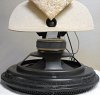
This angry-unibrow-looking face is my Walsh 3 driver with the can removed.

Note the dome tweeter (many 2nd-gen Walshes used cone tweets, like my FRS-11s) and the pizza-slice shaped chunk of mineral wool designed to shape the tweeter's polar response which has already been shaped by giving it a corner placement on a cardboard baffle. The bottom (horizontal) half of the baffle is propped up by a little chunk of styrofoam. The tweeter, which is stuck via doublesided stickypad to an angled aluminum bracket which is in turn stuck atop the "woofer" magnet, is angled upward slightly.

The date of manufacture, 1986, is stamped on the cardboard.
Walsh3closeup-2.jpg
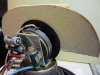
Here's the back of the assembly, showing the tweeter from the rear. The "fuses" look like.. well, fat tubular fuses but they've been painted black (!) and covered with spaghetti. They're actually tubular incandescent bulbs being used as surge protectors. Didn't work for this tweeter-- it's dead, Jim.

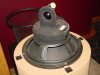
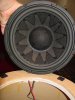
Before we go, a look at the "woofer": the surround is heavily doped, and the dope is still very sticky. Part of the surround's job on a Walsh is to absorb the traveling surface wave coming down the cone, and there's no doubt this surround was specified to accomplish that (whether it does is another matter). This is not your typical foam-rot victim, which is one reason to buy the Walsh 3 over the foam-surround Walsh 4. Also note the curved cone profile, an effective technique for suppressing tangential modes in the Walsh cone as well as in more conventional drivers.

Anybody wanna have a guess at what the capacitor's for? It's not connected to the tweeter. It's in parallel with the top "fuse".

EDIT: Ericj's friend explains the capacitor and its strange function here.

NEXT PROJECT: identifying the tweeters, then replacing both of them with something better without messing up the dispersion Ohm wanted for the 3. I've got a pair of monopole Heils arriving shortly.
 
Last edited:
Ericj, did you ever perform your crossover rebuild? Let me know.

Wualta, thanks for the pix and for encouraging other Ohm Walsh owners. Were you able to identify your tweeter? I pulled the can off my Walsh 5 several years ago. That was the easy part. Tougher was the identification of the tweeter. (Ohm is obviously of no help whatsoever in this respect. They'd rather charge you $$$ for a repair or upgrade versus $ for a replacement part.)

Anyway, with a lot of image searching, and some luck, I was able to determine my Walsh 5's had a MB Quart titanium dome tweeter with a double magnet. I couldn't find the unit stateside, but was able to secure one from a guy on ebay in Germany. Cost was $45 including shipping. Hooked it up and all is well.

It may or may not apply to yours, but on my old tweeter the part number was on a label right where the tweeter magnet was bonded to the bracket. So you
-might- be able to find more information if you pull the tweeter off the bracket. I emphasize....-might-.

I'd appreciate it if you two guys would contact me to chat about this a bit more.

Ohighway
 
Crazy setup. Those guys had the good weed :D

Hey, let's invert the woofer and double sticky the tweeter to it. Cool.
 
Build your own Walshes from scratch for cheap: the sound will blow you away:music:. I have Walsh 5 Series 3 and the home brew loudspeakers come awefully close. Close enough for government work as they say.:D
 

Attachments

  • DSC00065.jpg
    DSC00065.jpg
    68.2 KB · Views: 740
  • DSC00066.jpg
    DSC00066.jpg
    69.9 KB · Views: 724
  • DSC00076.jpg
    DSC00076.jpg
    101.6 KB · Views: 395
I had no problem gently prying off the grill of an Ohm 2 can and then used black permatex to reassemble.
About the crossovers... I've used a heat gun (carefully) to get them loose.
 
Hey Dragon, I noticed in an earlier post you posed the question as to what does Ohm do with all the original F drivers that they take in trade. I've often wondered myself. I mean, if they don't rebuild them, then why do they need them?

 
Hey Dragon, I noticed in an earlier post you posed the question as to what does Ohm do with all the original F drivers that they take in trade. I've often wondered myself. I mean, if they don't rebuild them, then why do they need them?

I've heard that they crush them. They want you to buy new ones I guess.
Wouldn't it kill you to see a mess of A's & F's being smashed. Ahhhhh! :tears:
 
Back
Top Bottom