
WobblySam
Well-Known Member
No, no, no, no - I want them for my HF linear amplifier.I'd call dibs on the 811's. My Altec 1570B's could use some new friends


No, no, no, no - I want them for my HF linear amplifier.I'd call dibs on the 811's. My Altec 1570B's could use some new friends

THAT'S not an amplifier; THIS is an amplifier!
We are all humbled by your proposed quarter mega-watt single-ended amplifier with a transformer the size of a suburban home. The push-pull version would generate more eddy currents than one of US Steel's legendary arc furnaces and would require restricted airspace zones for hundreds of miles around it, lest the induced currents melt low-flying planes. The DC filament supply alone would require an entire month's copper output from Bolivia. Pacemakers on the other side of the planet would fail when it played Kenny G., while Motörhead at low volumes would cause entire nations to spontaneously combust. This would be the only amplifier worthy of Disaster Area, which would commission a few gross, merely on general principles.
Disaster Area was a plutonium rock band from the Gagrakacka Mind Zones and was generally regarded as not only the loudest rock band in the Galaxy, but also as being the loudest noise of any kind at all. Regular concert goers judged that the best sound balance was usually to be heard from within large concrete bunkers some thirty-seven miles away from the stage, whilst the musicians themselves played their instruments by remote control from within a heavily insulated spaceship which stayed in orbit around the planet—or more frequently around a completely different planet.
Their songs are on the whole very simple and mostly follow the familiar theme of boy-being meets girl-being beneath silvery moon, which then explodes for no adequately explored reason.
Many worlds have now banned their act altogether, sometimes for artistic reasons, but most commonly because the band's public address system contravenes local strategic arms limitations treaties.
The Restaurant at the End of the Universe by Douglas Adams

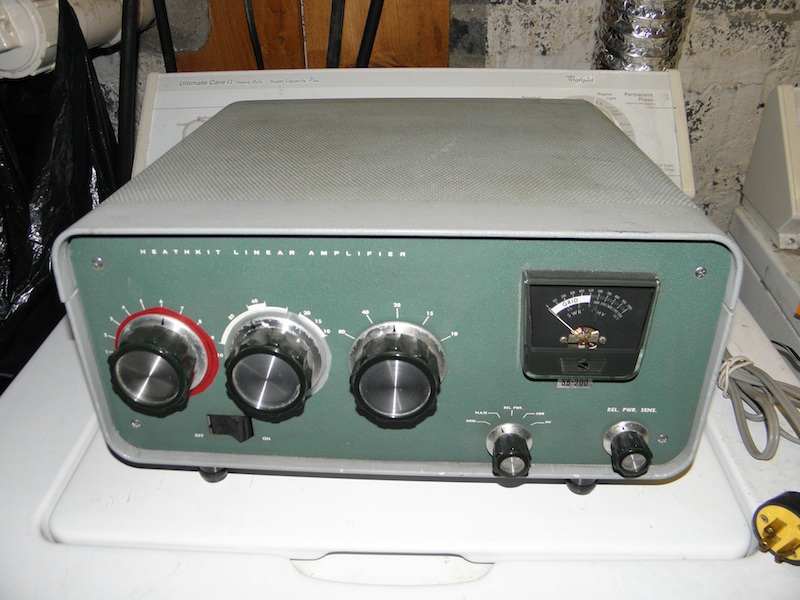

From what I understand, the 572B is a beefed-up version of the 811A. According to this page, the 572B is rated for 2,400V on the plate, while the 811A is rated for only 1,500V. Since this page indicates a typical (if somewhat modified) Heathkit SB-200 putting 2,100V on its tubes, using a pair of 811As in a SB-200 probably wouldn't work out too well without major modifications. However, I have found that an 811A makes for an excellent table lamp, at the least:No 572Bs but the 811A may be an option.
Thanks,
Joe Y

The generators are AC?
To clarify, I was thinking that the internal submarine distances are not great, so the inefficiency of DC distribution would not be too extreme, and the systems must run with the generators off which would suggest DC power distribution.
It's been decades since I was on the USS Ling, but I remember the massive banks of lead-acid batteries. Much like an electric car in the 1970s, it seemed that the lead-acid batteries filled much of the ship's volume.


Some of y'all are nuts.
PPP 807s or 1625s would be enough power for me.
Most of these tubes were generally used in amateur radio service. In particular, both 6146s and 811As remain popular 'final output' tubes in RF service, both with older and more modern production units. Fully solid-state RF amplifiers are available, but vacuum tubes remain quite popular for use in various RF applications, including some very high powered transmitters. Even without a broadcast license, my amateur radio license allows me to use a transmitter as powerful as 1,500W, and companies like Ameritron still produce tube-based linear amplifiers like this for this purpose.Some of y'all are nuts.
PPP 807s or 1625s would be enough power for me.