• The move to the new server is done. There are some software and database maintenance updates in process. This has us passing the hat around to help out. We appreciate any donations. Seriously, even a dollar helps. The payment page may be found here - https://www.audiokarma.org/support.html

solder not sticking/adhering or tinning to braided wire

Sometimes a manufacture just gets it right with the simple basics and without over-engineering. Kinda like the old Magnavox counsel TV I had. 27" screen and huge speakers on each side of screen - that thing sounded great, for a TV. It's on the list of things I wish I kept, along with a '71 Camaro with 350 and 4 speed Muncie transmission.
I like Occam's Razor in building things, too! :thumbsup:

"Occam’s Razor in engineering — software, products, or physical structures — is the principle that the simplest design or solution is usually the best, favoring fewer, more impactful components over unnecessary complexity. It serves as a "shaving" away of unnecessary elements to reduce risk, enhance clarity, and maximize efficiency."
 
327 had smaller journals resulting in less friction. 327s revved higher. 377 was the hot ticket, not 383.
isn't that a 400 block with 350 rotating parts? i know someone who used that config in something with good results. He said the short stroke big bore combo revs better, but the 383 long stroke makes better torque at the cost of RPM. All depends what you need to do I suppose.
 
That I can remember - 350 Chevy.

I just bought AIM solder. Supposed to be good, comparable to Kester but less expensive.

View attachment 3754950

That's good stuff; 63/37 is very easy to work with, and 2% RA flux will provide excellent cleaning. I've always had good results with AIM products.

I work on a lot of vintage tube-type Tektronix oscilloscopes, and they have ceramic terminals that require the use of a silver-bearing solder. I use the AIM Sn62/Pb36/Ag2 with 3% RMA flux. The work is a bit heavier, so I use the 0.050"Ø.
Good to hear, thanks!

Now I have to buy components, and indicator bulbs.... I just struck-out trying to save some money there. 12v AC/DC incandescent bulbs for automotive use are too dim. :confused:
 
I work on a lot of vintage tube-type Tektronix oscilloscopes, and they have ceramic terminals that require the use of a silver-bearing solder. I use the AIM Sn62/Pb36/Ag2 with 3% RMA flux. The work is a bit heavier, so I use the 0.050"Ø.

Kudos to anyone who works on those big ol' boat anchor scopes. Did not know about requiring silver-bearing solder. Learn something everyday. :)
 
I will try and clean them first, also the wire looks like its aluminum. It wiring inside of a marantz 1977 receiver thanks
Marantz did not use aluminum wiring in their receivers. As recommended, use some rosin flux.
Way too hot for anything with 60:40 and even at the top end for some lead free. You'll just burn tips, vaporize flux and generally make a mess of components and joints.

350C (662F) is the top temp with 330C (626F) quite usable for most people and small traces/lands.

I use 350C and rarely ever need to go higher.
I always run mine (Pace ADS-200) at 800F. Anything colder is too freakin' slow.
 
Mine typically runs in the 700-750F range, basically wherever I left the control last time I moved it. Its not a digital and those two points are fairly close together on the knob. I've not found it to be a particularly fussy value.
 
Mine typically runs in the 700-750F range, basically wherever I left the control last time I moved it. Its not a digital and those two points are fairly close together on the knob. I've not found it to be a particularly fussy value.
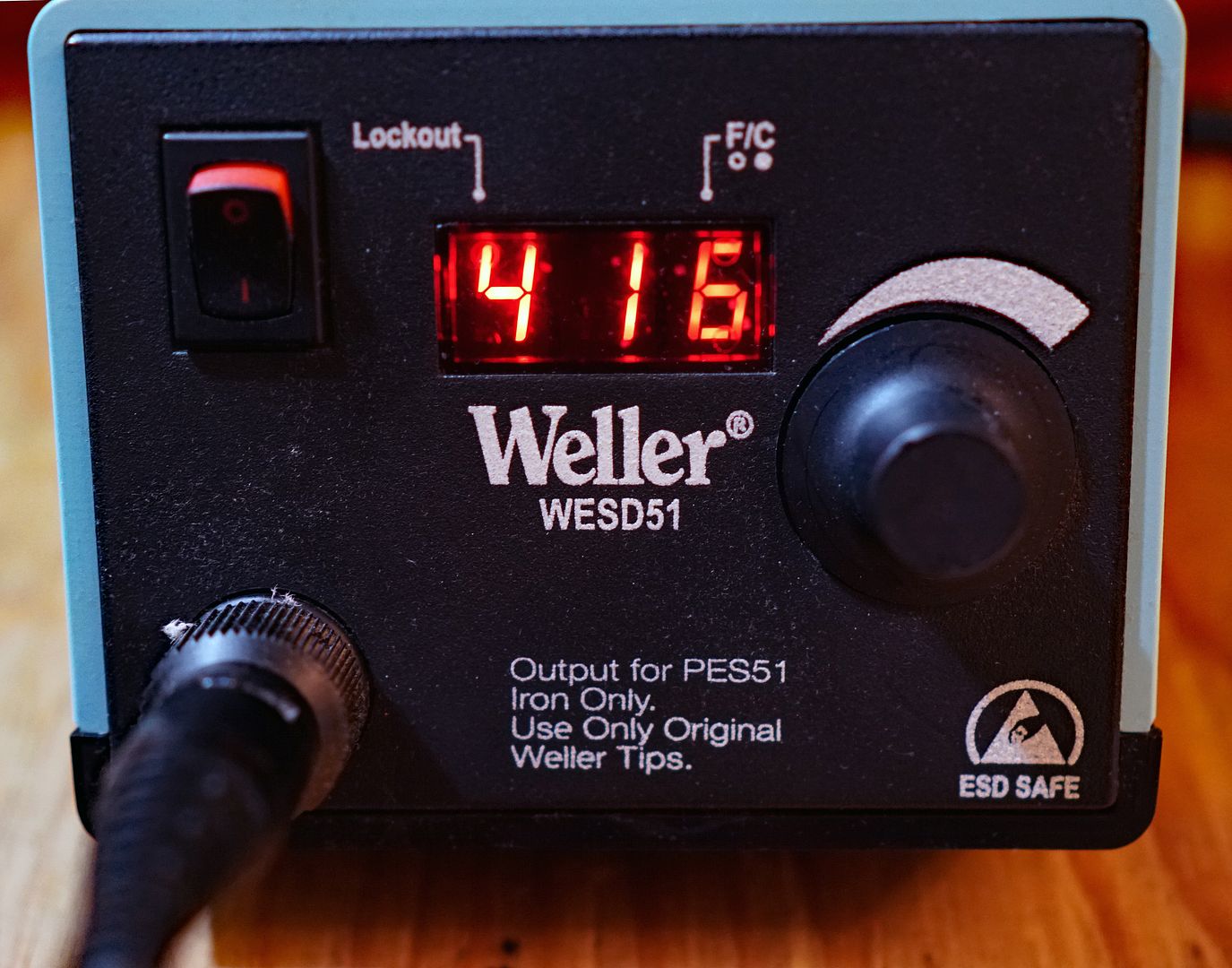
I'll crank the temp for turret boards. You want to get those right the first time. 416ºC = 780ºF.

00f6e7ad-3906-4d2b-873b-ad8cc7995063.jpg


2abe98b6-9bfa-48bc-95a6-fd894be7a5e6.jpg
 
Mine typically runs in the 700-750F range, basically wherever I left the control last time I moved it.

Do you have a thermocouple digital tip thermometer (calibrated)? If I need more heat (for a large thermal mass joint) I move up to the 120W iron (same temperature).

I guess if you're doing a lot of large tag-strip heavy gauge copper point to point you might need >100W but it's super rare to need a temp anywhere near 400 degrees C. Your tips will burn in front of your eyes. Put it this way, I still have and can use the Hakko tip that came with the first 926 station I bought in the late 1980s. Sure I've replaced it, but it's serviceable, still.

350 C (662 F) for me, is the upper limit for 60:40, unless it's a huge ground plane and even then 370 C would be the limit. A >120W watt iron eats that without thinking. LeadFree is a whole other sh#tfight and if that's what you're referring to, OK.

Hot-air rework at 750F (400C) is at the top end for PbFree in my lab.

But I have to agree, a high temp for us guys who have been soldering since we were 7 years old is not a problem. That said, I like my tips to last.
 
I've found cranking the soldering iron to 750°F works when needed. Ain't nobody got time for anything else. Oh no, you might burn your $15 tip; has not happened to me yet, and if it does I'll get new ones from hakko.

That said for OPs problems, more/better/more aggressive flux is likely the answer.
 
I seriously doubt the OP meant 750C. 750F is fine for medium to larger connections.

It is only logical that, if the oxidation/corrosion of wire is too extensive, merely using flux won't work. The surface of the wire must be physically cleaned/scraped. Flux is only for already-in-good-shape surfaces.

I seriously doubt there has ever been aluminum tinning in any electronic equipment. It's tinned with regular solder.

Doug
 
I automatically thought 750C when I read it, as I don't have a temperature readout on my iron, and haven't spent much time wondering how hot they get. When I looked up some specs, I realized that it's hotter than soldering irons are generally capable of.

While aware that Fahrenheit is still in use for weather temperatures, it never occurred to me that people still think in Fahrenheit for something like soldering. I just don't encounter Fahrenheit much at all these days. Other than weather, I wonder if it's much used in my home country (England).
As I like to say, there are two kinds of countries: those that have landed men on the moon, and those that use the metric system. :biggrin:
 
Assuming that's 750F, the temp is a bit high. My Xtronic unit is set at 375C. I found that I pretty much have to clean the tip every 2-3 joints or oxidation makes tinning poor or non-existent. Either the brass Brillo thing or wet sponge work fine. If temp is too low, time to melt involves a lot of heat soak, easy to fry components. Copper plated aluminum wire is terrible; if you get it to solder, it breaks, bad stuff. Pure aluminum, forget it, wire wrapping and glue. Old green wire, soak it in IPA, then Deoxit, it can be cleaned well enough to solder. Toothbrushing required.
FWIW, when I worked in med devices, techs, who had good technique, soldering teeny weenie stuff all day long used tip temps of 750F. Soldering technique is as important as other factors, takes some time to develop.

Your solder is fine, doesn't matter much, anything with specs is OK.
 
Back
Top Bottom