• The move to the new server is done. There are some software and database maintenance updates in process. This has us passing the hat around to help out. We appreciate any donations. Seriously, even a dollar helps. The payment page may be found here - https://www.audiokarma.org/support.html

Sony PS-X6 and X7 Hall Gain and RPM Offset adjustment

Bulletseever

New Member
Hi All, been restoring a Sony PS-X6 and X7. Did full recap and mechanical rebuild with new grease. They run beautifully, mechanically. There is a catch however. The X-7 has a wow2sigma flutter of 0.01, superb. The X6 has a wow2sigma flutter of 0.1, not great. So i want to adjust the hall gain and rpm offset with RV202, 203, 204 and 205. I have a constant 1.5v dc power supply, white lead wire disconnected, according to the service manual. But with the turntable power and the 1.5v DC power supply I can't measure 1.9v AC voltage on the given H1 and H2 measurement point in the manual. I cant read any AC voltage. I can measure DC voltage, but cannot get this to 0V DC, as this messes up the spinning stability. I have an oscilloscope to see the DC voltage wave from the motor.

Anyone has any experience with these adjustments and cares to help? Thank you all! If any advise is needed on the mechanical part of this TT I can give all the help in getting it to move perfectly, slow tonearm drop and precise needle droppoint.
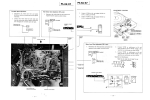
 

Attachments

  • Sony PS-X6 Hall gain and RPM offset.png
    Sony PS-X6 Hall gain and RPM offset.png
    325.2 KB · Views: 8
Register to hide this ad
The turntable must be spinning at 33.333rpm for that adjustment. Drop the circuit board so the pots sit below the plinth and elevate the TT on four full toilet rolls (1 on each corner). Then adjust it.

An analog VTM is preferable or an average reading DMM, not a true RMS. Just use you scope on AC coupled to view the waveform, switch between the Hall sensors and the jig is to smooth and average the signal.
 
Last edited:
Thanks for your reply John. I did the measurements with the turntable on, but if you disconnect the white lead wire as the manual says, the platter won't spin at all. After adjusting the potmeters and reconnecting the white lead it starts spinning again.
 
I presume you've made sure the speed detecting head is positioned perfectly? I use a piece of typical business card to set the distance to the inner magnetic strip.

You can rule out damage to the magnetic stripe by swapping platters and seeing if the problem stays with the platter or the deck.

I can run a few tests on a 7 that's at my father's place in a week or two.

You could have a flaky hall sensor, but in my experience those Sony ones are pretty reliable.
 
I presume you've made sure the speed detecting head is positioned perfectly? I use a piece of typical business card to set the distance to the inner magnetic strip.

You can rule out damage to the magnetic stripe by swapping platters and seeing if the problem stays with the platter or the deck.

I can run a few tests on a 7 that's at my father's place in a week or two.

You could have a flaky hall sensor, but in my experience those Sony ones are pretty reliable.
Yeah, platter is turning beautifully. I just want to adjust the hall gain and motor offset according to factory specs so I can get the best wow2flutter. It currently has 33.35rpm at 0.07 wow2. Factory spec is 0.02. So I think I can get this by these adjustments. Could it be that my power supply isn't the right amperage to supply the voltage needed for the servo circuit to turn the platter? And I can't measure any ac because the platter isn't turning? Would turning it by hand deliver me the ac needed to adjust the potmeters?
 
What are you using to test the W&F and can you show wow and flutter separately?

Better still, can you make either a 3150Hz or 3000Hz .wav file (30 seconds) off your test record and upload it. I can run it on my standalone W&F meter and also my analyzer. Have you looked at the spectrum (FFT) to see what you're dealing with?

In other words, is it a cyclic once per revolution issue, a slow change (wow) or a constant hunting (flutter)?

edit: Just been over to my Dad's place this morning (Sun) and picked up his PS-X6 so I can get some scope shots/voltages on these points of interest on his unit. I restored that TT several years back.
 
What are you using to test the W&F and can you show wow and flutter separately?

Better still, can you make either a 3150Hz or 3000Hz .wav file (30 seconds) off your test record and upload it. I can run it on my standalone W&F meter and also my analyzer. Have you looked at the spectrum (FFT) to see what you're dealing with?

In other words, is it a cyclic once per revolution issue, a slow change (wow) or a constant hunting (flutter)?

edit: Just been over to my Dad's place this morning (Sun) and picked up his PS-X6 so I can get some scope shots/voltages on these points of interest on his unit. I restored that TT several years back.
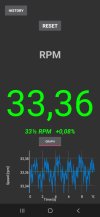
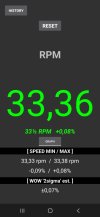
Wow thanks for the effort your putting into it. I'm just a hobbyist. Use my phone on a platter weight to measure wow with rpm speed & wow app. Don't have a 3150hz test record. I can get one to send the recorded signal to you.
 
These are the measurements I get with the app.
 

Attachments

  • Screenshot_20260830_090424.jpg
    Screenshot_20260830_090424.jpg
    34 KB · Views: 5
  • Screenshot_20260830_090415.jpg
    Screenshot_20260830_090415.jpg
    33.1 KB · Views: 5
That is a cyclic speed variation. Have a look at the mini graph and notice the cycle is approx 1.8 seconds, which is 1 revolution at 33.333rpm. That IMO rules out an electronic issue and makes it more likely to be mechanical. Is the platter perfectly flat when viewed from the side when rotating?

Have you lubricated the main bearing BTW? It's a bit of a job, you need to drop the motor out and then pull the spindle/magnet ring straight up and off. Then clean out the bearing, shaft, inspect the thrust washer and re-lubricate with a synthetic oil.

Is there any lateral play if you put you fingers either side of the platter on the outer edges and try to gently rock it? I find those Sony bearings are a bit soft and even this one here of my Dad's has a bit of lateral rock/play. You can help that by using a more viscous oil. If the table was ever transported with the platter installed, that can cause bearing damage/wear.

I won't get to take some in circuit/operational 'scope shots until tomorrow or tuesday (it's Sunday night here), but I'll update the thread. It'sa popular and beautifully built turntable that exhibits a few issues mechanically and sometimes electrical gremlins, but all in all, it's one of Sony's classic best tables in my opinion. Once they got in linear, bio-tracer and digital controls things got too smart for themselves. :)
 
Yeah I did it. So my own regulated power supply couldn't supply enough current to get 1.5v dc in the circuit. Bought a new one and the platter started turning. Then on the points mentioned in the manual I could measure ac and could set it to 1.9v a then I set it to dc and could set the waves to 0v dc. This got me to a wow2sigma of 0.04. Next up is pulling the motor and lubricate it. Then new tone arm wiring and rca cables and ground and it is as good as new. Thanks John for all the advise. I'm happy.
 
Back
Top Bottom