• The move to the new server is done. There are some software and database maintenance updates in process. This has us passing the hat around to help out. We appreciate any donations. Seriously, even a dollar helps. The payment page may be found here - https://www.audiokarma.org/support.html

Sorta Bozak Urbans

Thanks Retovert, I appreciate your explanations, this place is so helpful, thanks go to you , Steve (thanks for the private advise), Biggles, Gadget, twii, Bicyclist, and others.
Also my land based friends, wheels, who has a pair of these, and Pete, my go to for all things caps and resistors.

I am incorporating all of your advice, and if my schedule holds, they will be playing in the living room this Sunday.

Ok, gotta go hop in the long boat and set some crab traps in the bay for the labor day crabfeast.

(much like homemade Bozaks and old pretty fiats, catching your own is all part of fine living on a budget).
 
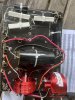
Excellent and we'll done sir. However, grab one of those inductors and get it about 6" from the other inductor if you can. Yeah yeah, I know. It's a pain in the arse. But you've got magnetic, dang it. The term escapes me. But because they're so close, the value of the inductors drifts. You've got them pointed in the right direction. Just a little further. And yes, this does matter.

Biggles
 
Soldering

I don't mean this in any mean or snarky way, but your soldering technique is misguided and the entirety of those connections should be repaired prior to further use.

The key to soldering is a solid mechanical connection with the wires or leads physically wrapped around each other. Tack-soldering is suitable for testing, but the joint is mechanically weak and electrically higher resistance. Vibration can cause those tack-soldered connections to fail.

From a prior posting of mine, here are some excellent guides to soldering:
NASA Workmanship Standards, Through-Hole Soldering
2002
https://workmanship.nasa.gov/lib/insp/2 books/links/sections/files/601.pdf

Soldered Electrical Connections, NASA Technical Standard NASA-STD-8739.3
1997
https://nepp.nasa.gov/docuploads/06AA01BA-FC7E-4094-AE829CE371A7B05D/NASA-STD-8739.3.pdf

Student Workbook for Crimp, Cable and Harnessing, NASA Training Program
December 1998
https://s3vi.ndc.nasa.gov/ssri-kb/static/resources/NASA Student Handbook for Hand Soldering.pdf

Files are too large to post as attachments.

Inductor Placement

Biggles is completely correct that your inductor placement is incorrect, and the coupling will degrade the sound.

I have elsewhere posted the following explanation:

The inductors must be placed far enough apart that the fields do not interact. The rule of thumb suggests minimizing coupling between two air-core inductors in the same plane by ensuring that the inter-inductor distance is no less than 2.5 times the diameter of the larger inductor.

Which admittedly seems a bit much, but Troels (below cited) sets forth about four inches as sufficient for his example, and that seems to be in keeping with the rule given the diameters of those coils. I refer you to the work of Troels Gravesen, the master on the subject of inductor placement:

The most important aspect of crossover construction are:
(a) proper mounting of the inductors (above set forth); and
(b) proper securing of all components using non-conductive ties or mounts to prevent fracturing the solder joints via vibration from the sound.​

One suggestion: the crossover is best placed outside the cabinet for initial testing. Mistakes happen and inserting/removing the screws rapidly becomes time consuming and tedious. Plus the screw holes sometimes loosen and must be filled with epoxy, then drilled, etc.

Bypass Capacitors

I also suggest adding bypass capacitors to improve the high-frequency performance. Boston Acoustics, to cite an example of commercial use, added bypass capacitors in many of its lines because the sound was deemed improved enough to warrant the additional manufacturing expense.

Here is a discussion I posted with followup comments from others about the benefits:

 
Crossovers do not require a break-in period. That is audiophoolery unsupported by physics and electrical engineering, let alone double-blind testing.

If capacitors required break-in, then military equipment, hospital equipment, and mission-critical equipment would require it.

The brain, however, needs time to adjust to new sound as the default sound.
 
No, but wait Retrovert. I can say for certain that the lenses in my glasses need at least 2 to 4 weeks to break in before I can see correctly. Glass is like that, all wavy until it settles in. It's how I feel about it.

Biggles
 
Ha I looked at audio karma battles on this topic and they were epic.

I feel the same way about speaker connectors. Mono price is my go to. 10 bucks fine quality.

anyways pretty happy with the bozaks for the first couple of days. I have played a ton of different genres on them and they handle everything well. Still a well recorded record is a well recorded record and Becks morning phase shined on them among a few others. I probably put about 40 hours into the build. Followed almost all the advice given here. The are properly batted, mids covered, the curtain is proper the cabs are braced, crossovers had the inductors spaced out and the got 4 coats of primer and 3 coats of quality paint. Thanks boys, it ain’t hard with your advice.
 
But you've got magnetic, dang it. The term escapes me.

magnetic coupling.

Very likely not your ears. Bozak was trying to compete with other awful speakers and made its own awful speaker.

I kind of remember this being mentioned, which is why at some point i had planned to change the crossovers but honestly I just lost interest in it. The parts sat in the box for 3 years, which is a pretty good indicator I wasn't going to do anything with or about it. Happy to see they finally got used rather than just being a flat surface to collect junk and dust at my place.
 
Last edited:
So I have been listening to my bozaks for 5 days. Sometimes critically and also casually just doin house stuff. As mentioned your ears really do get adjusted I flipped the a b speaker switch and fired up my kg 4s for the first time in 5 days. I always liked them though I found the horns piercing on occasion. I can’t really listen to them any more with my sx 750. Just too forward for me any more. My bozaks are the right speaker for me. Those mids are on point.
 
So I have been listening to my bozaks for 5 days. Sometimes critically and also casually just doin house stuff. As mentioned your ears really do get adjusted I flipped the a b speaker switch and fired up my kg 4s for the first time in 5 days. I always liked them though I found the horns piercing on occasion. I can’t really listen to them any more with my sx 750. Just too forward for me any more. My bozaks are the right speaker for me. Those mids are on point.

Yup. Heh, piercing, even with compromised hearing. Noted.
 
I don't waste time either , the KG4s are on CL and Bartertown. alway the minimalist. I hate too much stuff. I did the Crites crossovers and diaphrams so they are at least ready to rock for the right person.
 
I don't waste time either , the KG4s are on CL and Bartertown. alway the minimalist. I hate too much stuff. I did the Crites crossovers and diaphrams so they are at least ready to rock for the right person.

Did the same with my equipment after my first Bozaks went in. I did keep my Trusonic 80FR project though. No point in keeping the other pieces, they can't keep up.

Biggles
 
Get a quality mid powered tube amp(I'm using a McIntosh MC240 on mine) on those 302's, and you'll really never look back.
 
I am looking to do just that, I am a little intrigued by the Prima Luna evo series. The self bias mechanism seems to get good reviews and the build quality also from what i have seen so far. The pricing seems fair. but lots to look at, I have an old st-70 but looking for something modern potentially
 
Whatever hardware you choose tobgo with, the Bozaks will give you an unbiased review Pronto.

Biggles
 
Back
Top Bottom