• The move to the new server is done. There are some software and database maintenance updates in process. This has us passing the hat around to help out. We appreciate any donations. Seriously, even a dollar helps. The payment page may be found here - https://www.audiokarma.org/support.html

SOTA Pyxi Initial Impressions

Yes, should have said that is previous post (thanks for that), these are directional in that the cable shield is connected only on the source end, the target end has only the conductor attached to connector shield.
This is correct. Even using shielded cables within the unit, maintain this protocol. ;)
 
This is where I have had different results. One end of the shield only connected I got more hum than both ends connected to GDN . But this might have been a one off case. I need to be more data collection oriented while doing these tests, i.e., keep better notes of what I am doing, something I admit I lack discipline in.

This is why I try to keep my phone by my work. To take photos to document job and time/date done.

You'd be surprised how something you thought you did 2 years ago, was really done 5-7 years ago.
 
Doing research just now on the subject most say the shield end should be connected at the Amp end of the cable ... although you all here state it should be at the TT end of the cable?

Now I am more confused lol ;)

Nashou
 
Doing research just now on the subject most say the shield end should be connected at the Amp end of the cable ... although you all here state it should be at the TT end of the cable?

Now I am more confused lol ;)

Nashou
Most of what I've read and what people a lot smarter than me have advised is to put the "shield grounded" end on the source end of a connection. Simple theory is that any noise passed from source gets "absorbed" in the shield and is not passed to the next component in the chain.

Cables I made this morning are working just fine, been listening to music through the Pyxi all day...
 
Most of what I've read and what people a lot smarter than me have advised is to put the "shield grounded" end on the source end of a connection. Simple theory is that any noise passed from source gets "absorbed" in the shield and is not passed to the next component in the chain.

Cables I made this morning are working just fine, been listening to music through the Pyxi all day...

Thats the thing I always assumed if the shield is connected at the source( TT end) the noise would blend in with the low level signal and be amplified . But As I think about it it be the same if it were only connected on the pre amp end.

So then I found posts where the absolute proper way is to connect one end of shield to tonearm and chassis of TT ( not to any - signal ) and the other end to the chassis of the Preamp and not the Outer RCA so then the noise gets channeled to earth GND and has no way to get into the circuitry. This method of cable construction I have not tried yet . So it may be worth a go.

what say the others who are watching this thread, and sorry it got derailed.

@mprince good to see you may have figured out the Pyxi mystery noise !!! So back to that, how is it sounding now that its problematic strange noise has been mittigated?

Athanasios
 
Connecting both ends of the shielded braid to ground can potentially make a ground loop --- if there is more than a little resistance between one end of the braid and the other.

Understanding Shielded Cable.
Right but some times it doesn't. And thats the conundrum for some.

Here is excerpts from a page I found . Its from the end of the paper. Here they say to terminate the shield at the amplifier end.

TTCabling.html

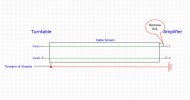
We can restore balance to signal source by using two cores inside the screen - one for the +ve and one for the -ve pole of the cartridge. The screen is connected to the negative core at the amplifier end and any noise it picks up finds it's way to earth rather than back up to the cartridge as that is it's new path of least 'resistance'.
The other useful feature of this arrangment is we can use the screen to replace the earth strap, without introducing any unwanted noise. By connecting the turntable end of the screen to the chassis/tonearm, we can send all of the inteference picked up by the tunrtable body to ground without using the audio signal as a conduit. As win-wins go, this is hard to argue with!


DirectionalRCACable.jpg

2-core screened cabling for Phono Turntable
The diagram above shows how the wiring is constructed. A pair of inexpensive RCA plugs and some 2-core screened instrument cable are all that is required. The negative wire from the cartridge is connected to the screen at the amp end. The screen is connected to the tonearm/chassis at the turntable end. Simple and effective.


This is not the scenario i stated where its connected at both ends, but its not at the TT end which makes sense as they explain it " path of least resistance" especially if you have an MC cart with low impedance coils compared to MM which are in the 100's to 1000's ohms
 
Well, as long as it works. :thumbsup:

Personally, I haven't had issues with grounding one side, only. The input side of the signal.

input_shielded_wiring_(LARGE).jpg
 
Very interesting thread! I've been following this since the beginning, partly because I am also a happy Pyxi owner, but also because I have spent many hours troubleshooting intermittent noise on computer systems.

One of the most difficult problems to first identify, and then to resolve.

A few things to look out for;

- Any wires that can act as an antenna
- Any loose screws on chassis, etc.
- Something that generates vibrations
- Cold solder joints (I've actually seen this. Everything on the board checked out, but I would see noise on the ground pin through the scope, so I reflowed the solder on that pin, and problem solved!)
- Look for things that might be associated with frequency of the occurrence such as refrigerators, generators, sump pump, any kind of large motor, construction or renovations going on beside you, etc.

I once followed a pretty serious noise issue that would cause a critical system to crash before the days of UPSs. It was often around the same time. Turns out it was a company that was starting up various shifts on a manufacturing floor. They were injecting noise onto the grid. The challenge was to identify the issue. Then you could address or mitigate.

Edit: Another issue I ran in to was a LAN for a small organization. Intermittently, the network would go down. There didn't seem to be any identifiable cause. I finally decided to bring in a Time Domain Reflectometer, using it for the first time without any experience or training. I figured it out. Eventually, we found out that they were breaking thin wire ethernet rules with a drop too close to another on the other side of the wall. The network would start having issues whenever we got sunspots of a certain magnitude. Breaking those networking rules(I know, old school) could create intermittent problems with cause being very hard to identify.
 
Last edited:
Correct. Hence my comment "You need pretty good, grounded shielding on the wires to work well. Essentially the input should look like an instrumentation amp with shielding connected to ground at the termination and complete (and thick) coverage provided to avoid leakage."
Perhaps I should have added the word ONLY between connected and to.
I once spent a considerable amount of time trying to read up on this kind of connection, but never found the reasoning for which end of the shield should be connected to chassis ground. And of course, finding lots of contradicting opinions about the only correct directivity. I think the more informed consensus - especially in cabling for measurement use, which alway should be checked for reference - is to have the shields connected to the receiving end. But I still haven't found out why. Nor have I come across what this setup should be named - the best I've found would be "quasi balanced", which I only use within quotes, since it has too much an air of marketing department fluff around it.

Anyhow, I've been using this scheme consistently in my restoring work for several years now. Signal cabling floating from the cart to the output (rca) jacks. Tonearm and tt chassis grounded to one point together with the cable shields and the ground wire to the amp. On turntable cabling I've connected the shields to the tt end, I think mostly because of old habit, and the soldering of the connectors at the amp end becoming neater that way.

This has worked out fine on every kind of deck I've been working on, with two exceptions. The first being the Rega types, whitout any chassis to ground, and at worst with the arm grounded to one of the cable shields. Not much to do there, since I'm not too keen on rewiring tonearms just for the sake of it. The other was those "powerline" computer networks I mentioned before. In both of those cases the noise disappeared with a standard cabling, with the cable shields isolated from the tt chassis. My guess is that the power noise was induced into the signal cabling from the cable shield. If I come across that problem again I should try reversing the connection of the shield. I suppose any results from that test will depend on the grounding of the amp.

I like working with Mogami W2549, but they are difficult to get at in Europe. My goto has instead become the German "Sommer Cable sc-micro-stage". Not as nice to solder and work on as the Mogami and with only a single braided shield. Bu it has a low capacitance, and is a thinner and softer, more flexible cable, which I like considering mechanical vibrations into the turntable. Not perfect, but good enough for most jobs.

Does anybody know of a reasonably thin and flexible low cap quad cable, and how to fit it into a rca plug?
 
Last edited:
Hi! The Pyxi will be available for purchase in the EU. SoTa have added a choice on their purchase page for non-North American purchasers.
This is promising, but the extra fee for the euro power adapter together with the shipping and customs fees become a bit on the high side. I hope the next step will be a distributor inside EU.
 
Just remembered why i do connect the shields ”backwards”. Using rca plugs, that is the only way to separate the shields from the signal wires, which I suppose is good. Unless it creates potential diff between the shield and the signal zero due to lacking power ground?
 
@tothmes do you have a diagram of you cable dressing ?
Is it similar to the one I showed previously?
Not quite:
DirectionalRCACable_tothmes.jpeg
I separate the cable screen from the tt and amp chassis ground, keeping the signal path floating all the way to the amp. This can't be done without the extra ground wire unless you use xlr connectors - it hums like swarm of bees without it.

I think star-quad cabling would be ideal for its damping of surrounding magnetic fields, but as I wrote, I haven't figured out how to combine those thick cables with rca connectors.

And of course this is also asking for trouble with carts with grounded housings, like old Pickerings and such if the headshell is grounded to the arm.

If your cabling to the diy Wyn stage is connected as you show, you do have a ground connection between the audio circuit in the phono stage and the tt chassis. This may not be ideal. On the other hand, my setup doesn't provide any chassis ground between the tt/phono stage and the amp, which could cause the hum I described before unless you add the extra ground wire between the phono stage and the amp. But I have also needed that extra ground wire with tt:s with standard signal cabling with the diy box, both with and without safety ground on the power lines. I really don't understand why.
 
This is promising, but the extra fee for the euro power adapter together with the shipping and customs fees become a bit on the high side. I hope the next step will be a distributor inside EU.
There was a distributor in the UK. They dropped SoTA in favor of Thorens.
 
Most of what I've read and what people a lot smarter than me have advised is to put the "shield grounded" end on the source end of a connection. Simple theory is that any noise passed from source gets "absorbed" in the shield and is not passed to the next component in the chain.

Cables I made this morning are working just fine, been listening to music through the Pyxi all day...
Well, I view these issues as ones of relative electrical potential.
You want the shield at the same potential as the return line in the receiver as otherwise the field difference can induce noise in the receiver input, and you also want the shield at receiver ground potential. In the case of the WP design this means that the phono cartridge (which is "intrinsically" a floating voltage source) -ve line and the shield should be shorted at the phono stage input and connected to the ground there. That allows the input opamp to act, effectively, as a differential receiver. This works pretty well for me.
Here's what Alex Korf has to say on the matter.

Of course, with RF all bets are off as far as "balanced" is concerned. Basically you have to just ensure that nothing gets through the shield to pollute the conductors and that definitely means connecting the shield at the receiver end as well.
AT least, that's how I see it, and how I do it with pretty good success.

 
This is where I have had different results. One end of the shield only connected I got more hum than both ends connected to GDN . But this might have been a one off case. I need to be more data collection oriented while doing these tests, i.e., keep better notes of what I am doing, something I admit I lack discipline in.

Also I have read a few places where many in the "profession" say for phono cable the shield should be GND'd at both ends as a mandatory practice. But I guess its what works in your system.

I will revisit my cables construction at some point in the near future .

Nashou
It depends on the configuration. If the source is intrinsically signal plus ground, then that makes some sense. However, cartridges are not that. There is no ground terminal (at least there should not be) for a phono cartridge. The shield should also be connected to the mechanical system of the TT, provided the mechanical system is not connected to safety ground at the TT end.
 
It depends on the configuration. If the source is intrinsically signal plus ground, then that makes some sense. However, cartridges are not that. There is no ground terminal (at least there should not be) for a phono cartridge. The shield should also be connected to the mechanical system of the TT, provided the mechanical system is not connected to safety ground at the TT end.
Thanks for this Wyn.

So this means Connect the shield only to the Chassis and Tonearm and not to any of the - Signal GND's.And only on the TT end not at the Amp/Pre end. Then run a separate GND from the TT GND( shielded cable end would be connected there as well) to the Pre's Chassis GND .

I assume for GND potentials sake this would be more critical for MC cartridges vs MM as the resistance of the MC has a much much lower resistance than a MM and therefore the GND would rather flow to the MC cart rather than the Amp or Pre which have aa higher GND potential ?

Am I close with that thought?
 
Thanks for this Wyn.

So this means Connect the shield only to the Chassis and Tonearm and not to any of the - Signal GND's.And only on the TT end not at the Amp/Pre end. Then run a separate GND from the TT GND( shielded cable end would be connected there as well) to the Pre's Chassis GND .

I assume for GND potentials sake this would be more critical for MC cartridges vs MM as the resistance of the MC has a much much lower resistance than a MM and therefore the GND would rather flow to the MC cart rather than the Amp or Pre which have aa higher GND potential ?

Am I close with that thought?
No. The shield should be connected at the phono stage input ground end where the cartridge -ve lines are connected.
The shield can also be connected at the TT end if the connection goes to the metal bits and they are not connected to chassis safety ground, or the TT ground lug can be connected to the phono chassis ground lug (also if the TT is not grounded through the mains).
 
Well, I view these issues as ones of relative electrical potential.
You want the shield at the same potential as the return line in the receiver as otherwise the field difference can induce noise in the receiver input, and you also want the shield at receiver ground potential. In the case of the WP design this means that the phono cartridge (which is "intrinsically" a floating voltage source) -ve line and the shield should be shorted at the phono stage input and connected to the ground there. That allows the input opamp to act, effectively, as a differential receiver. This works pretty well for me.
Here's what Alex Korf has to say on the matter.

Of course, with RF all bets are off as far as "balanced" is concerned. Basically you have to just ensure that nothing gets through the shield to pollute the conductors and that definitely means connecting the shield at the receiver end as well.
AT least, that's how I see it, and how I do it with pretty good success.
Ok, so if my cable between the Pyxi and preamp has only one copper shield end connected to RCA ground, which end should it go on? So far I've used a self made cable with shield connected at both ends, and another with the shield connected only on the Pyxi end, could not detect any differences between these. The 3rd party cable I had been using ( a fancy Morrow) has been put back in the cable bin.

Played records all day yesterday through the Pyxi, no noises I could detect (although I'm not actively in troubleshooting mode listening for noise, I'm trying to enjoy the music now). So for now I am happy with things and still mystified as to what changed to make the noise go away.

I am gone for the next week, so hopefully when I come back and turn everything back on nothing changes.

Edit to add: the wiring from my tonearm plugs directly into the Pyxi, it is a continuous loom. I think I may have a white paper from Audiomods somewhere describing the wiring from the cartridge pins to the RCA connectors.
 
Last edited:
Back
Top Bottom