• The move to the new server is done. There are some software and database maintenance updates in process. This has us passing the hat around to help out. We appreciate any donations. Seriously, even a dollar helps. The payment page may be found here - https://www.audiokarma.org/support.html

Spade Adapter Question

dfunghi

L.I. NY
Subscriber
I realize this is probably been asked and answered but I could not find it in search. I find a ton of threads and posts about the Banana adapters.

I have a set of cables I really like but (as expected) the spade end (amp end) has spades much too beefy to fit the 2205 I recently bought. For now I have one "leg" of each spade screwed in tight and I find plenty of music comes through that.

I am wondering if there is a spade adapter that I can screw into the back of the 2205 that will accept the beefy spades from the cables? I do not want to add bananas as I would have to have it done for me as these are fat quad cables and I am sure I would do more harm than good if I began to cut off the ends and tried to re tip.

Do the banana adapters spoken about here at length accept the beefy spade? It looks like they will but pics can be difficult to decipher.

What have others here done to alleviate this issue?

TIA,
David
 
Register to hide this ad
A #6 spade terminal fits most of the vintage McIntosh amplifiers. So, if you're rocking #10, #12, or even 1/4" spades on exotic cables, you can bend the forks at 90deg angles with your pliers and then clamp both down under the set screw plate.

I always just terminate my cables with #6 spades and it's a perfect fit. I keep these on hand for cables up to 8 AWG.

I'm not aware of any spade to spade adapters. All of the spade to banana adapters on the market that I've seen suffer from the same problem - the spade itself has FAR TOO LARGE of an opening to fit properly on the tube amps and first gen SS amps. Sure, you can get it under the screw, but only the outermost edges make contact with it. They look to be designed for a 1/4" bolt. I've even got a pair that won't fit properly within the plastic separators on the strip of my (sold) MC2105. Very poor design.
 
Thanks for info. Looks like I need to make some changes to cable ends. I suppose in 1974 this was not an issue or MAC would have addressed it.
 
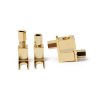
The is a right-angle fork that fits the terminal strip, and has a binding post above it, that will take a spade, banana, or larger gauge unterminated wire.

You can insert a banana in the hex screw, put a spade under the shoulder of the hex screw, or insert bare wire in the side, and tighten the screw down on it.

fork adapter.jpg
Pic came from ebay.
 
I have a set of those same ones. The hex head is 6mm with a 5.8mm width of the threaded shank. Not suitable for any fork i have on hand and I have all sizes.

Garbage IMHO.
 
Adapters and adding banana plugs to existing cables is the solution I landed on.
A #6 spade terminal fits most of the vintage McIntosh amplifiers. So, if you're rocking #10, #12, or even 1/4" spades on exotic cables, you can bend the forks at 90deg angles with your pliers and then clamp both down under the set screw plate.

I always just terminate my cables with #6 spades and it's a perfect fit. I keep these on hand for cables up to 8 AWG.

I'm not aware of any spade to spade adapters. All of the spade to banana adapters on the market that I've seen suffer from the same problem - the spade itself has FAR TOO LARGE of an opening to fit properly on the tube amps and first gen SS amps. Sure, you can get it under the screw, but only the outermost edges make contact with it. They look to be designed for a 1/4" bolt. I've even got a pair that won't fit properly within the plastic separators on the strip of my (sold) MC2105. Very poor design.


Seems a #8 spades is as small as I can go due to cable size according to manufacturer. 12 AWG Bi Wired is an awful lot of wire to stuff in there. Any idea if that will fit the 2205? Sorry for being so dense and ignorant on this.
 
I had a set of those adapters from eBay. They claim to be gold plated copper so I cut one in half with a hacksaw. No copper to be found. Who knows what they are made of.

2x 12awg wires are going to be hard to fit into any of those spades.....
 
I was thinking there must be a better way.

I found this:
http://jeffsplace.me/wordpress/?p=4559

Although I may have trouble building these (just not that handy and lack tools) I will put out a feeler here (and maybe BT) to see if some AK DIYer wants to make these. The difference is I would add heat shrink to provide extra protection from stray metal touching by any chance.

Also I do not have 5 way speaker cable, just one spade.

I really like the big fat spades on my cables and I am sure they contributed to the cost, so I would like to keep the cables "stock".
 
Frankly, having non insulated & unsecured connectors dangling so closely is a bit too rich for my blood. :yikes: Besides, does anybody know for certain if the material underneath the thumbnuts is any better than that of the forks shown above?
headscratch.gif


In any case, the very short distance of the fork is unlikely to affect resistance to any notable degree.


Binding-post-adapters-on-R-channel.jpg
 
I use the pomona 6-32 threaded banana adaptors, Less than ideal but better than the right angle ones posted before. Doesn't help if you want to use a spade though. Short of changing the binding posts (terminal strips of the amp) which most of us are loathe to do because it likely entails cutting chassis, i don't see a great solution. I've given it some thought. I was thinking you could take the larger wire into a butt splice (I was thinking crimp) and come out to a smaller wire that a #6 fork can be used. (also less than ideal). For short runs 16awg should be fine and fit into a #6 fork directly. I also thought about using closed eye. Remove screw and put it through. I don't think it will make any better connection than the fork but it can't pull free.:idea:
 
I have no trouble using 12 ga with the forks. I sure wish they were made of something better than the pot metal nevertheless they sure beat the [affordable] alternatives of which I'm aware.
 
With al the different options and weigh ins I may just keep the one prong of the spade tightly screwed to the post for now. The smaller spades will not accept all that wire of a 12 AWG Bi Wire. The Vandersteens are Bi Wired and jumpers are not recommended by Richard V, so no option to reduce that.

Would it be crazy to cut off one of the prongs so it fit?
 
I seem to remember a special stud used on 1970s GM starter solenoids that were SAE 3/8 coarse thread on one end and stepped down to 10/24 on the other.

Something like that would allow the barrier strip screw to be removed and replaced with a stepped up larger stud size with appropriate nuts and washers.
 
Frankly, having non insulated & unsecured connectors dangling so closely is a bit too rich for my blood. :yikes: Besides, does anybody know for certain if the material underneath the thumbnuts is any better than that of the forks shown above?
headscratch.gif


In any case, the very short distance of the fork is unlikely to affect resistance to any notable degree.


Binding-post-adapters-on-R-channel.jpg
The wire should not go under the screw head as shown. The wire should go under the metal plate below the screw as this plate has the actual wire from the output transformer soldered to it, inside the amp. You may have to loosen the screw and lift the plate up with a small screwdriver, then place the cable below the plate and screw down. Much better connection.

Thanks,
Ron-C
 
The wire should not go under the screw head as shown. The wire should go under the metal plate below the screw as this plate has the actual wire from the output transformer soldered to it, inside the amp. You may have to loosen the screw and lift the plate up with a small screwdriver, then place the cable below the plate and screw down. Much better connection.

Thanks,
Ron-C

Not my setup but good to know all the same. I did not realize the plates under the screws could be lifted in that manner.
 
Back
Top Bottom