• The move to the new server is done. There are some software and database maintenance updates in process. This has us passing the hat around to help out. We appreciate any donations. Seriously, even a dollar helps. The payment page may be found here - https://www.audiokarma.org/support.html

Spade Adapter Question

The cables are bi wired and two strands of 12 AWG will not fit.

There are times at work where we have to double up on similar terminals (not speakers). We generally install back fork with barrel of crimp towards back (side facing chassis/terminal strip) then the front fork has the barrel away from strip where both forks sit flat against one another. You may have to bend them slightly but you get a good tight, neat, secure connection, even on strips that don't have a clamp plate as described in a previous post.
 
There are times at work where we have to double up on similar terminals (not speakers). We generally install back fork with barrel of crimp towards back (side facing chassis/terminal strip) then the front fork has the barrel away from strip where both forks sit flat against one another. You may have to bend them slightly but you get a good tight, neat, secure connection, even on strips that don't have a clamp plate as described in a previous post.

Hmmmm, So you are saying rather than stuff all that wire in ONE spade split the bi wire into TWO spades and attach both to the amp? Sounds brilliant and may just be the solution I need.
 
I had the same problem w/ my ALK crossovers for my Klipschorns. Here is the suggestion from ALK, which I employed successfully; it may work on your amp as well


Many installations make use of very heavy speaker


cables such as “Monster cable”. Finding a spade lug that will

both fit the #6 screws on the barrier blocks and the heavy

wire can be a problem. A simple and inexpensive solution is

to modify spade terminals intended for larger screw sizes. An

example is Gardener Bender terminals (10-116) available at

Lowes building supply stores. These are intended for 12 - 10

AWG wire and #8 - #10 screws. Simply spread the two “fingers” using pliers and bend them back on

a tighter radius. This looks to be difficult but is actually very easy to do.
 
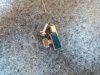
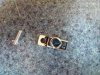
Here's another option. These adapters stick out beyond the barrier strip plastic dividers and allow you to use a bigger spade. I got them from ebay.
 

Attachments

  • 20160331_165524.jpg
    20160331_165524.jpg
    140 KB · Views: 81
  • 20160331_165506.jpg
    20160331_165506.jpg
    122.1 KB · Views: 76
I use this post adapter with is super nice. I have been using it for years on all McIntosh and other amps. Works everywhere.

It's written preludeaudio.com on it and if I recall I got it from Audioclassics, Ryan to confirm. Wasn't cheap but it does the trick nicely.

Sorry for the crappy shot, but you got what I am taking20160405_114354.jpg about.
 
Yea,
I spoke with AC but they do not have these anymore and are trying to find a new manufacturer for them. I think I am going to have each cable terminated in a pair of #6 spades for my bi wire speaker cables and just get a longer screw to tighten down on a pair of spades.

If you ever come across another set please let me know.

TIA,
D
 
I tried to find another one or something similar for biamping my speakers but I did not succeed either.
 
Get a #12-#10 crimp-on for use with 1/4" quick connectors:
http://www.allelectronics.com/make-a-store/item/2325/1/4-quick-connect-male-yellow/1.html
(for example)
Use a drill or Whitney Jr. punch to carefully enlarge the hole to fit your #6 screw, install wire, and affix to terminal strip. (You may have to trim the 'shoulders' just a bit for perfect fit, but you can do it with good scissors, since they're copper.)
(You will have to back the screw all the way out of the hole, which may run afoul of some folks' sensibilities...)
Yer dun.
It will be solid, with no dangling uninsulated bits. You should be able to place it above or below the wire/plate coming from inside. It can be carefully bent at an angle for clean wire flow. A safely stackable solution for bi-wire-ers.

You can also replace one or two of the terminal strip mounting screws (bagging and tagging the screws for posterity) and replace them with standoffs and cable clamps for strain-relief of the larger bundles of speaker cable.

Chip
 
Last edited:
I have a set of MC40 mono blocks connected to a set of Heresy speakers. I use 16 gauge wire with #6 fork crimp connectors on each end. Cables are 15 foot long.
I see no advantage to using heavier cables as the maximum current flowing through the wires is well below the rating of the cables, well below. After playing for several hours the cables are still at ambient temperature indicating to me that there is not a problem as excessive current flowing through to small a gauge of wire will cause heating of the conductors. Look at the last bit of wire going to the terminal strips inside of the amp's themselves.
Also look at what the amp manufacture recommends for speaker wire gauge size. If they could get better performance out of there product by going up one or two sizes in wire gauge than they would insist on it.
We are not trying to play speakers with a 1 or 2 ohm impedance with 1000 watts of power.
What I see as a problem is pictures of massive cables hanging off of brittle plastic terminal barrier strips, a definite no no. Some are even pointing up and looping downwards putting a lot of strain on the barrier strips. I dress my cables as to put zero strain on the terminal strips.
I purchased banana jack adapters for my Mac's but never used them as I didn't like the added strain they would put on the barrier strips. Besides, for a really great connection, it's hard to beat the simple forks under the screw method.
That's my take on it, YMMV

BillWojo
 
Ambient temp of speaker cables is a new one on me. Unheard of & unfathomable in the real world. Concert stacks use 70 volt cables. Even there, it's unfathomable.
 
Lesterbest, you have never ever felt a power cord that was being overloaded? It's why circuits are specified with certain gauge wire to carry X amounts of amps. Try pushing 50 amps through a 12 gauge extension cord, it's going to get real hot very quickly.
And yes, I agree that speaker wires should never get warm. I was making a point. I just don't understand why some folks need super heavy cables to drive speakers. There is not that much power going through them. It doesn't hurt but it doesn't help either.

BillWojo
 
In the real world, AC cables cause fires when they overheat - not speaker cables. As far as speaker cables go, resistance is the main operative. There are charts for load & distance. Thinner cables over distance affect the damping factor along with making the amp work harder.
 
Vampire wire makes a BAR spade that will take 10 to 12awg wire and fit neatly into the barrier strip. They are relatively cheap. If you can't fit those then get new speaker wire.

Those cling-on looking adapters some posts back for jeffsplace on the first page are the most ridiculous things I have ever seen! Holy cow...I suppose when you spend 1700 on a pair of speaker cables then you need to find some ridiculous contraption to attach them to an amp that was designed to be connected with lamp wire.
 
Last edited:
Lesterbest, you have never ever felt a power cord that was being overloaded? It's why circuits are specified with certain gauge wire to carry X amounts of amps. Try pushing 50 amps through a 12 gauge extension cord, it's going to get real hot very quickly.
And yes, I agree that speaker wires should never get warm. I was making a point. I just don't understand why some folks need super heavy cables to drive speakers. There is not that much power going through them. It doesn't hurt but it doesn't help either.

BillWojo
 
Back
Top Bottom