• The move to the new server is done. There are some software and database maintenance updates in process. This has us passing the hat around to help out. We appreciate any donations. Seriously, even a dollar helps. The payment page may be found here - https://www.audiokarma.org/support.html

Speaker cable gauge considerations

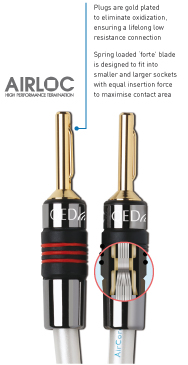
Locking bananas or something like an air lock work well

airlogotop.jpg

Multiple solutions apply .. ...
I'd just ask if there is as much contact area as a bunch of individual strands smashed down onto a contact plate ??
Bare wire into a 5-way binding post works for me ..
 
do the math - you betcha

An interior view of the actual mating surfaces might be more informative than the math ..
And an expanding plug certainly beats the heck out of most normal bananas which are actually only making contact on 3-4 tiny little points ..
Malleability and a seriously tightened connection are the best solution to good contact ..
 
And personally I refuse to use banana plugs for anything but temporary connections ... there's a reason for the complete lack of them in pro audio ..
I'd guess that the lack of banana plugs in pro audio is due to the distinct possibility of short circuits or incorrect polarity and the abundance of idiots in the world of rock'n'roll.
Of course, I could be wrong.
 
I need to run some speaker wire in the garage and in my warehouse, and didn't like what I saw at home depot. Spotted this on the bay and bought 100'.
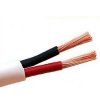
Ebay photo:

cl3.jpg

It's 14/2 oxygen free copper wall speaker wire CL3 rating. It showed up yesterday but I have yet to use any. You have to be careful shopping for it because most of it is CCA, but it all looks the same in the photos.

First application - a Pioneer SX737 driving a pair of EV Dominators in the garage. I just need help getting the 120# buggers on the top of the pallet rack shelving.
 
I use the same thing from lowes, sold as whole house speaker cable. From my cable shoot outs I liked it the best.


IMG_2456.JPG

IMG_2455.JPG
 
No just look at the surface area, that will tell you all you need to know. Most wires squished, like you said, only contact on a very small part of the round wire.

View attachment 1691492


ec5cff72d3d8188d6855cd762dd76ef7--scoliosis--year-olds.jpg


But the aging contact areas suggested by this image
clearly shows the benefit of bananas.
A quick change, bent over for ten seconds.
Means more to Christine and I than the banana's
alleged shortcomings.​
 
Being a Lineman, more bigger's always more better...

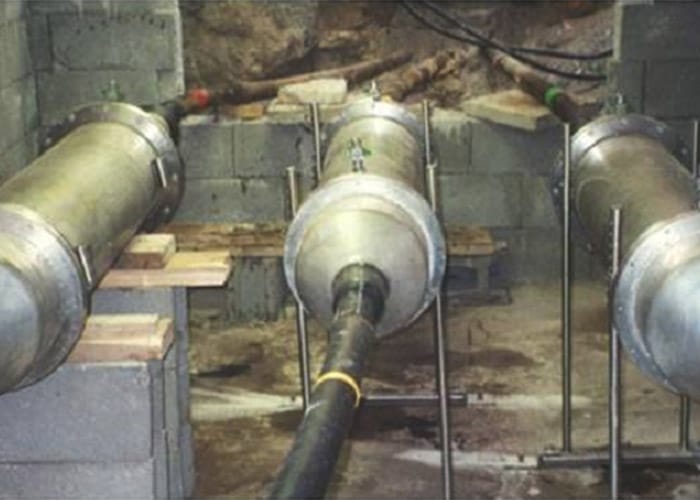
We happened to have some scrap Okanite 138Kv 1000mcm CU Transmission (1st pic below) cable leftover, at work, from splicing a failed underground cable :naughty:
Me thought this would be make an excellent large (Cu) shielded cable to drive my current hungry Infinity Kappa 9 Speakers :banana:
So, I cut 4-8' lengths from the throw-away pieces.

Not sure yet why I found this cable so difficult to work with... @ 9lbs per foot it just seemed a tad too stiff/heavy to maneuver into the shape I needed to connect at the amps :eek:
But, the speaker side was doable :rockon:
I must have been doing something wrong here too... @ just shy of 3" in dia per conductor I found twisting was a bitch :eek2:

Not one to be discouraged... I tracked down some nice braided jacket to dress-up the look.
Thinking I had conquered the obstacles presented... up pops anudda issue unbeknownst to me, couldn't find any spades or bananas to fit the conductor :confused:
Was gonna go Self Contained HPF&G Terminations (2nd pic below), available @ work...
But, that would mean re-configuring my amps (vertical bi-amped) & speaker terminals :thumbsdown:

Ended up throwing them into the scrap bin :(
Went back to my 5-gauge Sigma ME2K cables :thumbsup:

Cable (definitely not to scale).
s-l500.jpg


Self Contained HPF&G Terminations... cinder blocks in background for scale.

gw-electric-tjnt140-transmission-joint.jpg
 
Last edited:
I'm always amused by speaker wire discussions. Other than using twisted pair to eliminate noise via induced currents, all that really matters is adequate cross section to carry the signal without significant loss. What that size needs to be depends on the application, the power used or needed, and how long the run is Auditorium sound systems don't compare to a typical home setup with 6 or 8 ft runs!

The general rule of thumb from manufacturers of audio equipment is minimum 16 awg for less than 50 ft using "typical" output levels and speakers (I'd guess under 200W per channel and 8 ohm), 12 awg if longer or more current.

Undersized wire does indeed make a difference -- I was using the wire my Dad did back in the 60's until just recently, and yes, telephone 4 conductor wire with splices is NOT adequate even in short runs..... 12 awg works much better. Probably mostly because the connections have been untouched for 27 years and were the push-in clamps on the back of my HPM-500s.

Tinning the ends will help a lot with corrosion and resultant high resistance/diode effect too, but so will a little DeOxit paste.
 
Agree HP...
One can have too small a speaker cable. But that's usually getting to 16-gauge and smaller depending on length.
Not sure how the difficulty of hard to drive speakers with low ohm and sensitivity comes into play. Always stayed @ 12 gauge & larger for mine just to be safe.
That's with difficult to drive Kappa 9's.

I do think that terminations can make a difference. Whether it's bare, crimped, soldered, cold welded and others.
Difference in resistance measured. Not sure our ears are good enough to hear the difference in a cable measuring 2-ohms better over a 10' run to include the terminations.
A tighter connection with bear-grease is better than an upgrade in cables.

Been there done that.
From basic to higher-end cables.... Home Depot's 12-gauge cord to many dollar cables.
With my system and ears I couldn't tell the difference between them, so I ended up with some eye candy cables... what looked nice to me.

I don't have a resolving system and it very well could be the reason for not hearing any differences.
I prefer a warmer sound rather than ear-bleeding resolution. I get fatigued easily with that sound.
Might be the reason I can spin vinyl all day but have to stop after a few hours with digital... unless I've had some frosty beverages. Then loudness is the goal.

My previous post was humor driven.
Wasn't makin' fun.
I've gone down the hole...
 
I am an engineer in the wireless industry. I have been in the business since the mid 1980’s. Prior to LTE, wireless transceivers were mounted in radio huts at the base of a tower and connected via coax cable to the antennas. The problem with the advent of LTE was the time delay incurred by routing the signal through 50-400 feet of cable plus some other RF plumbing. These timing delays would limit the data rates. So, the transceivers were moved to the antennas. In most cases, there’s a short jumper, but there are some manufacturers that put the transceiver inside the antenna housing. The advantage is it reduces wind load, cabling, etc. the disadvantage is much more difficult to replace when it fails, expensive, and limited antenna designs. This model is standard in microwave transmissions though. This is an example of a measurable impact of cabling.
My point is, why haven’t manufacturers produced high quality amps at or inside the speaker? I know they make speakers like this, but it isn’t because of speaker wire sonic limitations. For that matter, the price of some boutique wires could justify placing a power amp at the speaker. I suspect it is because the manufacturers don’t see wires as an obstacle to sound production. They don’t recommend oxygen free, giant braided wires, special alloys, keeping wires off the floor, special power cords, directional fuses, burning cables in, etc. Why? It has been brought up here that speakers function by converting voltage to sound. If your speaker components sound different, why can’t it be measured and quantified?
 
I would guess that no fancy cables is a result of the fact that, at the frequencies and loadings required for analog audio data transfer from amplifier to speaker any decent condition copper conductor is essentially transparent to the signal, and normally the cable length is too short for any of the long distance effects to appear so long as the wire is low enough resistance. As noted before, old copper single four conductor telephone wire isn't really adequate, you need more cross-sectional area and more contact area at the connections. Beyond that, should be no effects.

Remember, this is a complex AC signal, not an encoded digital signal over short distances. RF, particularly cm wavlength RF over a 500 ft cable carrying encoded digital data, yeah, I would expect timing errors on a serial signal causing issues, we are talking nano or pico seconds here. Signal timing errors result in the digital signal becoming noise rather than coherent. Not an issue for reproducing a low frequency AC signal 10 ft away.

While I'm aware that it is possible to hear things that don't measure well, if it's not possible to measure a difference in speaker output/frequency response, I'm doubtful that there is a real audible difference. Perception is a very tricky thing, eh?
 
I would guess that no fancy cables is a result of the fact that, at the frequencies and loadings required for analog audio data transfer from amplifier to speaker any decent condition copper conductor is essentially transparent to the signal, and normally the cable length is too short for any of the long distance effects to appear so long as the wire is low enough resistance. As noted before, old copper single four conductor telephone wire isn't really adequate, you need more cross-sectional area and more contact area at the connections. Beyond that, should be no effects.

Remember, this is a complex AC signal, not an encoded digital signal over short distances. RF, particularly cm wavlength RF over a 500 ft cable carrying encoded digital data, yeah, I would expect timing errors on a serial signal causing issues, we are talking nano or pico seconds here. Signal timing errors result in the digital signal becoming noise rather than coherent. Not an issue for reproducing a low frequency AC signal 10 ft away.

While I'm aware that it is possible to hear things that don't measure well, if it's not possible to measure a difference in speaker output/frequency response, I'm doubtful that there is a real audible difference. Perception is a very tricky thing, eh?
 
My analogy refers to latency and not errors. Point being, it is a measurable delay and was addressed. Regarding speaker wires, they are just a link between two substandard collections of materials such as brass, steel, regular old copper, various solder alloys, imperfect amplifiers, crossovers, etc. my opinion is If there is need to fix the inherent faultiness of speaker wires, it would have been addressed long ago by the engineers that design the equipment.
 
Another consideration is the environment that the cable is in. For speaker wire 24 Gauge may prove to not be robust enough for use in a typical household situation. @N8Nagel is right to suggest a more robust cable, which has no real downside.

Full Disclosure, I am an adherent of the Montgomery Scott School of (Over) Engineering.

Mark Gosdin
Montgomery Scott also once said that "a difference that makes no difference is no difference."
 
I am an engineer in the wireless industry. I have been in the business since the mid 1980’s. Prior to LTE, wireless transceivers were mounted in radio huts at the base of a tower and connected via coax cable to the antennas. The problem with the advent of LTE was the time delay incurred by routing the signal through 50-400 feet of cable plus some other RF plumbing. These timing delays would limit the data rates. So, the transceivers were moved to the antennas. In most cases, there’s a short jumper, but there are some manufacturers that put the transceiver inside the antenna housing. The advantage is it reduces wind load, cabling, etc. the disadvantage is much more difficult to replace when it fails, expensive, and limited antenna designs. This model is standard in microwave transmissions though. This is an example of a measurable impact of cabling.
My point is, why haven’t manufacturers produced high quality amps at or inside the speaker? I know they make speakers like this, but it isn’t because of speaker wire sonic limitations. For that matter, the price of some boutique wires could justify placing a power amp at the speaker. I suspect it is because the manufacturers don’t see wires as an obstacle to sound production. They don’t recommend oxygen free, giant braided wires, special alloys, keeping wires off the floor, special power cords, directional fuses, burning cables in, etc. Why? It has been brought up here that speakers function by converting voltage to sound. If your speaker components sound different, why can’t it be measured and quantified?

That's a thousand dollar question ..
But given that the ear is the measuring device, I think that maybe you've left the realm of the easily quantifiable ..
 
How else could they convince someone that a strip of wire can make a big difference? They can never be in the realm of the quantifiable-LOL. Reminds me of an old Richard Pryor bit where his wife catches him in bed with another woman and he tells her “ now who you gonna believe, me, or your lying eyes?”
 
How else could they convince someone that a strip of wire can make a big difference? They can never be in the realm of the quantifiable-LOL. Reminds me of an old Richard Pryor bit where his wife catches him in bed with another woman and he tells her “ now who you gonna believe, me, or your lying eyes?”

To each his own ..
My music is heard, and appreciated, not quantified ..
And I can can clearly discriminate changes in the strip of wire .. try some 36ga speaker wire and listen to it
 
Back
Top Bottom