• The move to the new server is done. There are some software and database maintenance updates in process. This has us passing the hat around to help out. We appreciate any donations. Seriously, even a dollar helps. The payment page may be found here - https://www.audiokarma.org/support.html

Speaker Crossover Analysis

PTkacik

Member
Is there a way to determine if a crossover is bad? That is, if the caps need replacing or something else?

Is there a phone app I can use to read output or something? I don’t even know how this would be input or read but I remember in grad school that microphones can be self calibrating (although I don’t recall how).

I just re-foamed two Allison 2’s that I bought new in 1975 and they sound wonderful. All twelve speakers are working. However, there is a point where the sound gets garbled and it might be the crossover. It might also be the music (Led Zeppelin 4 very loud).

I am not an electrical engineer or electrical technician but I am pretty handy if the instructions are clear enough. The speakers are hung upside down from the ceiling in a room 15’ x 22’ x 10’ high, (I think okay by Allison). I also just recapped (plus new transistors and rectifiers) an SAE Mark 4 power amp (100 wpc that I also bought new in 1975).

Sounds very nice but I’d like to know if I’m missing something.

Thank
Peter
 
Register to hide this ad
Are you driving the Allisons with the SAE? If the amp is working properly, it should not distort unless you have it cranked to its limits, and the distortion is how you know you've reached the limits and you should turn it down. Led Zep cranked would be on a list of things that can make that system reach its limits. :)

However, I don't know how old those Allisons are but it's very possible they have caps that are off spec. Particularly nonpolar electrolytic ones.

You'd need a capacitance meter or a multimeter with capacitance setting to measure them. But reading the uf is not the only test: old caps often have high ESR (equivalent series resistance).

For this reason some people just replace old caps as a matter of course.

You might want to find a schematic for the crossover so you know what you're going to need.
 
Here you go.
http://www.classicspeakerpages.net/...ies_schemati/allison_models_one_and_two_.html

Looks like maybe a 40 uf electrolytic in the woofer circuit, that should be replaced. In the mid circuit is a single 6.2 uf, that's going to be a film cap but still not expensive.
The tweeters too have a single 3 uf cap.

I'd get some metallized polyprop 5% Daytons at Parts Express, or if you wanted to take a step up, you can go to film and foil and 1% tolerance.

Also check the resistors while you're in there and make sure they're within 10%.
 
More likely a garbled recording, or you are causing the voice coils to knock on the back of the air gap (or hyper extend). Anything from the Phil Spector school of recording will overtax speakers, there is far too much distortion and noise in there. Unless you have an amp with exceptional damping factor and short wires, the woofers will go out of control and flap, my friend did that with the cheapo woofer in the HPM-500s I gave him for a wedding present. The correct woofer was OK, but when he turned the loudness on and the bass way up, the cheapo started knocking and fluttering. Most speakers run some of the midrange on the woofer, so if it's flopping around the midrange will go mushy I think.

I am of the firm belief that there is actually something called "too loud" if the issue goes away when you turn the volume down, leave it down. Will save your ears, too.
 
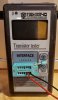
I use this gizmo a lot. I think it was about $25 on eBay, several years ago. It's marked "transistor tester" but tests most anything electronic.

20210511_213222.jpg

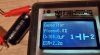
With caps, it shows Vloss and ESR in addition to capacitance. Lower is better on the first two.

20210511_214436.jpg

It does inductance up to large values. A great tool for crossover parts.

20210511_215624.jpg

You can use it to match transistors pretty closely if you need that. I imagine a curve tracer is better, but that's beyond my expertise.
 
Those little "computerized" testers are fine for comparisons and matching transistors, but they aren't very accurate in most cases. They use low voltages and a single test frequency (maybe two) and do NOT test capacitors at actual loads and voltages, nor things like power transistors.

Within those limitations they are fantastic though -- they work very well for small signal transistors and lower voltage power transistors and very nicely for lower value capacitors working near the tester's voltages (typically 5V and 21V).

I wouldn't bet the farm on the measurements they make, but for relative measurements they are very, very useful. The ones I have convinced me that 40 year old capacitors are almost always either failed or failing, even the large ones. After all, high leakage is high leakage compared to new, doesn't matter if it's 3% or 4% when the spec is 0.2%, eh?
 
Great information.

What is the coil looking thing on the schematic? It says “479 turns 6.84 mH 1.7 ohms DCR” and another says “165 Turns 0.537 mH 0.4 ohms DCR”.

Since my speakers are pre-1980 I went to that schematic.

Thanks,

Peter
 
Those are inductors, which are low-pass devices (they let frequencies thru that are lower than a cutoff based on their value), as opposed to capacitors, which are high-pass. That's why you will almost always see an inductor in series with the woofer. They rarely need replacement. If heavily overdriven they can melt and fuse turns together but it's rare. Sometimes cheaper designs (small gauge wire or ferrite core inductors) are changed out for fancier ones, but it's not at the top of the list for improving speaker sound.

Here are a couple basic info pages about how crossovers work.

https://www.diyaudioandvideo.com/Guide/WireSpeakerCrossover/

http://www.colomar.com/Shavano/crossover12db.html
 
There are phone apps and inexpensive mics to get pretty fair frequency response plots that will show big peaks and suck outs. Will also include all the room effect.

There are LCR meters under $40 to measure capacitance, inductance and resistance of the XO components.
 
Regarding music, I purchased Heart, “Dreamboat Annie” from the 1970’s as I remembered playing it when I chose the Allison speakers. I haven’t heard it since then but it sounds great. Maybe a combination of isolated sounds (in the song, Dreamboat Annie) not interacting with each other but it sounds very good.

Otherwise, the speakers now seem to have too much mid and high frequency response. I’ve got the treble turned down and base turned up. that seems like an odd thing to occur from a crossover problem, (or maybe not).

Thanks,
Peter
 
Ha! Clipping. My old man ears wanted to stress the system but even with 100WPC amp, it was a bit too much for me. Lower down, it sounds much better. Ha! My wife returned from visiting my son so it won’t be getting that loud. Sounds pretty good (except for the bass up and treble down part).

Peter
 
Couple notes here -- if you have to turn the treble way down and the bass way up, I'd suggest it might be time for a good hearing test -- this is a hint you are losing some sensitivity at low frequencies, and possibly some high ones. Hearing damage works opposite of exposure, lots of low frequency sound above damage levels tends to reduce hearing response at high frequencies, and vise versa. I've lost quite a bit of the high end (that is, I have "normal" hearing now instead of the extended range I used to have). Still have pretty good low frequency hearing -- down to 15 Hz or so, maybe 10 with the right amp and speakers. If you "can't hear the bass" it may be because, indeed, without hearing aids you really cannot hear it!

The other is that high noise level recordings (i.e. most Rock) will drive an amp into clipping MUCH faster than you expect due to the very high levels on the recordings. A lot of Rock is badly recorded and mastered, usually at excessively high levels for the medium, and goes "muddy" pretty fast when input levels exceed the maximum rating for the amp input.

I like big amps as well as anyone else, but rarely use more than a watt or two on the output side -- big amps give clean transients for things like piano, I could care less about breaking the windows.
 
I've noticed that harsh or overly loud mids and highs are tamed by recapping. Old caps absorb some of the power due to increased ESR (which varies by frequency so it messes with the response curve), and changing capacitance values also lead to sound coming out of the wrong drivers, which again messes up the factory designed response curve.

Also, not to insult OP's intelligence, but check the connections and make sure the speakers are in phase. If they're connected opposite of each other it will tend to cancel out bass the most. It may be just the location of the speakers that's doing it though.
 
Last edited:
Regarding speaker phase, I just put new speaker wires on and since they have red and black conductors, as do the speakers, speaker control box, and the amp. I assume that is okay.

Regarding connections, the wire is 12 gage 100% oxygen free copper. All ends have been tinned and the amp connection goes into gold plated banana plugs.

About that old Radio Shack 40-244 speaker control box, I'm not sure if it has something to do with this. I guess I could remove it for a test to see if it (and its snap lock connectors) is an issue.
 
How do you get at a crossover to replace the caps? The Allison 2 is triangular in cross section and probably only 8" deep inside with the crossover on a wood board at the top and the two 8" woofers, 24" below. The mid range and tweeters are pretty small so I assume the holes would be small as well.

Surely, somebody has done something like this before
Peter
 
Typically the woofers come out to get to the crossover. I'd bypass the speaker control box (I assume it's a selector switch for a and b sets, right?) and see if dirty contacts or connectors are the issue.

If someone has been in the speakers, it's often possible to wire the woofers incorrectly. Most speakers have different sized slip-on connectors for the plus and minus sides, but this is not universal and having the woofers wired opposite in two different speakers will definitely greatly reduce bass sounds. If you haven't been in there, probably not, but if they are new to you, hard to say someone hasn't screwed around inside.
 
I just re-foamed the speakers and was pretty careful about the four woofer phase connections.

As for the speaker control box, it is easily a question mark. It is at least 20 years old (if not twice that) and was inexpensive when I bought it.
 
If these have a separate crossover board in the TOP of the cabinet, that's going to be a pain to work on. Is it screwed in or glued? If you can detach it and pull it down to where you can work on it that would be best.

Sometimes you wonder what they were thinking.
 
Back
Top Bottom