• The move to the new server is done. There are some software and database maintenance updates in process. This has us passing the hat around to help out. We appreciate any donations. Seriously, even a dollar helps. The payment page may be found here - https://www.audiokarma.org/support.html

Speaker repair advice and help - I've never done this before!

Patrologia

Active Member
I bought a nice pair of 60s Telefunken SB86 speakers a while back, and after listening to them for a little while, realized that one of them was playing wrong. The other sounded so good when I gave them a quick listen, that I hadn't noticed. (Always listen to speakers one at a time as well as together!)

Anyway, I finally got around to opening up the bad speaker to see what was going on and discovered what the previous owner had done. I am pretty green, so here are some pics and I'll beg the more experienced to walk me through what needs to be done.

First, an overview of part of the arrangement. Notice the two wires that have been cut. They ran to the mids (2 identical 5x7) arrangement. Those two are completely disconnected now, only the woofer remains connected.
004.jpg


Here are the problems that I spotted. Two capacitors look bad to me. I assume they are a problem and need to be replaced.
005.jpg


There are two wires on which I see slight burn marks, and the insulation pulling away. Bad, right? What am I dealing with there?
006.jpg
013.jpg


Last question, one of the 5x7s, the first one the signal goes to, has this extra winding on the side. What is that? I don't assume that I will have to do anything with it at all, I'll just eventually reconnect the wires coming from the crossover area, but I am curious what they are.
012.jpg


Here are several other pics that I took largely to have references of what was in there. No real questions about them, but feel free to take a look and comment if anything grabs your attention. Clickable thumnails.
 
Register to hide this ad
i have never heard telefunken speakers. how do they compare to others in your oppinion? after you replace the caps and get those mids connected they should sound alot better :D
 
Your diagnosis looks good to me. If you're not sure how to wire them up you can always open the good speaker and copy what you see there.

Those old alnico magnet drivers can sound pretty sweet.
 
I can't answer all your questions, but I would replace all the caps on both speakers, test the drivers, and wire the modified speaker to match the other one. I suspect there was a reason someone cut out the midranges. Either they are damaged or the crossover had a problem. It would be nice if it was just the caps.

I suspect the "brown" wires were just singed by a soldering iron, but if they really look damaged it wouldn't hurt to replace them or cut off the dubious parts (just shorten them if possible).

Not sure about those little coils.
 
Last edited:
i have never heard telefunken speakers. how do they compare to others in your oppinion? after you replace the caps and get those mids connected they should sound alot better :D

The good one sounds great to my ears - but mine aren't the most experienced. As frperdurabo says, they can sound very sweet.

Your diagnosis looks good to me. If you're not sure how to wire them up you can always open the good speaker and copy what you see there.

Those old alnico magnet drivers can sound pretty sweet.

I can't answer all your questions, but I would replace all the caps on both speakers, test the drivers, and wire the modified speaker to match the other one. I suspect there was a reason someone cut out the midranges. Either they are damaged or the crossover had a problem. It would be nice if it was just the caps.

I suspect the "brown" wires were just singed by a soldering iron, but if they really look damaged it wouldn't hurt to replace them or cut off the dubious parts (just shorten them if possible).

Not sure about those little coils.

I don't understand how crossovers work well enough to judge, but I'm hoping that the bad caps were making the mids sound bad and that's why he cut them out. The copper of the wires still looks fine, so I'll probably just hope for the best with them. Not sure there's enough to shorten them, and I am nervous about digging in to the works too much.

Now I need to do some research and find a source for those caps.

Thanks for the advice so far.
 
Good luck!

Yes, bad caps could have been the problem, and even if they weren't it's good to replace old ones like that. Parts Express is a good source for caps. You can buy nonpolarized electrolytic capacitors like the originals for peanuts, or film capacitors (Daytons, Solens, Janztens, etc.) for something that will last longer and may sound better, but are larger and cost a lot more.

Either way, try to get something that has the same capacitance (shown in microfarads, like 2.7 uF), and at least the same voltage capacity (like 50V) as the original. A higher voltage capacity is fine and in fact better for power handling.

If you can't find the exact same capacitance, plus or minus 10% should be OK. On the Parts Express site search window, type in something like "2.7uF" and see what pops up. If nothing pops up, try 2.6, 2.8 etc., until you find a value. Caps don't cover every possible value and sometimes you need to fudge slightly. You can wire caps in parallel and sum their capacitance to equal the original value.

Those wires are probably fine. The wiring tends to be the last thing to fail from too much power or distortion.
 
Last edited:
What Z said is good info. The wire insulation can get burnt from the heat from a soldering iron so no problem.

I would start by hooking everything back up as factory (look inside the other one) to determine what does and does not work. That way if you do have a blown driver you do not invest more money then it is worth.

BTW the cap with the broken wraper may not be bad, but, the other one looks like it is leaking so that may hamper it's ability to do it's job.

:thmbsp:
 
Last edited:
I haven't gotten too far into this, but two things strike me as I'm looking for the 7uF cap on several sites. One is that they don't look anything like what I'm looking at (connections are very different), and also, they seem to be more expensive than a lot of others. (1) how much should I be expecting to pay for these caps, (2) what "form factors" for lack of a better term are OK, and (3) I know I am OK to go high on voltage, but why is most of what I'm finding in the 1kV range rather than the 15 V range?
 
There are a lot of different types of caps.

how much should I be expecting to pay for these caps

For 7 uF, an electrolytic is around $0.50. Films start at $3 or so and go up to hundreds.

they don't look anything like what I'm looking at (connections are very different)... what "form factors" for lack of a better term are OK

The electrolytics that you want, and films as a more expensive alternative, are cylindrical, with leads coming out of the axis on both ends ("axial"). Films will be bigger with a shiny or matt plastic or other finish, often black or white; sometimes yellow, red, silver or other colors. Electrolytics have a colorful shiny metallic, plastic-coated skin.

Elecrolytic:

027-336_s.jpg


Film:

027-402_s.jpg


I know I am OK to go high on voltage, but why is most of what I'm finding in the 1kV range rather than the 15 V range?

Not sure what those might be, but if the ones I'm suggesting are going to be 100+ volts. Here is a 6.8uf in electrolytic (top) or film:

http://www.parts-express.com/pe/showdetl.cfm?Partnumber=027-336

http://www.parts-express.com/pe/showdetl.cfm?Partnumber=027-424

6.8 is close enough, but you can add a 0.22 uF if you're worried; just wire it in parallel, for 7.02 uF:

http://www.parts-express.com/pe/showdetl.cfm?Partnumber=027-402

Another trick is to use cheap electrolytics for the bigger caps, and wire films in parallel for better sound, so you could use the cheap 6.8 and the more expensive 0.22 together.
 
Last edited:
That little coil which seems to be in parallel with the driver is probably an inductor, part of the crossover.

A 1st order crossover uses a capacitor, in series, to block low frequencies from getting to the high frequency drivers. The capacitor doesn't block all of the LF and that's where the inductor comes into play. The inductor sends most of the remaining LF to ground. The series capacitor followed by the parallel inductor makes a 2nd order high-pass filter.
 
There are a lot of different types of caps.


For 7 uF, an electrolytic is around $0.50. Films start at $3 or so and go up to hundreds.


The electrolytics that you want, and films as a more expensive alternative, are cylindrical, with leads coming out of the axis on both ends ("axial"). Films will be bigger with a shiny or matt plastic or other finish, often black or white; sometimes yellow, red, silver or other colors. Electrolytics have a colorful shiny metallic, plastic-coated skin.

Elecrolytic:

027-336_s.jpg


Film:

027-402_s.jpg


Not sure what those might be, but if the ones I'm suggesting are going to be 100+ volts. Here is a 6.8uf in electrolytic (top) or film:

http://www.parts-express.com/pe/showdetl.cfm?Partnumber=027-336

http://www.parts-express.com/pe/showdetl.cfm?Partnumber=027-424

6.8 is close enough, but you can add a 0.22 uF if you're worried; just wire it in parallel, for 7.02 uF:

http://www.parts-express.com/pe/showdetl.cfm?Partnumber=027-402

Another trick is to use cheap electrolytics for the bigger caps, and wire films in parallel for better sound, so you could use the cheap 6.8 and the more expensive 0.22 together.

Thanks for the help so far. So if the 6.8 is close enough, that certainly makes things cheaper. 7 was harder to find, and got more expensive pretty fast. Does the +/- 15% mean that it could have been more like 6 than 7 anyway (is that why 6.8 is good enough)? I'm a little nervous deviating from the original value, but am very willing to be shown that there is no need for concern. Also, why would the .22 films have significant impact on the sound quality. Actually, unless there is a really simple answer, scratch that question. (If the answer's simple I'm all ears.)

In looking back over my pictures, the one that is above (on the screen) the 7uF cap looks like it has + + + around one end, and - - - around the other. Am I right to assume this one is polarized, and so I should be shopping for the same thing there?

That little coil which seems to be in parallel with the driver is probably an inductor, part of the crossover.

A 1st order crossover uses a capacitor, in series, to block low frequencies from getting to the high frequency drivers. The capacitor doesn't block all of the LF and that's where the inductor comes into play. The inductor sends most of the remaining LF to ground. The series capacitor followed by the parallel inductor makes a 2nd order high-pass filter.

Interesting, a last line of defense for signal the drivers wouldn't be able to handle.
 
Does the +/- 15% mean that it could have been more like 6 than 7 anyway (is that why 6.8 is good enough)? I'm a little nervous deviating from the original value, but am very willing to be shown that there is no need for concern.

Since the originals were 7s plus or minus 15%, getting a 6.8 plus or minus 5% is well within the original margin. You can spend more and get ones with tighter tolerances, but I doubt you'll hear any difference. (Plus, I think the 1% Daytons are just the same ones, tested and culled from the 5% pool.) Being anal, I would get add on 0.22s just to feel better.

Also, why would the .22 films have significant impact on the sound quality. Actually, unless there is a really simple answer, scratch that question. (If the answer's simple I'm all ears.)

That issue exceeds my brain capacity. You can spend hours reading debates on the subject of "bypass" caps, which is a related concept (running very tiny caps parallel to big ones), and it's interesting to see that different people offer difference explanations or justifications for so doing. I spent a fortune on my 250Ti caps and their bypass caps because they're very high-end speakers, but for cheaper speakers I doubt it's even arguably worth it.

But you should know that starting in the 1980s JBL began using bypass caps on their crossovers, so a 2.7 cap might have a .01 next to it. My 250Tis even have bypass caps on their bypass caps (.001s on the .01s)! Their designer, Greg Timbers, has stated that he thought they made a sonic improvement, so maybe they do. He's the Man, so I defer to his expertise.

In looking back over my pictures, the one that is above (on the screen) the 7uF cap looks like it has + + + around one end, and - - - around the other. Am I right to assume this one is polarized, and so I should be shopping for the same thing there?

Good catch. I don't know enough about crossover design to answer that question. Most crossover caps are nonpolarized, so I bet you can use them here, but I do not know for sure.

Hey, if you get a chance, post up pictures of the overall speakers. I Googled them and I really think they look cool!
 
Last edited:
Telefunken sb86

Pat I'm not sure the red caps are bad the lines on them just look like the glue that was used to hold them to the board at some time. Replacing them is probably a good thing I just don't think they are split. The caps with + & - are not polarized look for the indentation in the cylinder if there is one one both ends they can be used ether way
Telefunken sb86
 

Attachments

  • hifi_klangbox_sb86_753973.jpg
    hifi_klangbox_sb86_753973.jpg
    14.8 KB · Views: 16
Since the originals were 7s plus or minus 15%, getting a 6.8 plus or minus 5% is well within the original margin. You can spend more and get ones with tighter tolerances, but I doubt you'll hear any difference. (Plus, I think the 1% Daytons are just the same ones, tested and culled from the 5% pool.) Being anal, I would get add on 0.22s just to feel better.

Excellent, thanks. I suspected as much, but wasn't sure. After briefly checking the prices (and seeing a video showing how simple the bypass actually is) I'll definitely be doing the bypass. Something very German in me wouldn't let me sleep if I could get that close to 7 that easily and cheaply. Especially since it is rumored to give better sound. Not that I'll be allowed to turn it up loud enough to hear the difference all that often. My 5yo son ran out of the room during some organ music yesterday, and that was just on the Advent/3s!

Good catch. I don't know enough about crossover design to answer that question. Most crossover caps are nonpolarized, so I bet you can use them here, but I do not know for sure.

Pat I'm not sure the red caps are bad the lines on them just look like the glue that was used to hold them to the board at some time. Replacing them is probably a good thing I just don't think they are split. The caps with + & - are not polarized look for the indentation in the cylinder if there is one one both ends they can be used ether way
Telefunken sb86

Looking at the caps in real life, I'm pretty sure that the wrapper at least has split, it isn't just glue. I don't see any evidence that they were glued down like I've seen in other speakers anyway. That big 50uF cap above the rest of the assembly in the first pic is strapped down with a metal strap, and appears to be the only one that was secured. The others are all suspended around 3-4 inches off the board (which is the front wall of the speaker). There is a metal plate that screws to the side wall that protects them from the unbelievable quantity of fiberglass insulation stuffed into the speakers.

I don't know much about either speaker design or electronics, but I'm starting to get the impression that you can pretty much always use a non polarized cap in place of a polarized cap, but the reverse isn't true. I need to open up the good speaker to compare, but I will also investigate indentations to see if I can just use the non-polarized. Especially with borus saying that he doesn't think they are polarized, I'd be a little afraid to put in a polarized cap and NEED bi-polar.

Hey, if you get a chance, post up pictures of the overall speakers. I Googled them and I really think they look cool!

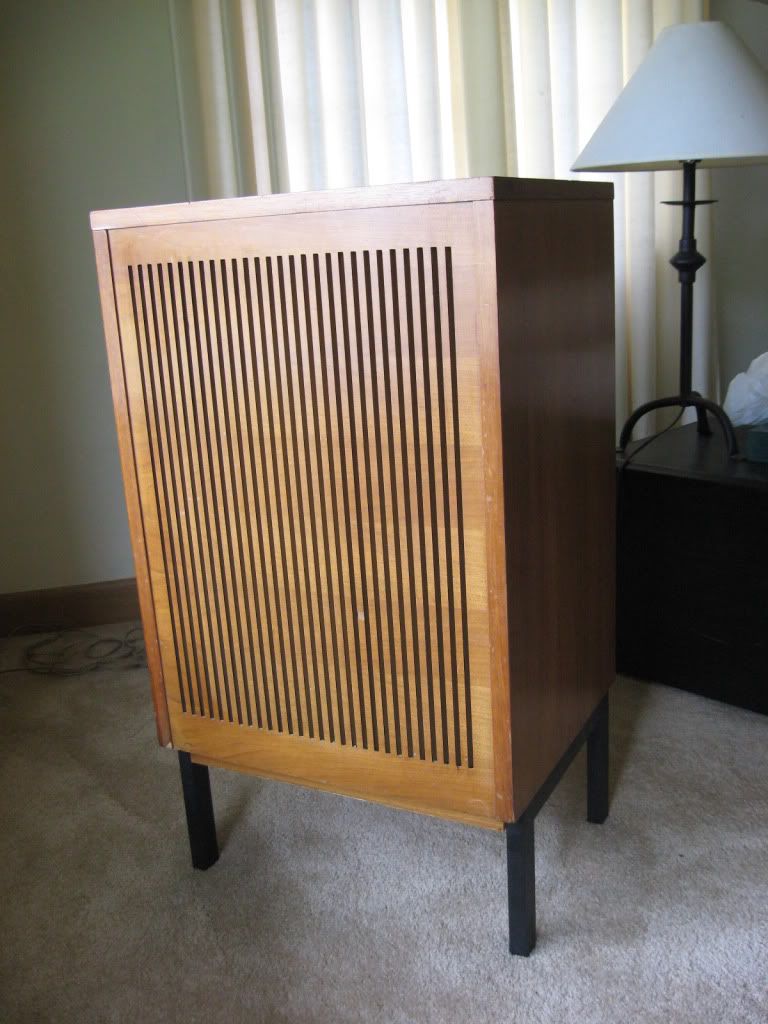
They are pretty cool looking. I have a pic of one of them:
TelefunkenSB86.jpg


TelefunkenSB86-1.jpg


I want to get a pic of them where they are sitting right now. Until I get a chance to recap, they are serving as stands for the Advent/3 speakers that are doing their work in the Living room! Just have to wait for a convenient morning for a pic.
 
You are correct about subbing polarized and nonpolarized.

Hardly anyone uses polarized electrolytics nowadays. For larger values the film caps get expensive so nonpolar electrolytics are the way to go. This is usually in the bass circuit where it doesn't make that much difference in sound quality. The place where fresh caps really shine is in the mids and tweets anyway. With NPEs (nonpolar electrolytics) you don't have to worry about + and - ends, since they have none.

You might also look at Madisound for cheap audio caps.

Great looking cabinets! Awesome, even.
 
Last edited:
This project is coming slowly - finishing a dissertation is taking priority for some reason! Anyway, just to check what I was in for I hooked up the receiver directly to the cut wires running to the 5x7s last night, and I only get sound from one of them. It looks to me as though they are wired in parallel, such that there is no reason for the second driver not to play unless one of the wires running to it is broken somewhere, or the driver itself is bad. I need to take it out and check it (which I haven't done yet), but does anyone see anything else I should check?

The second question has to do with sealing this thing back up when I'm done. There appears to have been a gasket of some sort sealing the back panel. To get a proper seal, I suppose I'll need to replace this. Any suggestions of what to use or where to find it? I would compare to my other, good, un-messed-with speaker, except that brings me to question 3:

How in blue blazes am I supposed to get this back panel off? The other one is pretty hard to remove, and it has been taken off before and the sealing gasket is gone. The good one is bloody near impossible. There is precious little clearance between the back and the sides, so I can't get anything in and get an angle to pry. There is a bracing 2x2 in the center of the unit that terminates in a peg that can be pressed into a socket on the inside of the back panel. Once in, it is hard to pull out. To finish things off, that sealing gasket seems to have some adhesive qualities. (It might not have in Germany in the 60s, but over the course of 50 years, things have changed, and it seems to now.) The only idea I have is to use a wood screw (a size or two larger than the screws that hold the panel onto the box), screw that into the panel, and use it as something to pull on. I'm worried about this because it is particle board. The hole the cable goes in through seems designed not to allow me to remove that plug, so that isn't offering me much either. Any thoughts that allow me to avoid destruction?
 
6.8 is close enough, but you can add a 0.22 uF if you're worried; just wire it in parallel, for 7.02 uF:

http://www.parts-express.com/pe/showdetl.cfm?Partnumber=027-402

Another trick is to use cheap electrolytics for the bigger caps, and wire films in parallel for better sound, so you could use the cheap 6.8 and the more expensive 0.22 together.

Planning to go with this plan (this has been on the back burner for a bit, but I'm now coming back to it). Are the Daytons in the linked recommendation bi-polar? I can't find a statement that they are, but maybe it is just understood by those in the know.
 
Planning to go with this plan (this has been on the back burner for a bit, but I'm now coming back to it). Are the Daytons in the linked recommendation bi-polar? I can't find a statement that they are, but maybe it is just understood by those in the know.

yes, non-polar poly.
 
Not to split hairs, but nonpolar is not exactly the same as bipolar electrolytic. The Dayton film and foil or metallized film caps are not electrolytic in any way shape or form. Nonpolar electrolytics (NPEs) are a type of electrolytic cap that has + and - ends, but they are arranged back to back inside the cap in such a way that the resulting complete package is non-polar. These are a lot smaller and cheaper than film and foil or metallized film caps, and it's commonly believed they don't sound quite as good, so use the film caps whenever you can afford them and fit them in, esp. in mid and tweeter circuits.
 
Back
Top Bottom