• The move to the new server is done. There are some software and database maintenance updates in process. This has us passing the hat around to help out. We appreciate any donations. Seriously, even a dollar helps. The payment page may be found here - https://www.audiokarma.org/support.html

Speaker sensitivity

S.A.

New Member
Hi all,

New member welcomes you all. I'm in the process of getting some (old) speakers for my vintage Pioneer SX-434. As far as I know some high efficiency speakers would be best and I targeted a set of CS-53 speakers. These are rated 94db and some spec even mention 100db.

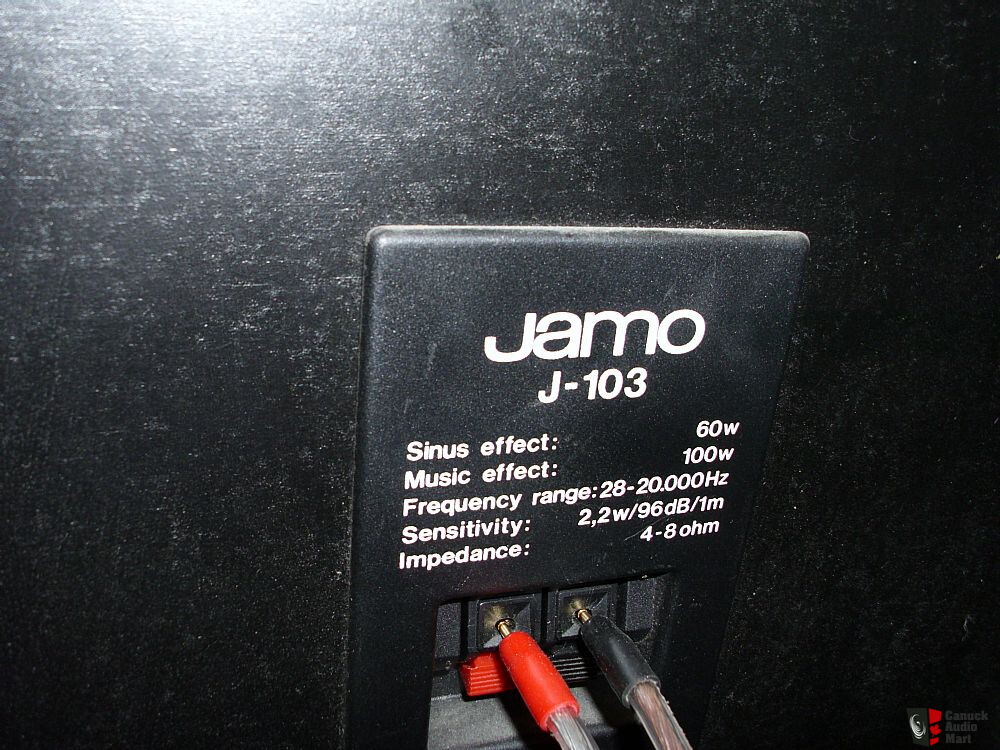
But in my search for alternatives the sensitivity is not always mentioned in dB but in Watts or a higher value than 1w/dB/1m. Example a set of Jamo J-103 which are rated at 2,2w/96dB/1m.

I'm getting confused. What would be the sensitivity of these Jamo speakers at 1w/dB/1m?
 
Register to hide this ad
Thanks Blue Shadow. But how to intererper speaker sensitivity when one only mention watt. Like B&O S60. These are rated with sensitivity of 5 watt. See: https://www.beoworld.org/prod_details.asp?pid=670

Is there a formula to get this converted to 1w/dB/1m?
B&O is a fashion-focused company, not a stereo-focused company. Like Bose, they sell "lifestyle" products. It could be a misprint or they don't know.
 
Example a set of Jamo J-103 which are rated at 2,2w/96dB/1m.
Fine example of specs massaged to create a bit of an illusion.

They don't want to be pinned down on the impedance either.

Kinda sleezy.

237628-548f0c1b-jamo_j103_bookshelf_speakers.jpg
 
You can use your Pioneer to power pretty much any speaker. you can power a huge pro PA speaker with a 9V battery. The question comes down to what are you using it for? What are your listening styles. Sensitivity only matters if you listen to your music loud. Or need it louder because you're filling a large space. Maybe you listen to Hip Hop or another music style that has heavy bass tracks and spikes that require more power.

With yours being a lower watt output amplifier, you just want sensitive speakers if you like it loud, because speakers that are inefficient will require that amplifier to go into clipping, causing distortion and heat and eventually meltdown, it can also damage the speakers by sending square waves to them. If you listen to almost all your music at lower volume levels than really any speaker can work. You can drive Vandersteens with it (notoriously thirsty brand), just don't expect to crank it up.
 
Last edited:
A
You can use your Pioneer to power pretty much any speaker. you can power a huge pro PA speaker with a 9V battery. The question comes down to what are you using it for? What are your listening styles. Sensitivity only matters if you listen to your music loud. Or need it louder because you're filling a large space. Maybe you listen to Hip Hop or another music style that has heavy bass tracks and spikes that require more power.

With yours being a lower watt output amplifier, you just want sensitive speakers if you like it loud, because speakers that are inefficient will require that amplifier to go into clipping, causing distortion and heat and eventually meltdown, it can also damage the speakers by sending square waves to them. If you listen to almost all your music at lower volume levels than really any speaker can work. You can drive Vandersteens with it (notoriously thirsty brand), just don't expect to crank it up.

How loud would the OP be able to play Vandersteen 2Ce speakers, at a listening distance of 10 feet, and with minimal clipping (crest factor of 12dB)?

BTW, Vandersteens are no less sensitive than many/most modern bookshelf speakers.

And those B&O speakers are about 89dB
 
The Vandy's were just an example, the statement stands true...for all we know his listening distance is 5ft in a dorm room. I was simply explaining sensitivities relevance to your listening situation/style.
 
Hi all, many thanks for your comments. Like driving a car, once in a while you drive it fast just for fun or to get some adrenaline running. But generally I drive relaxed respecting the speed limit. Same with music.....you need to play it loud sometimes for various reasons. I want my 'new' speakers to cater my needs and to be able to annoy the Neighbours sometimes. A sensitive speaker can do this w/o necking my old SX-434.
 
Vintage Klipsch are usually known for their high sensitivity, and also being able to go loud and also sound great quiet. But as a brand they have a following and known for specific "sound". This is usually due to the fact that they horn load almost anything. I do like most of the klipsch I've heard. I had a pair of KG4's that I enjoyed very much, and have a pair of harder to find CF3's that would require more power than your amp, but they're also the size of refrigerators. KG4's come up often for between $250-$350
 
Klipsch's current sensitivity specs are inflated, apparently (presumably) by adding in a few dB for real-world "room gain" and/or (perhaps) some imaginative interpretation of "nominal impedance".
Whether that's good or bad is in the eye of the beholder, I suppose.

e.g.,
The Klipsch [Forte III]'s specified sensitivity is an extraordinary 99dB/2.83V/m; my estimate was lower, at 95.2dB(B)/2.83V/m, but this is still 8dB higher than the average sensitivity of the speakers I have measured over the past 30 years. This speaker will play loudly with a mere handful of watts. Klipsch specifies the Forte III's nominal impedance as "8 ohms compatible." I found that the speaker's impedance magnitude (fig.1, solid trace) dropped below 6 ohms only in the upper bass and in the valley between the twin low-frequency peaks that define the reflex woofer loading. The minimum value is 3.65 ohms at 125Hz. However, the electrical phase angle (dotted trace) is sometimes extreme, and there is a current-hungry combination of 5 ohms and –49° phase angle at 90Hz. Despite its high sensitivity, the Forte III will work best with amplifiers that are comfortable driving 4-ohm loads. And the very large difference between the average impedance in the lower midrange and that in the treble means that the speaker might sound a touch bright with tube amplifiers having high output impedances.
source: https://www.stereophile.com/content/klipsch-forte-iii-loudspeaker-measurements

I used DRA Labs' MLSSA system and a calibrated DPA 4006 microphone to measure the Klipsch Reference Premiere RP-600M's frequency response in the farfield, and an Earthworks QTC-40 mike for the nearfield responses. I left the grille off for the measurements, The Klipsch's specified sensitivity is an extraordinarily high 96dB/2.83V/m. My estimate was much lower, at 89.6dB(B)/2.83V/m, though this is still higher than is typical for a small two-way speaker. Fig.1 shows that the RP-600M's impedance magnitude (solid trace) remains above 10 ohms for the entire treble, which means that in this region at least, the Klipsch is very efficient, the speaker drawing significantly less current from the partnering amplifier than would a nominal 8 ohm design. The impedance is lower in the midrange and bass, with a minimum value of 3.5 ohms between 180 and 220Hz. There is also a current-hungry combination of 5.3 ohms magnitude and –42° electrical phase angle (dotted trace) at 128Hz, which suggests that the RP-600M will work best with tube amplifiers when driven from their 4 ohm output-transformer taps.
source: https://www.stereophile.com/content/klipsch-reference-premiere-rp-600m-loudspeaker-measurements

Klipsch specifies the Klipschorn's sensitivity as 105dB/2.83V/m, which is extraordinarily high. My estimate was lower, at 101.1dB(B)/2.83V/m, but this is still the second-highest sensitivity of all the speakers I have measured over the past 30 years. (The highest was the Auditorium 23 Hommage Cinema, which features a measured voltage sensitivity of 102dB(B)/2.83V/m.) The Klipschorn's sensitivity is a whopping 18.6dB higher than the sensitivity of the BBC LS3/5a I always measure at the same time I test a speaker (to ensure that I haven't made an error in setup). This speaker will play loudly even with flea-powered amplifiers driving it. And at typical listening levels, the drive-unit diaphragms will hardly be moving, which implies low distortion.

Klipsch specifies the Klipschorn's nominal impedance as "8 ohms compatible." This is optimistic: Not only does the speaker's impedance magnitude (fig.1, solid trace) drop to 3 ohms in the midbass and 2.7 ohms in the upper bass, but the electrical phase angle (dotted trace) is sometimes extreme. There are current-demanding combinations of 4.1 ohms and –43° phase angle at 44Hz and 4.1 ohms and +43° phase angle at 139Hz. Despite its very high sensitivity, the Klipschorn will not be at its best with amplifiers that are not comfortable driving 4 ohm loads.

source: https://www.stereophile.com/content/klipsch-klipschorn-ak6-loudspeaker-measurements
I left the impedance curve comments in, too -- as another illustration of the "spin" that 21st Century Klipsch likes to put on things. :(

see also, e.g., https://www.theabsolutesound.com/articles/klipsch-heresy-iii-loudspeaker

caveat emptor
 
Thanks Blue Shadow. But how to intererper speaker sensitivity when one only mention watt. Like B&O S60. These are rated with sensitivity of 5 watt. See: https://www.beoworld.org/prod_details.asp?pid=670
Is there a formula to get this converted to 1w/dB/1m?

There are potential pitfalls depending on the units of described sensitivity, re. dB/W/m vs. dB/2.83V/m

However, relative to watts...

dB ratio = 10log(p2/p1)

So, the ratio of 1 watt to 5 watts would be

10log(1/5) = -7dB, so subtract 7dB from the 5W sensitivity to have it roughly normalized to 1W sensitivity.

In post #1,

10log(1/2.2) = -3.4dB

You see the 3dB approximation was close enough. If one has to start splitting hairs with a couple dB sensitivity then I opine the amp/speaker pairing probably isn't a good alignment in that regard.
 
Last edited:
Just a a note ...

Back in the 70's and early 80's the Japanese speakers were all carrying questionable sensitivity specs ..
When the audio magazine reviewers measured them using standardized comparison specs the manufacturer's specs were always much higher than the reviewers ..
The inflated specs were consistent across different magazines with different reviewers . typically 8 or 9 db above what the reviewer found.
Take them with a grain of salt ..
FWIW ... YMMV ...
 
Back in the 70's and early 80's the Japanese speakers...

Take them with a grain of salt ..

No thank you. Not much for Japanese speakers.

But the information was good about them over rating the sensitivity.
 
Last edited:
Ditto , but the peo
No thank you. Not much for Japanese speakers.

But the information was good about them over rating the sensitivity.

Ditto, but the people who like them should understand that a little 30wpc amp isn't likely to drive those old sealed box
systems without sacrificing the bass notes....
Sealed box system aka Accoustic Suspension is in my opinion what killed off tube amps that are mostly limited to 30-45 wpc ... with some very expensive notable exceptions ..
They need more power, more power to sound their best.

Specs are definitely bendable ..
 
Last edited:
OMG guys. I releases wild Goose..

I like some full round base. Warm full sound. What would match my SX-434 best?
 
Back
Top Bottom