• The move to the new server is done. There are some software and database maintenance updates in process. This has us passing the hat around to help out. We appreciate any donations. Seriously, even a dollar helps. The payment page may be found here - https://www.audiokarma.org/support.html

Speaker wire questions...

RunOutGroove

Addicted Member
I just bought a pair of Quad 12L speakers, which incidentally I'm quite happy with and as part of the deal I got a pair of Audio Quest speaker wires. They're the bi-wire type with banana plugs on both ends. I'm thinking about using these with another set of speakers that I have, a set of Jamo c103s, which like the Quads also have bi-wire type connections.

First of all, I don't really understand the theory of these bi-wire connections. Sure, if you're using separate amps for the bass/treble terminals, I can imagine that there could be a real improvement in sound over one amp driving everything. I don't understand though how one set of wires that split and go to those same bass/treble terminals would have any real effect over just a single cable to one of those connections that are bridged together. What's the theory on this?

Secondly, the amplifier that I'll be using with all of this is a Marantz 2270 receiver and of course the speaker outs can't accommodate the banana plugs of these wires. Is there then some kind of adapter that would go on the end of these speaker wires which would convert it to something that would fit the tiny connections in the back on my Marantz?

Also, assuming that there is a good way to adapt these wires to my amp, I wonder if there's a good way to extend them just a bit, like is there an adapter than comes with a year or so of wire between the ends of it? my issue is that one of my speakers is a little bit too far from the amp for the length of these Audio Quest cables that I have...

Lastly, I wonder with the amp that I've got if it even makes sense to hook this all up? Am I only likely to get the benefit of these expensive wires if I have a much higher end, higher resolving amp? If that's the case then I'll just sell those things and raise a bit of money towards the cost of those Quad speakers that they came with.
 
Register to hide this ad
Many articles on this subject, Richard Vandersteen highly recommends his speakers be Bi wired and once you own a pair you then understand why it does make a big difference. Here’s an article from him.


What is bi-wiring and what are the advantages?

Bi-wiring uses two separate sets of speaker cables to connect a single pair of loudspeakers to an amplifier. Coupled with a crossover designed specifically for bi-wiring, it offers many of the advantages of bi-amplifying the speakers with two separate amplifiers without the cost and complexity of two amplifiers.

We began experimenting with bi-wiring back in the early ‘80s, an era when horizontal bi-amplification was considered the ultimate way to drive quality loudspeakers. (Horizontal bi-amplification used one amplifier to drive the low-frequency section of a speaker and a second amplifier to drive the high-frequency section.) We noted that speakers sounded better when bi-amplified by two amplifiers than when driven by a single amplifier. Surprisingly, this superior performance was evident even when the speakers were bi-amplified by two identical amplifiers at a low volume level and the amplifiers were each driven full-range without an electronic crossover. We initially believed that the double power supplies and other components of two amplifiers were responsible for the improvement, however building amplifiers with twice the power supply and doubling-up on other critical components failed to provide the bi-amplification benefit.

So we looked at the speaker wires. With two amplifiers, bi-amplification used two sets of speaker cables so we experimented with doubling-up the speaker wires and with larger wire. Neither duplicated the bi-amplification improvements. Then we considered that in a bi-amplified system, one set of wires carries the low-frequencies and the other set of wires carries the high-frequencies. We modified a speaker’s crossovers to accept two sets of cables and present different load characteristics to each set so that the low-frequencies would be carried by one set of wires and the high-frequencies by the other set of wires. Finally we heard the sonic improvements of bi-amplification with a single amplifier.

Additional experiments with a Hall Effect probe revealed that high-current bass frequencies created a measurable field around the wires that expanded and collapsed with the signal. We believe that this dynamic field modulates the smaller signals, especially the very low level treble frequencies. With the high-current signal (Bass) separated from the low-current signal (Treble) this small signal modulation was eliminated as long as the cables were separated by at least an inch or two. (To keep the treble cable out of the field surrounding the bass cable.)

The crossovers in Vandersteen bi-wirable speakers are engineered with completely separate high-pass and low-pass sections. The bass inputs pass low-frequencies to the woofers, but become more and more resistive at higher frequencies. The treble inputs pass high-frequencies to the midrange and tweeter, but become more and more resistive at low-frequencies. The output from the amplifier always takes the path of least resistance so deep bass frequencies go to the bass input (Low impedance at low-frequencies) rather than to the treble inputs (High impedance at low frequencies). For the same reason, treble frequencies go to the treble input (Low impedance at high-frequencies) rather than to the bass inputs (High impedance at high-frequencies). At the actual crossover frequency, the output from the amplifier would be divided equally between the two inputs as they would both have the same impedance at that frequency. Because of the different reflected impedances of the cables, the crossover between the woofer and midrange actually occurs at the wire ends where they connect to the amplifier.

The benefits of bi-wiring are most obvious in the midrange and treble. The low-current signal to the midrange and tweeter drivers does not have to travel on the same wire as the high-current woofer signal. The field fluctuations and signal regeneration of the high-current low-frequencies are prevented from distorting or masking the low-current high-frequencies. The back EMF (Electro-Mechanical Force) from the large woofer cannot affect the small-signal upper frequencies since they do not share the same wires.

The effects of bi-wiring are not subtle. The improvements are large enough that a bi-wire set of moderately priced cable will usually sound better than a single run of more expensive cable.

All the cables in a bi-wire set must be the same.There is often great temptation to use a wire known for good bass response on the woofer inputs and a different wire known for good treble response on the midrange/tweeter inputs. This will cause the different sonic characteristics of the two wires in the middle frequencies to interfere with the proper blending of the woofer and midrange driver through the crossover point. The consistency of the sound will be severely affected as the different sounding woofer and midrange drivers conflict with each other in the frequency range where our ears are most sensitive to sonic anomalies. The disappointing result is a vague image, a lack of transparency through the midrange and lower treble and a loss of detail and clarity.

Some of the benefits of bi-wiring are from the physical separation of the high-current bass and low-current midrange/tweeter wires. So-called bi-wire cables that combine the wires in one sheath do not offer the full advantages of true bi-wiring although they may be an excellent choice for mono-wiring the speakers.

The cables should all be the same length. This is not due to the time that the signal takes to travel through a cable, but rather that two different lengths of the same cable will sound different. If the cables connecting one speaker are a different length than the cables connecting the other speaker, the resulting difference in sound between the two speakers will compromise the imaging and coherence of the system. If different lengths of cable are used for the bass and midrange/tweeter inputs of the speakers, the effects will be similar to those experienced when using two different cables as described above.

Since short runs of speaker cable sound better than long runs, consider placing your electronics between the speakers rather than off to one side. If for convenience or aesthetic considerations, the electronics must be located a considerable distance from the speakers, it is usually preferable to place the amplifier between the speakers and use long interconnect cables and short speaker wire.

Audiofreak71
 
First of all, I don't really understand the theory of these bi-wire connections. Sure, if you're using separate amps for the bass/treble terminals, I can imagine that there could be a real improvement in sound over one amp driving everything. I don't understand though how one set of wires that split and go to those same bass/treble terminals would have any real effect over just a single cable to one of those connections that are bridged together. What's the theory on this?

There is a bit of controversy over bi-wire. Logically, it seems like it couldn't possibly make any difference because everything is just tied together with practically 0 ohm connectors (wires). Electrically, however, there is a big difference with bi-wire. If amplifiers just pushed out current into the speakers irrespective of the load, bi-wire wouldn't make any difference because everything is essentially shorted together and the amp is pushing what it wants to push. In reality, though, current is drawn from the amplifier based upon the apparent impedances of the speaker circuit at all frequencies. In single-wire, it is a combined impedance of woofer, tweeter, and crossover that dictates the speaker circuit impedance at every frequency. In bi-wire, there are separate paths to the woofer and tweeter circuits, and each has its own impedance at any given frequency, meaning that there are very different currents running down each set of speaker wires. The tweeter path will have high impedance to low frequency signals (and therefore almost no current is sent for low frequencies), and the woofer path will have high impedance for high-frequency content.

Electrically, there is a big difference between the two. Soundwise, I have no opinion on whether the clear electrical difference that exists in bi-wiring has any impact on sound quality, and I've never tried to compare the two. I do run bi-wire when I have the option, because, why not?
 
Last edited:
I agree with most things said about bi-wiring in the above post.

For balance, the single wire camp objects that bi-wiring introduces a phase-shift between the top and bottom frequencies. They claim that this phase shift is audible as a false space is the sound.

I have never heard this false space with bi-wiring. My recordings are played with very different soundstages, so I personally don't see this as a problem.
I wasn’t a big believer in Bi Wiring until I bought Vandersteen speakers, it’s an absolute must to get the best sound from them. Other speakers I have owned it made no difference to me in how they sounded whether bi wired or not. I have also never heard the phase shift that some talk about .

Audiofreak71
 
The only system I've had that could be bi-wired was a pair of Polk SDA SRS3.1 paired with an Adcom GFA 555 amp. That system in that room yielded a significant improvement when bi-wired. No speakers I've owned since provide the option.
 
More questions: It looks like I can buy both an extension to make the wires long enough for my purposes as well as an adapter that coverts the banana plug ends to pins that will fit in the speaker wire terminals of my old amp. I wasn't able to find any kind of extension cord/adapter combo so if I were to use these Audio Quest cables that I have, I'd to use them with two junctions, both an extension piece as well as an adapter. I wonder then, with so many junctions like that would I be negating any possible benefit of using these higher quality wires with the bi-amp ends? Would I do just as well to keep my plain old speaker wires and sell the Audio Quest ones to someone who can use the shorter length of them?
 
More questions: It looks like I can buy both an extension to make the wires long enough for my purposes as well as an adapter that coverts the banana plug ends to pins that will fit in the speaker wire terminals of my old amp. I wasn't able to find any kind of extension cord/adapter combo so if I were to use these Audio Quest cables that I have, I'd to use them with two junctions, both an extension piece as well as an adapter. I wonder then, with so many junctions like that would I be negating any possible benefit of using these higher quality wires with the bi-amp ends? Would I do just as well to keep my plain old speaker wires and sell the Audio Quest ones to someone who can use the shorter length of them?
Are you trying to Bi amp or Bi wire? Because your first question was about Bi wiring , just trying to clarify.

Audiofreak71
 
Are you trying to Bi amp or Bi wire? Because your first question was about Bi wiring , just trying to clarify.

Audiofreak71
Bi-wire.... I have the wires for going from a single source, split into two pairs of ends, but too short a length and without the kind of ends that I need on the amp side (to fit those old, tiny speaker wire connections).
 
Last edited:
Bi-wire.... I have the wires for going from a single source, split into two pairs of ends, but too short a length and without the kind of ends that I need on the amp side (to fit those old, tiny speaker wire connections).
Ah ok. You most likely won’t have enough signal loss to notice any difference tbh. Best thing to do is try it and see if you like it or not before you pass them on.

Audiofreak71
 
Last edited:
Ah ok. You most likely won’t have enough signs loss to notice any difference tbh. Best thing to do is try it and see if you like it or not before you pass them on.

Audiofreak71
Thanks for the vote of confidence... I think I'm gonna order some stuff! The extension and adapter pieces appear to be pretty cheap so I won't have lost much if I don't like the arrangement. I'll probably look for somewhat higher quality pieces as even those ones aren't likely to be too expensive... Not nearly the price of longer Audio Quest bi-wire cables. Once I've got these things I'll do the test that I always do with speakers; hook up one with the new arrangement, switch the amp to mono and A/B the old and new...
 
More questions: It looks like I can buy both an extension to make the wires long enough for my purposes as well as an adapter that coverts the banana plug ends to pins that will fit in the speaker wire terminals of my old amp. I wasn't able to find any kind of extension cord/adapter combo so if I were to use these Audio Quest cables that I have, I'd to use them with two junctions, both an extension piece as well as an adapter. I wonder then, with so many junctions like that would I be negating any possible benefit of using these higher quality wires with the bi-amp ends? Would I do just as well to keep my plain old speaker wires and sell the Audio Quest ones to someone who can use the shorter length of them?

Thanks for the vote of confidence... I think I'm gonna order some stuff! The extension and adapter pieces appear to be pretty cheap so I won't have lost much if I don't like the arrangement. I'll probably look for somewhat higher quality pieces as even those ones aren't likely to be too expensive... Not nearly the price of longer Audio Quest bi-wire cables. Once I've got these things I'll do the test that I always do with speakers; hook up one with the new arrangement, switch the amp to mono and A/B the old and new...

A picture or two would be worth at least 1k words. I don't mean this to be critical, but I have no idea what you are talking about with regard to extension cords for speaker wires. Honestly, if you buy some inexpensive 100% OFC (oxygen-free copper) speaker wires, you should be fine and it will be very inexpensive and easy to bi-wire. Just avoid the CCA (copper clad aluminum) wire, as it is pretty crappy to work with (aluminum doesn't conduct as well as copper, but the bigger problem is that it isn't malleable like pure copper, so CCA is pretty brittle when you twist the wire ends). You can upgrade the speaker wires later if you want, but it's one of the last things priority-wise. Bare wire is fine for amp output spring-loaded clips and fine for binding posts.
 
A picture or two would be worth at least 1k words. I don't mean this to be critical, but I have no idea what you are talking about with regard to extension cords for speaker wires. Honestly, if you buy some inexpensive 100% OFC (oxygen-free copper) speaker wires, you should be fine and it will be very inexpensive and easy to bi-wire. Just avoid the CCA (copper clad aluminum) wire, as it is pretty crappy to work with (aluminum doesn't conduct as well as copper, but the bigger problem is that it isn't malleable like pure copper, so CCA is pretty brittle when you twist the wire ends). You can upgrade the speaker wires later if you want, but it's one of the last things priority-wise. Bare wire is fine for amp output spring-loaded clips and fine for binding posts.
I believe he’s meaning the adapters for the ends so he can try out the Audioquest cables.

Audiofreak71
 
A picture or two would be worth at least 1k words. I don't mean this to be critical, but I have no idea what you are talking about with regard to extension cords for speaker wires. Honestly, if you buy some inexpensive 100% OFC (oxygen-free copper) speaker wires, you should be fine and it will be very inexpensive and easy to bi-wire. Just avoid the CCA (copper clad aluminum) wire, as it is pretty crappy to work with (aluminum doesn't conduct as well as copper, but the bigger problem is that it isn't malleable like pure copper, so CCA is pretty brittle when you twist the wire ends). You can upgrade the speaker wires later if you want, but it's one of the last things priority-wise. Bare wire is fine for amp output spring-loaded clips and fine for binding posts.
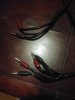
Here's a photo that shows both ends of the wires in question. One end will plug into my speakers which have the dual inputs for high/low and the other side, which goes to my amp needs to be a pin type connector in order to fit the vintage speaker wire terminal on my amp. They're also a few feet too short for what I need. So: wrong type connector (needs to be pin and not banana plug) + too short length = need for extension piece + female banana plug to male pin adaptor - in order to make these Audio Quest wires work for me. Both of these items are available (I checked) but the question is, should I bother with that arrangement or am I likely to loose any possible benefit of those bi-wires (buy having too many connection points)? Lastly, I realize that bare wire to the amp is fine, but I really don't want to modify these Audio Quest wires that I have, just in case I'm not happy with the arrangement and want to sell them. Currently I have single wires (not bi-wires) hooked up; Monster cable brand, 12 or14 gauge, I'm not sure (the writing on the wire is impossible to read, not because of the tiny size so much but the poor printing quality).

It's not that I'm unhappy with the wires that I have, I just feel that I owe it to myself to try out these new (used actually) Audio Quest bi-wires and see if I can notice any improvement. It's just a question of whether it's worth doing if I have to use extension pieces and adapters to make it work. So far, I have one "yes" vote, but I'm willing to hear other perspectives...

20201006_200958_resized.jpg
 
Another question: If I'm going to be buying an extension piece and adaptors to make my speaker wires work, where should I shop for these? Amazon has what I want, but they only have very inexpensive versions of these particular things and I worry that they might not be all that good. Browsing several sources for cables, I see that there are few that make the kind of extension cables and adaptors I'm looking for and the one that I found that does only offers them as custom made pieces and is very expensive. Is there maybe an online shop that sells a lot of this kind of thing and has lots of options in all different price ranges? Otherwise, I may just order the stuff from Amazon, experiment with it and hope for the best...
 
Currently I have single wires (not bi-wires) hooked up; Monster cable brand, 12 or14 gauge, I'm not sure (the writing on the wire is impossible to read, not because of the tiny size so much but the poor printing quality).

There is nothing magical about Audioquest's physical implementation of bi-wire, you can duplicate the same bi-wire with the Monster cables just by doubling them up -- twist two pairs of speaker wires together on the amp side (I would "tin" the twisted wires with solder), and then run separate wires to the woofer and tweeter circuits. 12 or 14 gauge doesn't matter for reasonable run lengths -- if you go too big, you might not be able to fit the twisted pair into the Marantz outputs (though you can thin the ends before you twist to make them fit). You should use the same length and type of speaker wire in both sets -- if you don't have enough Monster cable, any OFC (oxygen-free copper) speaker wires of 12 or 14 or so gauge will work (don't use CCA (copper clad aluminum) -- CCA durability sucks (aluminum doesn't like to bend/twist) and CCA is slightly less conductive). I would do that Monster-based bi-wire all day long rather than try to extend or adapt or modify the Audioquest cables. If you like the bi-wire with normal Monster wire, and want to later upgrade, you can sell Audioquest and then buy a set that fits (pins on amp side and sufficient length).

It's not that I'm unhappy with the wires that I have, I just feel that I owe it to myself to try out these new (used actually) Audio Quest bi-wires and see if I can notice any improvement. It's just a question of whether it's worth doing if I have to use extension pieces and adapters to make it work. So far, I have one "yes" vote, but I'm willing to hear other perspectives...

Since you need to adapt and extend the Audioquests for them to work, I would argue that you really won't be evaluating them in any kind of fair way. Much better to sell them -- either because you find Monster bi-wire more than sufficient (which I suspect you will) or because you liked the Monster bi-wire so much that you want to upgrade (in which case you can use the Audioquest money to buy better cables that fit (with pins and proper length)).
 
Last edited:
The difference is physical, not magical. Audioquest have diagrams and video clips that show how their cables are made. They particularly avoid bunched multi-stranded wires and soldered connections. Every little thing matters, that's why we do what we do.

There is no "magic" in splitting to bi-wire. Differences in the "magic" within the cable itself is a separate concern, but unless using he is using identical Audioquest cables to extend, he will be foregoing a good chunk of that cable magic by extending it with non-AQ wire.

I have nothing against the Audioquest cables, but they don't fit and using them with adapters and (particularly extenders) won't be the same at all. If he can move the speakers closer to eliminate extending them, then it's probably fine because the adapters are, by far, the "lesser" issue. If the extenders are matched Audioquest cable, they're going to be pretty expensive and he would still be adding another coupling. In my opinion, money would be better spent selling those and getting speaker cables that fit (proper lengths and native pins rather than adapted pins).
 
Last edited:
OK, I've devised a plan, one so clever and so absolutely perfect that I know that you folks will appreciate it! If I was capable of thinking more coherently and more linearly, I would have surely come up with it sooner (this is why I'm not an engineer!).

Anyway, I figure I'll order the adaptors and extension pieces and when I have 'em, I'll rig up one side with just the adaptor (I need that and I don't see it being much of an issue anyway) and the other side with both the adaptor and the extension piece. I'll switch the amp to mono and do a test (using the balance control to isolate each channel) and If there's much of a difference between the two and the extension piece causes reduced sound quality, then I'll sell my fancy Audio Quest cables and be done with it. I should also say that before I do this particular test, I'll do one where I've got one speaker with the bi-wire setup (but without the extension) and the other with my plain old Monster Cable, non bi-wire hookup. If I don't hear much of a difference with that setup then I won't be bothering with the bi-wire at all. I suppose that if I do like the bi-wire but feel like the extension thing is hurting it, I'll just plan on investing in the proper length bi-wire thing at a later date...

As far as doing what may seem to be obvious and just moving that further speaker closer to the center or moving my amp, this unfortunately isn't really a possibility I've got a built in bookcase that I can't move and a need for my TV to be in the center between the speakers... and as long as that's a requirement, I can't put the amp in the center position.
 
More intrigue... I called a local audio shop and spoke to a guy there who clearly knows something about this stuff. He didn't have adaptors or extension pieces to sell me and advised against the extension pieces. He also didn't like my idea of A/B testing as he said that with both speakers on, with only slightly different loads due to different cables (or different speakers as I've often done) could produce an imbalance in the amp and cause damage. I told him that when I do this sort of thing, I generally have the balance set so that I'm listening to only one side at a time, which he said is safer for the amp but still might do something to the signal to where I wouldn't be getting a true comparison.... and that the only way to do properly do these kinds of tests is to unhook/re-hook up both speakers and play them as a pair. I feel like without a more direct A/B comparison though I have a much harder time picking up on differences...

The guy also said, and I realize that this is a minority opinion here, that bi-wiring doesn't typically make much of a difference... bi-amping yes, but bi-wiring not so much.

Anyway, I'm still curious about what these cables really do, so I might just end up buying the adaptors and testing them out in a temporary configuration with the speakers moved closer together (so that I don't have to bother with extension pieces, which apparently are a bad idea (and I totally understand why). With this plan, I would be planning on selling those wires (too short for my purposes) but at least I would first get to satisfy my curiosity on whether or not they make enough of a difference to me to know whether or not if I might be interested in investing in a longer pair in the future...
 
OK, I've devised a plan, one so clever and so absolutely perfect that I know that you folks will appreciate it! If I was capable of thinking more coherently and more linearly, I would have surely come up with it sooner (this is why I'm not an engineer!).

Anyway, I figure I'll order the adaptors and extension pieces and when I have 'em, I'll rig up one side with just the adaptor (I need that and I don't see it being much of an issue anyway) and the other side with both the adaptor and the extension piece. I'll switch the amp to mono and do a test (using the balance control to isolate each channel) and If there's much of a difference between the two and the extension piece causes reduced sound quality, then I'll sell my fancy Audio Quest cables and be done with it. I should also say that before I do this particular test, I'll do one where I've got one speaker with the bi-wire setup (but without the extension) and the other with my plain old Monster Cable, non bi-wire hookup. If I don't hear much of a difference with that setup then I won't be bothering with the bi-wire at all. I suppose that if I do like the bi-wire but feel like the extension thing is hurting it, I'll just plan on investing in the proper length bi-wire thing at a later date...

As far as doing what may seem to be obvious and just moving that further speaker closer to the center or moving my amp, this unfortunately isn't really a possibility I've got a built in bookcase that I can't move and a need for my TV to be in the center between the speakers... and as long as that's a requirement, I can't put the amp in the center position.

I don't think the concern about running two identical speakers with different speaker wires is a legitimate issue. Don't take my word for it (hopefully others will chime in), because I don't want to be blamed if something happens, but the speakers are 8 ohms, or whatever their nominal impedance is, and the speaker wires are practically zero ohms, there should be virtually no difference in the load the amp sees. There are some speaker wires, like Kimber, that have high capacitance, so they may have affect how the amp operates, but I still can't imagine any "risk" from different speaker cables given that the left/right amps are separate and the only commonality should be the power supply. You haven't provided any info about what the model of Audioquest speaker wire, so it's impossible to look anything up to know more.

The comparison I would do first is Monster single wire on one channel, and Audioquest bi-wire on the other (with adapter but with speaker temporarily moved so you don't need an extender). Then you would know the audible difference between Monster wire single and AQ bi-wire (if there is one). A second test could be between non-extender and extender to know if there is any negative impact from the extender -- which is good information also, but not nearly as good as understanding the difference between what you have now (single wire Monster) and bi-wire AQ.

Can you please provide clarity on what the "extender pieces" are? Is this an Audioquest product, or are you talking generically about wires to be used to extend, or have you picked out a particular extender product? Same (though lesser concern) with the "pin adapters" -- AQ product? generic product? Pics and/or brand and model numbers on everything would help a LOT.
 
Last edited:
Back
Top Bottom