

You are using an out of date browser. It may not display this or other websites correctly.
You should upgrade or use an alternative browser.
You should upgrade or use an alternative browser.
Speakers and rooms...
- Thread starter RunOutGroove
- Start date


+1 on the mattress toppersMemory foam mattress toppers on the wall work well, then cover with decoration of choice.
 . I've had good luck with the egg crate style mattress toppers.
The New Advents in the garage open up with 300 watts available for dynamic content.80 watts is what I have. And I was happy with that. Until a friend loaned me a 350 watt Carver for a week. I want more watts now.
It's possible, however, to over dampen a room. There's a guy near me who killed the sense of space in his room with blankets and damping on every wall. I prefer using diffusion as you find in concert halls. Even in the garage.Memory foam mattress toppers on the wall work well, then cover with decoration of choice.


50nstillhifi
Super Member
I'm realizing just how much the room colors the sound of the speakers. I bought a new pair of them, Jamo c103 (which sound great!) that I'm using in my living room, which meant that the Elac Debut 6.2 speakers that I had there moved into my bedroom/office and I sold the pair of Wharfedale Diamond 10.1 speakers that I had in there previously. I liked the sound of my Elacs more than the Wharfedales (as nice as they are) so I got rid of the Wharfedales, but now I'm feeling that the Elacs don't sound nearly as good in the smaller room as they did the big one. The smaller, punchier sounding Wharfedales may have been a better match for the smaller room than the larger, less punchy but more spacious sounding Elacs. The Elacs seem to loose a lot of the imaging that they had in the larger room in the smaller room, arranged closer together on stands, on either side of my computer desk. The Wharfedales may have been more ideal for a small room/near-field listening.
All this being said, I don't have too much complaints with the sound and with getting rid of the Wharfedales. Even if those speakers might have been a bit more ideal for the room, I would have had a much harder time getting rid of the Elacs, which I attribute to getting me into a higher fidelity zone with my audio system. There isn't really much that I can do with placement either as the room is small and I want the speakers around my computer desk.... anywhere else and they'd be in the way anyway. Just an observation is all...
I didn't see you mention.. "equalization".. have you tried this component, you might be surprised how it can manage standing waves and other nuances for your listening room.

tomlinmgt
Lunatic Member
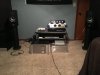
I’ve used the same Elacs in a 12x12 (well, 11.5) spare bedroom...speakers set up approx 30” from front and side walls, 7’ apart, listening spot 7’ away, with absorption panels at side wall first reflection points, on back wall directly behind listening spot, and on front wall against the corners. The speakers image precisely and throw up a great sound stage. Your problem isn’t the speakers. It’s likely the way you have them set up, the room’s acoustic influence or both. I’ll pull up “Palm Grease” tonight and listen for the location of the shaker and will also create a “near field” listening scenario and see how that affects image and sound stage resolution. I’ll report back with my findings.
Michael

Michael
Last edited:
It’s likely the way you have them set up, the room’s acoustic influence or both.
I didn't see you mention.. "equalization".. have you tried this component, you might be surprised how it can manage standing waves and other nuances for your listening room.
I think this text from the original post will clear up the first question and why the second question won't help:
"arranged closer together on stands, on either side of my computer desk."
You see many systems here where the speakers are narrowly spaced and slammed up against a cabinet or desk and frequently positioned further back than the furniture which further worsens the diffraction and kills the image. I appreciate this case where the OP may not have a choice - but so many other folks do.
Last edited:

RunOutGroove
Addicted Member
I’ve used the same Elacs in a 12x12 (well, 11.5) spare bedroom...speakers set up approx 30” from front and side walls, 7’ apart, listening spot 7’ away, with absorption panels at side wall first reflection points, on back wall directly behind listening spot, and on front wall against the corners. The speakers image precisely and throw up a great sound stage. Your problem isn’t the speakers. It’s likely the way you have them set up, the room’s acoustic influence or both. I’ll pull up “Palm Grease” tonight and listen for the location of the shaker and will also create a “near field” listening scenario and see how that affects image and sound stage resolution. I’ll report back with my findings.
Michael
View attachment 1738850 View attachment 1738851
View attachment 1738852
I'm impressed that you're using such a fancy looking system to drive those cheap speakers! I know that Elacs are pretty good, but maybe not worthy of that setup... I don't really have the flexibility to experiment with the kind of setup options that you seem to be doing here. my space has to function as both a bedroom and an office, is tiny and the only real room that I have to work with is between two doors (that need to be opened and closed) on either side of a desk with my computer. I can move the speakers maybe a foot or so closer/further from the wall and experiment with toe in, but that's about it...
RunOutGroove
Addicted Member
I think this text from the original post will clear up the first question and why the second question won't help:
"arranged closer together on stands, on either side of my computer desk."
You see many systems here where the speakers are narrowly spaced and slammed up against a cabinet or desk and frequently positioned further back than the furniture which further worsens the diffraction and kills the image. I appreciate this case where the OP may not have a choice - but so many other folks do.
Yes! This is indeed the case with me. I really meant for my post to be more "observation" than "complaint," as I was really just observing the differences in sound from room to room with the same set of speakers. The sound isn't nearly as good in the small bedroom/office as the much more spacious living room, but I wouldn't expect it to be. The truth is that for me the sound I'm getting in this smaller room is if not great at least good and that's really good enough... I say that because my more critical listening is done in the bigger room.
tomlinmgt
Lunatic Member
I'm impressed that you're using such a fancy looking system to drive those cheap speakers! I know that Elacs are pretty good, but maybe not worthy of that setup... I don't really have the flexibility to experiment with the kind of setup options that you seem to be doing here. my space has to function as both a bedroom and an office, is tiny and the only real room that I have to work with is between two doors (that need to be opened and closed) on either side of a desk with my computer. I can move the speakers maybe a foot or so closer/further from the wall and experiment with toe in, but that's about it...
Thanks for the kind words. My son recently left for college so I’ve been using his room to mess with stand mount speakers and experiment with building systems in small room...which is new territory for me. And yes, some of that gear pictured is maybe a little more than what will typically be used by most with the Elacs (and damn, do they ever sound good with it), but there’s also a little Nuprime IDA-8 integrated and Musical Fidelity M2si integrated there in the room and the Elacs sound very good with those, as well.
You’ve definitely been given a valuable lesson in room influence/speaker set-up and, if nothing else, know now that a speaker can’t be judged on its performance based on how it sounds in one particular scenario. Keep messing with the positioning of the Elacs...I bet you’ll be able to get at least a little of the magic back.
Last edited:
In my experience diffusion has it's uses, but they're limited. Nobody master's an album with the intent that the listening space should add it's own color to the sound. Accordingly, my goal is to neutralize the room and make it sonically "generic". It should sound like "a" room, but have as few unique traits as possible. Absorption is also useful for simulating space you don't have.

I get that. I was visiting some old friends in MD (I live on the West coast) and we went to see a jazz jam at a local bar. I was there really for the hang and not the music but I couldn't help notice how bad the music music sounded in that room.
Sounds like the Ram's Head in Annapolis. The sound has never been good at that place. A shame because they book some pretty good artists.
tomlinmgt
Lunatic Member
Absorption is also useful for simulating space you don't have.
...and then use (proper) diffusion to create desirable reverb characteristics the room can’t generate on its own.
...and then use (proper) diffusion to create desirable reverb characteristics the room can’t generate on its own.
When it comes to producing euphonic distortion, which is basically what desirable room interaction is, I prefer to develop that inside the amp.

tomlinmgt
Lunatic Member
When it comes to producing euphonic distortion, which is basically what desirable room interaction is, I prefer to develop that inside the amp.
You may have misunderstood me. Desireable reverb characteristics in the room are achieved by optimizing the decay (of sound)..measured as an RT60 value.
RunOutGroove
Addicted Member
Wow... that's kind of unforgivable for a place that has shows of well known artists. The place that I was referring to has only very local folks playing there. I've been to a number of bigger venues where the sound wasn't too good, but still not nearly as bad as what I experienced in this little bar. It seems that if the folks who run that place had their act together at all they'd be looking at how they could make that room better... I suspect covering the areas of bare brick wall behind the band would be a start...Sounds like the Ram's Head in Annapolis. The sound has never been good at that place. A shame because they book some pretty good artists.
On the other end of the spectrum is my neighbor's place. He lives in a small space that's one half of a duplex and is a really serious (though non-pro) recording engineer. I've done a bit of recording there (I play drums) and have heard some of the other music that he's recorded there and the sounds that he can get for the drums in that small space that he has, with seemingly not much in the way of acoustic mods, is impressive. I lent him some drums for a recent recording session and once I set everything up I played the kit a bit and it sounds so much better than just about any other space where I've set it up! The space he's got is a tiny breakfast nook that's barely large enough to walk behind the kit when everything is set up. The only acoustic treatment that he has is a single repurposed office room divider (like maybe one side of a cubicle) and yet I hear a fatter bass sound out of the bass drum, the perfect crack out of the snare, a really smooth - not too metallic sound from the cymbals, etc... Some spaces just seem to sound better than they have a right to.
Last edited:

You may have misunderstood me. Desireable reverb characteristics in the room are achieved by optimizing the decay (of sound)..measured as an RT60 value.
I think I get it. 60dB is a very steep slope of attenuation to achieve in an average size domestic room. The need for absorption is unavoidable. Larger rooms are more tolerant of longer decays where diffusion may be more appropriate. Ultimately the acoustics of a room can be described as distortion if we're going to call distortion nonlinear response to the input signal. It's a complicated thing, but there's no doubt an overly lively room destroys imaging. You know your getting it right when the image opens up side to side and takes on convincing depth. Any more than that and the sound gets sucked out of the room.
In your case, it's not so much the *room* as it is the stuff around the system blocking the image.as I was really just observing the differences in sound from room to room with the same set of speakers.