If I try to replace the IC chips, does anyone know how to get them? Looks like the part numbers are msm5810 and msm4069, manufactured by OKI.New update. This thing is a pain! Replaced all transistors and caps. Replaced trim pots. I thought I finally fixed it, but the speed still fluctuates for half a second and then recovers every few minutes. Seems like it's getting worse. Should I try to replace the IC chips in the PLL Servo circuit??? Or should I go over all the solder joints?? That seems like a lot of work, but if it fixes the problem I'm up for it!


You are using an out of date browser. It may not display this or other websites correctly.
You should upgrade or use an alternative browser.
You should upgrade or use an alternative browser.
Speed Issue - Sansui SR-838; Help?
- Thread starter plresults
- Start date

What causes you to believe that those ICs are bad and that you need new ones?
 Here are the instructions in the SM. It says that you need to complete these adjustments when replacing capacitors, resistors, and ICs. Did you do this?
Since you went ahead and replaced "all transistors and caps and trim pots" Did you do all of the adjustments below?
Please post a photo of the oscilloscope screen shot when you adjusted it, or if you didn't use an oscilloscope and if you were able to adjust when the Quartz switch is OFF.
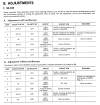
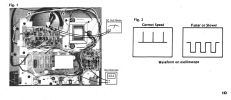
If you changed any of the parts listed in A, then you need to adjust these VRs.

One more thing to check is that the MSM5810 has a speed sensor input on pin 15. If it is faulty, it could be providing bad information to the speed control.
Attach a scope probe to this pin and see if there is anything interesting happening to pin 15 when you have this speed glitch.
If you haven't already done so, check to make sure all of the voltages around IC71 are like on the schematic.
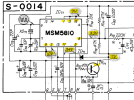
- MSM4069 is a CMOS hex inverter equivalent to a CD4069UB. If one of the 6 inverters were bad, the circuit would not work at all.
- MSM5810 is a MOS LSI Phase Locked Loop containing an oscillator, counters and a phase comparator. I don't know of a modern pin compatible equivalent. Were you able to adjust to get the waveform shown in Figure 2?
- The functions of the 5810 are:
Since you went ahead and replaced "all transistors and caps and trim pots" Did you do all of the adjustments below?
Please post a photo of the oscilloscope screen shot when you adjusted it, or if you didn't use an oscilloscope and if you were able to adjust when the Quartz switch is OFF.
If you changed any of the parts listed in A, then you need to adjust these VRs.
One more thing to check is that the MSM5810 has a speed sensor input on pin 15. If it is faulty, it could be providing bad information to the speed control.
Attach a scope probe to this pin and see if there is anything interesting happening to pin 15 when you have this speed glitch.
If you haven't already done so, check to make sure all of the voltages around IC71 are like on the schematic.
Last edited:
Thanks for taking the time and offer these suggestions. I calibrated after installing new capacitors, but then I never went back and calibrated again after installing the rest of the transistors. However, I followed the directions for calibration using a multimeter and it was spot on, 1.4 volts, and able to calibrate with quartz lock off as well. I looked at all the voltages highlighted around MSM5810 and everything checked out except pin 9, which was 2.35 volts instead of 3.2.
I haven't hooked the oscilloscope up to pin 15 yet, but I'll try that next.
I haven't hooked the oscilloscope up to pin 15 yet, but I'll try that next.
Ok, I have an update on this issue. I found an SR 737 for parts. I tried replacing the IC chips and also the entire motor control board. Same issues kept happening. While I was doing this I tested downstairs in my workshop and then tested upstairs in my living room I noticed there was never a speed issue when I tested downstairs. What's different? Well, there's a different receiver and it's on a different electrical circuit. So upstairs, I kept everything the same, but plugged the turntable in a different electrical circuit. My circuit with the receiver shares a circuit with kitchen lights...there's only two other outlets, with nothing else hooked up. The circuit with the turntable shares with living room lights and the television. What's going on? Are power draws from my harmon/kardon 430 causing power fluctuations in my turntable when it's on the same circuit? I'm happy I found a solution, but I want to understand what causes this to happen. Is there something wrong with my house's wiring? Is there something wrong with my receiver or turntable???? Maybe nothing is wrong and the receiver and turntable just interfere with each other???

mrwood200
Super Member
Sorry to hear of your ordeal -
But apparently there is something on the former turntable circuit upstairs that was impacting voltage, that impacted your TT.
The outlet that gave you problems is the receiver/kitchen lights outlet?
Usually it is high voltage appliances; in your situation, it could be your kitchen lights. It might be interesting to plug back to your old outlet & see if operating/diming the kitchen lights impact speed.
I don't know.I noticed there was never a speed issue when I tested downstairs. What's different? Well, there's a different receiver and it's on a different electrical circuit. So upstairs, I kept everything the same, but plugged the turntable in a different electrical circuit. My circuit with the receiver shares a circuit with kitchen lights...there's only two other outlets, with nothing else hooked up. The circuit with the turntable shares with living room lights and the television. What's going on?
But apparently there is something on the former turntable circuit upstairs that was impacting voltage, that impacted your TT.
The outlet that gave you problems is the receiver/kitchen lights outlet?
Usually it is high voltage appliances; in your situation, it could be your kitchen lights. It might be interesting to plug back to your old outlet & see if operating/diming the kitchen lights impact speed.
You might want to check the kitchen light and outlets to make sure that the hot (black) and neutral (white) wires are connected to the correct outlet pin and not reversed on one of the outlets. I would assume that the SR-838 and your receiver both have 2-prong AC plugs (un-grounded).My circuit with the receiver shares a circuit with kitchen lights...there's only two other outlets, with nothing else hooked up.
Is your SR-838 an international version or a U.S. version power supply?

Ok....I've narrowed it down to the LED overhead lights on a dimming switch. There are 4 of them on one circuit. The turntable speed fluctuates every few minutes when they are on. I can't believe I sourced IC chips and motor control boards and replaced all these capacitors and transistors and cleaned the switches like 4 times...and it turns out to be my kitchen lights! Holy crap!