

You are using an out of date browser. It may not display this or other websites correctly.
You should upgrade or use an alternative browser.
You should upgrade or use an alternative browser.
Stacking speakers
- Thread starter Harvey/ Ga
- Start date


Harvey/ Ga
Super Member
May we know more specifics regarding your "findings" as may relate to this discussion please? :scratch2:
Hi Zilch..
I did notice a different sound quality when I had the two different speakers stacked, and it was pleasantly different. But, IIRC, they had different impedances and sensitivities, so, not wishing to compromise my "new" CR-2020, I decided to keep them with separate amps and pursue better speakers for the main system, should I win the lottery


A/D/Slover
Well-Known Member
OK Ok OK
So are there really better speakers than ADS
So are there really better speakers than ADS

Duffinator will tell you soon....So are there really better speakers than ADS

judgeschreber
Well-Known Member
I stacked a couple pairs of Advents once, and I loved them. They weren't the highest fidelity, and they certainly had problems, but they had very good dynamics, solid bass, and a giant, all-enveloping soundstage. I kept them up for the night, drank some (OK, a lot) of nice whiskey, and enjoyed listening to some of my favorite recordings from a new perspective.
That said, I took the stack down the next day. It was kind of like eating a giant banana split. It was nice ear candy, but I'd rather have good sustenance on a day-to-day basis.
One thing I learned when trying to design a speaker crossover, and experimenting with phase coherence, is that phase interference can give a nice, immediate, "washed-over" sound. It can sound full and diffuse, which can be perceived as a good thing, since the sound seems to envelop you. However, when you switch the phase switch back, and the acoustic image snaps into place, you then realize all the detail and precision you've been missing.
I can certainly understand why people like the sound of stacked speakers. I like the sound myself, and if I had the room for another system, I would likely put together a stacked Advent system for those decadent times when I felt like listening to that nice, full, all-enveloping sound.
On the other hand, I much prefer a well-designed conventional (un-stacked) speaker system for daily listening, since I would generally take precision, detail, and pinpoint imaging over a diffuse and immense soundstage any day. Admittedly, the stacked advents are the only stacked system I have heard, so there are probably better combinations.
Finally, I greatly appreciate learning the theory and the empirical data behind the different methods. While it certainly boils down to subjective experience in the end (either you like the system or you don't), learning more can at worst do nothing to harm your listening experience. At best (and here I am in total agreement with Zilch), it can help refine your listening experience, helping you to discern with your own ears what is objectively closer to a faithful reproduction of the recorded material, and what is merely ear-candy.
Ear-candy is great for secondary systems and maybe even in home theater (who doesn't want grossly exaggerated bass rumbles when watching explosions on screen?). However, I would always rather have the closest I can get to faithful reproduction in my main listening system. That is what I want, but I also don't presume that everyone should want the same thing.
That said, I took the stack down the next day. It was kind of like eating a giant banana split. It was nice ear candy, but I'd rather have good sustenance on a day-to-day basis.
One thing I learned when trying to design a speaker crossover, and experimenting with phase coherence, is that phase interference can give a nice, immediate, "washed-over" sound. It can sound full and diffuse, which can be perceived as a good thing, since the sound seems to envelop you. However, when you switch the phase switch back, and the acoustic image snaps into place, you then realize all the detail and precision you've been missing.
I can certainly understand why people like the sound of stacked speakers. I like the sound myself, and if I had the room for another system, I would likely put together a stacked Advent system for those decadent times when I felt like listening to that nice, full, all-enveloping sound.
On the other hand, I much prefer a well-designed conventional (un-stacked) speaker system for daily listening, since I would generally take precision, detail, and pinpoint imaging over a diffuse and immense soundstage any day. Admittedly, the stacked advents are the only stacked system I have heard, so there are probably better combinations.
Finally, I greatly appreciate learning the theory and the empirical data behind the different methods. While it certainly boils down to subjective experience in the end (either you like the system or you don't), learning more can at worst do nothing to harm your listening experience. At best (and here I am in total agreement with Zilch), it can help refine your listening experience, helping you to discern with your own ears what is objectively closer to a faithful reproduction of the recorded material, and what is merely ear-candy.
Ear-candy is great for secondary systems and maybe even in home theater (who doesn't want grossly exaggerated bass rumbles when watching explosions on screen?). However, I would always rather have the closest I can get to faithful reproduction in my main listening system. That is what I want, but I also don't presume that everyone should want the same thing.
So whats that about......2 identicles..is no good.?
I was going to do that with my speakers... but I dont know if the Remote speakers function on my Superscopre R1220 will allow for me to run four speakers. I guess that'll jut make me have to use the more powerful but Input lacking soundesign receiver it only has one input... i wonder how much the cheapest multiple input selector costs?
I was going to run all 4 speakersa but it turns out the Magnavox bookshelf speakers are more efficient and have more bass than the floorstanders at low volume............. I wanted to add a peizo horn to the single driver floorstanding speakers should I?

RaymondLeggs:
I have a 20wpc Superscope R-340 receiver....and I'm running 4 speakers right now.
I suspect the R1220 and R340 Superscope receivers are very close spec. wise.
Steve
I bet they are... seince they have nearly the same wattage. Now If I could get all the nicotine off a certain soundesign receiver I'll have the ability to get better reception on the FM spectrum...
Sorry to resurrect an old post, but I joined specifically to say that I have a pair of old Tannoy 609's stacked with a pair of B&W CDM1NT's
I'm running them Bi-amped with a couple of Yamaha amps (both amps running only in Stereo) and they compliment each other beautifully.
Just thought I'd ad that in case there are people like me out there on a low budget and wanted (what I consider to be) an expensive sounding setup.
Great forum too btw guys. Many times I've visited as a guest for advice and ideas.
Thanks
Spas
I'm running them Bi-amped with a couple of Yamaha amps (both amps running only in Stereo) and they compliment each other beautifully.
Just thought I'd ad that in case there are people like me out there on a low budget and wanted (what I consider to be) an expensive sounding setup.
Great forum too btw guys. Many times I've visited as a guest for advice and ideas.
Thanks
Spas


Stacking stereo speakers
I have 3 pairs of Polk Audio speakers. They are Monitor 5's Monitor 7b's and Monitor 12 Series 2's. What are the pros and cons of stacking 2 or 3 pairs of these and what combination might be the best. I'm recently bought the 12's and am using them with a Yamaha YST 215 subwoofer. This is my secondary setup in a spare room. I'm running an Adcom GFA 5500 amp with an Onkyo TX-DS 696 being used as a preamp/tuner.
Any suggestions would be appreciated.
I have 3 pairs of Polk Audio speakers. They are Monitor 5's Monitor 7b's and Monitor 12 Series 2's. What are the pros and cons of stacking 2 or 3 pairs of these and what combination might be the best. I'm recently bought the 12's and am using them with a Yamaha YST 215 subwoofer. This is my secondary setup in a spare room. I'm running an Adcom GFA 5500 amp with an Onkyo TX-DS 696 being used as a preamp/tuner.
Any suggestions would be appreciated.

timsclips
Well-Known Member
Stacked Advents was the most famous use of stacking speakers. I remember the first time I heard them I was shocked by how much the midrange improved.
Has anyone tried stacking the EPI 100s? I would imagine that the same improvement in sound would be there and this model is very easy to find at a low cost.
Has anyone tried stacking the EPI 100s? I would imagine that the same improvement in sound would be there and this model is very easy to find at a low cost.
Nobody on this thread for quite a while, so I won't try to answer questions, but I did want to share an interesting experience. I noticed earlier in the thread someone had brought up the idea of unusual combinations and I think I accidentally hit on one. I like to give any of my tube equipment a regular workout, so I had hooked two systems to one preamp thinking it would incentivize more use. The preamp is a Conrad Johnson PV11 and I hooked it to one of Bob Latino's VTA ST70 Dynaco inspired amps and some Pioneer CS99a speakers. I connected the other output to some Ampex 621 speaker amps I recently had restored by a fellow AKer. I've been alternating these for sometime when I was poking around on audiokarma and read some articles on stacking. It occurred to me that I could play both of these together and I would have the advantage of volume control on the Ampexes, so I didn't have to worry about differing efficiencies. I guess the rest here is evident. If the result sucked, I probably wouldn't be writing this. The coupling seems better than the sum of the parts should be. The jbl designed full range drivers in the Ampex are extremely realistic and warm, but lack in both higher and lower ranges as is natural with full range drivers. The Pioneers have tweets galore and are vintage enough to not contrast sharply with the jbl's and even though their bass frequencies aren't their strongpoint they certainly enriched the little FR's. The result is a wall of sound that is pleasant and visceral at the same time. I tried it out first with Paul Simon's Graceland and the drums punched me. No bruises. So far everything I've played has been great. No heavy metal...I'm not that kind of guy...and I'm pretty sure these are not those kind of speakers, plus I don't feel like watching my wife of forty odd years walk out on me. Jazz, classical, bluegrass and progrock have all shined. I'm not going to stop using my other stuff...my altec a7's...my 604e's...my ads l910's..etc...but this is a pleasant surprise. I suppose I am adding my vote to the possibilities of excellent outcomes from stacking.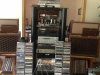

Glad you discovered something you like. Probably no one else will ever have that particular combination of vintage speakers together in a room for a long time.
Saw the title of this thread and thought "Oh boy, a stacker...where's Zilch when you need him?" Turns out to be an old thread Zilch was all up in.
Saw the title of this thread and thought "Oh boy, a stacker...where's Zilch when you need him?" Turns out to be an old thread Zilch was all up in.

woodj
Super Member
Yes.It's axiomatic: Multiple sources playing the same program material in the same space will interfere with each other:
woodj
Super Member
Yes.At low frequencies the sound doesn't care what shape it is, it's all pistonic.
One of the risks of more transducer out's than the recording transducer in's is the the soundstage may be affected.