• The move to the new server is done. There are some software and database maintenance updates in process. This has us passing the hat around to help out. We appreciate any donations. Seriously, even a dollar helps. The payment page may be found here - https://www.audiokarma.org/support.html

Stacking speakers

ADS Stacker

Ive had this as my main setup for a while now......I think 2 pairs of matched is prob the best.......Heres it L710 stacke.... NIKKO amps..one for each side...And my PS 5.0......
 
Ive had this as my main setup for a while now ... I think 2 pairs of matched is prob the best....
That's the rub, of course. Using pairs of identicals sets up the worst case for phase interference.

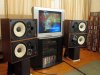
What's wrong with this picture:

attachment.php
 

Attachments

  • 4311 Stacks.jpg
    4311 Stacks.jpg
    72.1 KB · Views: 1,143
That's the rub, of course. Using pairs of identicals sets up the worst case for phase interference.

What's wrong with this picture:

The dust cap is dented :P~

It would be so much easier to tell you what isn't wrong with it..They're JBL's
 
I guess I would consider myself a "stacker" as well. Constantly trying out new stacking set-ups is a fun part of this vintage madness. Right now I have a pair of klh12's sitting atop a pair of hpm 100's. A macintosh 250 runs the 12's a sansui 9090db runs the hpms. Another stack I have is a pair of polk sda 2.3's and a pair of sansui sp3500's. A sansui 1000a runs the 3500's and a bose 1801 powers the sda's. Both these combinations sound very good to my ears and look quite impressive as well. I like giving each pair of speakers it's own amp as opposed to wiring in series so I can taylor the sound to my liking at a given time.
 
So whats that about......2 identicles..is no good.?
http://audiokarma.org/forums/showpost.php?p=1319817&postcount=3

Motorstereo, Robisme, and others have highlighted the potential benefits of using speakers having different capabilities and strengths in combination. That's just one step away from Powerman's setup, as example. The difference is you shut OFF what the several components do NOT do well so that they don't interfere with what's good about the other(s).

In Jackgiff's study of A-25s, it was clear that having the second woofer mutually coupling with the main enhanced the bass response. One approach would be to disconnect the tweeters in the second speakers so as to achieve that benefit while avoiding the apparent high-frequency interference problems. Even better would be to additionally install a low-pass filter on the second woofer at a frequency appropriate to optimizing the bass augmentation.

Alexkerhead reported a similar approach with his L100s here. His second pair effectively became subs, improving the overall performance of the mains.... :yes:
 
Stacking

So the debate continues..... Look, if you have a configuration that you enjoy, that is all that matters. So the data says this or that, okay, so you know that there are drawbacks in doing so. You still have to live with it in your own little world. Listen to both configurations and decide what's best for you and your own ears. Simple. Smoking cigarettes is bad for your health. Science has proven that, yet millions still do it. That's the beauty of it all, personal freedom of choice. So now you're armed with information and can make an informed decision. Completely up to you now. It's no crime to stack. I actually enjoy it. With respect to the phase problems, it's not the end of the world. Even in the best scenario, you could pick apart any system because of the mulitple types of anomalies inherent in any room or system. It just so happens that this stacking deal seems to pop up more often, than say, room modes and such. Stack 'em if you got 'em. You are the one that will live with them, not us. Listen with a single pair and listen to them stacked. It will either be :thmbsp: or :thumbsdn:
 
Depends on what you are stacking too.. when you have mids and highs stacked on subs, those more than likely will sound good.. but stacking 2 similar speakers, fed the same freqs.. well.. then it's a crap shoot.. some do.. some don't... I've had both results...

This is BY far the best sounding stack I have ever put together.. like they were made with this solution in mind.. I had a different speaker stacked on top of the subs, (the one on the floor beside the stack) and it sounded OK, but not the potential I knew it had.. It was a matter of finding the right mid and high cab.. and these were it..

(yes, another gratutious post, I still love sitting here looking at them :D)

attachment.php
 
"What's wrong with this picture:"

1: needs at least 4 more to even _think_ the words "line source".

2: needs a tv that is immune from magnetic fields.
 
So the debate continues..... Look, if you have a configuration that you enjoy, that is all that matters. So the data says this or that, okay, so you know that there are drawbacks in doing so.

Good post, Herr Meep. But I think what Zilch is battling, and what I try to help out with is that some (maybe a lot) of people don't know that there are drawbacks. Then they post here that they stacked these and those and it doesn't sound right and they're wondering why.

In the end, you're right. It's up to the listener and if they like what they hear then all is right in the world.

Ray
 
Many people who use speakers with wide freq dispersion patterns already deal with cancellations/phase problems from early reflections. Comb filtering in rooms is common place in high freq ranges. It's not at all surprising to me that people, in many cases, prefer the sound of stacked speakers, as they are used to the effects already from their rooms. The noticeable improvement in dynamics and reduction of distortion are probably more readily apparent to most then the phase anomolies caused by stacking. BTW, I don't feel that the 6db (if the amp can double it's power with half the impedance) is insignificant. It's a very noticeable and substantial increase in output.

All that said, I cannot argue with Zilch and Ray's points that there are compromises. Then again, just making bigger, more dynamic, lower distortion speakers may not be the solution either because it ignores a good portion of the equation (our hearing and the environment the speakers will be placed in). (quasi-)Anechoic frequency response graphs are nice, but to be really useful, I think it's important to see more than just FR on axis. Off-axis response at 15 degree intervals to 60 degrees would be nice start, in the absence of some waterfall plots and impulse response graphs.
 
Then again, just making bigger, more dynamic, lower distortion speakers may not be the solution either because it ignores a good portion of the equation (our hearing and the environment the speakers will be placed in).
"Better speakers" would include consideration of room interaction, presumably, with the objective of minimizing deleterious effects. If early reflections are a problem, I'd probably be looking to controlled directivity among other features and measures to achieve improved performance within the listening environment rather than exacerbating that situation with more sources.

The issue of reflective interferences was raised by Tube Overdrive in an earlier thread linked above. Virtually by definition, phase anomalies arising from room reflections are of a lower order than those generated by multiple direct sources, and the high-frequency ones are less problematic than low-frequency room modes in typical listening spaces. The Haas precedence effect plays a role in minimizing the significance of reflected sound, as well.

I'm going to stake out a position that, barring measureable deficits, the majority of us hear the same. It's the MEANING we ascribe to what we hear that varies and the subjectivist saw, "Everybody hears differently" is merely rationalization for our disinterest in, or our inability to discern, what's actually going on with "Personal preferences." Under controlled conditions, those preferences immediately reduce to a surprisingly narrow range among normal listeners, and absolutes become apparent.

The noticeable improvement in dynamics and reduction of distortion are probably more readily apparent to most then the phase anomolies caused by stacking.
Fellas that like Advents and A-25s and such HAVE to stack them to get halfway decent dynamics.
Indeed, there's little practical purpose here other than compensatory reaction.

More:

http://audiokarma.org/forums/showthread.php?t=96546
 
Harvey, it works best with matched pairs, frex my original Advents are stacked tweeter to tweeter, one pair connected to A the other pair connected to B on the CR-2040 and selector to A+B. This presents a 4 ohm load to the 2040 so stacked speakers must be 8 ohms or 16 ohms, never 4 ohms. Also don't pair 8 ohm speakers with 16 ohm speakers.

Thanks to all that replied....I doubt that I'll have another pair of Smaller Advents to stack with mine. Stacking the Advents and 2001's make for an interesting experiment, but I've put things back to the way they were. :yes:

Biding my time for the next set....would love a set of Vandersteen 2's or ADS L-810's....or....:scratch2:

Maybe I'll haunt GordonW's shop and see what's available.....need to get a few TT's serviced anyway :D
 
Personal preference rules everything in your life it can.

I'm going to stake out a position that, barring measureable deficits, the majority of us hear the same. It's the MEANING we ascribe to what we hear that varies and the tired subjectivist saw, "Everybody hears differently" is merely rationalization for our disinterest in, or our inability to discern, what's actually going on with "Personal preferences."

Well, you've certainly beat the drum enough that I'm sure that most readers around here have read your countless posts about the subject.
Everyone may ( or may not) hear the same, but the desire to continue to stack or to not stack is not measurable on a machine, nor can it be attributed solely to disinterest or an inability to understand the science.
It really does boil down to whether a person likes listening to their two pairs of speakers stacked, or just a single pair. The sound goes into their ears, it registers as either a "good thing" or a "bad thing". In essence, we like differently How's that for science Bud?
Speaking of an inability to discern, why is that so hard for you to understand?

To attribute it to some deficiency, and/or disinterest within another person is arrogant. It's like saying the same thing about another person that doesn't like a particular sandwich that you happen to really like ( of course the sense of taste is substituted for the sense of hearing/sound). You gonna join the Bon Appetit forum and beat a drum for Fried Bologna/Baloney because you think it's the Bee's Knees? I doubt it :D.

WARNING--WARNING-WARNING!! Does NOT compute, must re boot databank, cannot discern such malignant concept!! Cease and desist, CPU is above optimum operating temperature levels!! CLIO engaged, cannot hold out much longer...... Oh Lord, he's gonna STACK! No-no-no-no-no---..........Noooooooooooo:no:OOO:nono:OOOOOO!!!!! Too late, The China Syndrome has begun! :sigh:

--------------------------------OR---------------------------------------
The person will merely like it, or not......:yes: :smoke:
 
Stacking the Advents and 2001's make for an interesting experiment, but I've put things back to the way they were. :yes:
May we know more specifics regarding your "findings" as may relate to this discussion please? :scratch2:
 
"Better speakers" would include consideration of room interaction, presumably. If early reflections are a problem, I'd probably be looking to controlled directivity among other measures to achieve improved performance within the listening environment rather than exacerbating that situation with more sources.

The issue of reflective interferences was raised by Tube Overdrive in an earlier thread linked above. Virtually by definition, phase anomalies arising from room reflections are of a lower order than those generated by multiple direct sources, and the high-frequency ones are less problematic than low-frequency room modes in typical listening spaces.

I'm going to stake out a position that, barring measureable deficits, the majority of us hear the same. It's the MEANING we ascribe to what we hear that varies and the tired subjectivist saw, "Everybody hears differently" is merely rationalization for our disinterest in, or our inability to discern, what's actually going on with "Personal preferences." Under controlled conditions, those preferences immediately reduce to a surprisingly narrow range among normal listeners, and absolutes become apparent".

I'm not claiming to be a professional audio aficionado because I am not.
Still, I agree with Zilch that there are harmonics about any living space.
Does that mean that we should all remove the unpadded furnishings and
covers the walls and ceilings with 2.2 pound per square foot acoustic foam?
No, Does everything in life need a mathematical equation to make it work?
I think not, is it the belief of the majority of the psychiatric community that,
"Most" people believe that everyone else see's, hears, and believe's our own personal experiences the way we do, yes, but that is not reality as we are
though electro-chemically operative in similar fashion, and as well, biolically functioning quite the same. The experiences that we have beginning at conception, melded with our own genetic donor's DNA and our positions on each and every experience, affect our responses to each and every following experience. That being said, it is the belief of many that the believer's of the similar are the lonely and pushing the other away by
a personal percieved position of superiority most likely learned from a parent
that they lack the capacity to see the flaw in, and henceforth themselves.
So in other words, Stack how, "You" like the sound.
 
I'm saying that's a cop-out, evading the question and the fundamental underlying issues:

http://audiokarma.org/forums/showthread.php?t=120017

Particularly @83:

If anyone is interested in the subject of perception, Dr. Earl Geddes has published some very interesting papers on the subject. Perceived SQ isn't nearly as different between individuals as we might think...
Others have documented the same.

@66:

Naw, all I'm saying is the merit and value of preference or opinion must, by definition, be contingent upon the objective evidence it summarizes when the subjective is presumed to be inherently different for different observers.

If the objective is to ascertain which is better or worse in any sense, absolute or relative, then personal taste cannot have a role in that determination.

Alternatively, if taste rules absolutely, as some here posit, and there is, therefore, no better or worse, what of substance is there to discuss?

And Ozmoid's cogent synthesis @71:

AH - we're talking about two different things, no wonder I'm confused.

I can listen to the crappy car radio and enjoy it, if I like the song - high fidelity can go fly at that point, I'm just enjoying whatever I hear on a visceral level.

I can appreciate better quality reproduction of the music, and in fact I LIKE better quality reproduction of the music... but I don't see a universal acceptance of certain speakers/systems based on their "High Fidelity" specifications. I read too many threads here both trashing and loving the same speakers in the same system. Bound to be something going on there that an spl meter can't read.
Similarly, when there's such divergence as to the merits of stacking, particularly with respect to preferences, it's only appropriate to inquire as to what is actually gong on with these differential, indeed, opposing perceptions, and "Everybody hears differently" is at best an incomplete perspective, in my view.

OP requested an exploration of the theory of stacking and related issues; this is certainly a major one.... :yes:
 
Back
Top Bottom
