• The move to the new server is done. There are some software and database maintenance updates in process. This has us passing the hat around to help out. We appreciate any donations. Seriously, even a dollar helps. The payment page may be found here - https://www.audiokarma.org/support.html

stacking speakers

However, there are people who stack on sides, in which case you keep like drivers in alignment. The assumption with staking on sides is that the lower speaker has been raised from the floor sufficiently to have the mid/tweeter around ear level.

Are you referring to two stacked pairs, each speaker resting on it's side rather than standing upright? I've wanted to try this with a couple Wharfedale W60 pairs at some point. Or better yet, I'd be interested in creating a multi-tier system with a pair of woofers, a pair of cone-mids, and a pair of cone-tweeters, all facing forward/front-firing in a dual 3-way ported design, plus an addition dual-mid/dual-tweeter array on top in an open-air, free-mounted enclosure (like a gazebo) with all 4 drivers firing upwards.
 
I have my four original Advent stacks (quadraphonic) so the tweeters are at the top in each speaker instead of the usual prescribed flipped upper one.

I believe there is actually less interference between the tweeters this way than if they are closer together and it sounds better to me.

I also don't worry about series or parallel since each pair has it's own amplifier (four stereo amplifiers).

Doug
 
I have my four original Advent stacks (quadraphonic) so the tweeters are at the top in each speaker instead of the usual prescribed flipped upper one.

I believe there is actually less interference between the tweeters this way than if they are closer together and it sounds better to me.

I also don't worry about series or parallel since each pair has it's own amplifier (four stereo amplifiers).

Doug

Four Pairs???
In what space do you do this? Pics please?? :)
 
My present systems have JBL L35 with DCM TF 400s on the top. My other stack is Klipsch Quartets with DCM TF 600s on top. They both provide a sound that I am totally satisfied with and highly enjoy.
 
I have my four original Advent stacks (quadraphonic) so the tweeters are at the top in each speaker instead of the usual prescribed flipped upper one.

I believe there is actually less interference between the tweeters this way than if they are closer together and it sounds better to me.

I also don't worry about series or parallel since each pair has it's own amplifier (four stereo amplifiers).

Doug

When I had my Pioneer QX-949 up and going it could play up to 4 pair, 2 pair in front and two pair in the rear. Believe me, in that array, discreet quad is not necessary in order to impress. Stacked KLH's in the front and rear make for an unbelievable soundstage. Hopefully the 949 will be back from the shop soon so I can continue with the madness! :D
 
My best combination is the KLH 5's and 23's lying parallel with the 5's on top because of their added midrange. Big, almost live sound!

Six's stacked. Love it, amazing sound.
Now that I snagged a pair of Twenty Threes today, I'll have to try the Fives with them after a recap and reseal. A project for this winter.
 
Been experimenting with my jvc quad
Runs 8 speakers
Extra 2 in the rears great in quad mode
4 in the front stereo cool
Have to get all 8 simultaniously
I think is a good idea if you havent got stands
Two levels of sound projecting
 
I've never understood stacking.... why not simply get a larger more capable speaker?

Because I purchased two pair of KLH Fives -- an all or nothing deal. In my bedroom a single speaker would just fire directly into the side of the bed. The stacked speaker is at ear level. Since they match, they don't look as odd as one may think and they sound fantastic.

I would be curious to read what larger, more capable speakers you recommend for the $200.00 I have in these. Thanks. :D

Rob
 
I run ADS L710s stacked on top of ADS L520s. The L520s are rotated 45 degrees, giving an unorthodox appearance. I derived this configuration after consulting with other members of AK, and some experimentation. It seems that cross-overs are designed with the area of the front baffle as a primary factor. Stacking the speakers actually doubles the baffle area (if the speaker cabinets are the same size). Putting the corner of the L520 cabinets forward seems to avoid the increase in baffle area.

Why do I stack? The speaker pairs would strain from the output of my amp without the 'partnership' arrangement. Stacking also gives a larger (taller) sound stage.

I have them wired in series. Parallel hook up would drop the ohm load down below the capability of the amp.

Funny, I am stacking my ADS 620 beneath my ADS 880, the 880 is actually the smaller cabinet, it was a matter of space, and I am finding this to be a very nice array of sound with a giant sweet spot. And great bass dynamics.
 
i just recently bought some mordaunt short alumni 2 speakers (still awaiting their arrival ) i plan on stacking on my pioneer bs22's... - will let you know how it goes after i fiddle with them a bit.... ec
 
Whether stacked or simply used together--I've tried using two pairs of speakers together with the same amp or receiver. Since I don't have identical pairs of speakers, the usual problem is that the pairs I'm trying have different efficiency levels, so I mainly hear the higher efficiency pair. I hadn't thought of using separate amps for each pair. But considering sending the signal from one source through two amps at the same time, I find it hard not to expect inevitable ground loop hum.
 
I just setup my newly bought Polk Monitor 10 on the front/facing front and Realistic Nova 8B on the sides/facing each other about 8 feet away from the Polks. Both are running out of Pioneer SA 9800 that puts about 100 WPC... with 4 speakers its probably lower power?

Anyway, Polks are very nice...have some vintage flavor, somewhat open sound, OK bass, nice high freq handling and decent power.
Nova 8Bs are very vintage sounding...warm and easy. They have a bump in lower mid range.
None of the drivers in any speaker are disabled.

Polks in the front take over with volume leaving the Novas on the side with a nice headphone like stereo effect kinda like how surrounds work. The room is now getting very nicely filled and I don't feel sound is clashing.

I think when stacking, placement is the key and can solve the issue of similar drivers clashing. Unless you have identical models, its nice to be able to keep one pair dominant and other to 'add' as an effect....same concept as surround.

Once of the best things about using two different type of speakers in the same sound system is that you can switch speakers depending on mood and material.
 
I've been using stacked "Double Advents" for years. I hook them up so each pair is one 4 ohm speaker and drive them with an amp that has no issue with 4 ohm loads.

They sound great. Much better than a single pair. Most people stack them tweeter to tweeter, and I've tried that but can't tell a real difference from stacking them tweeter to woofer.

The biggest issue is making sure your amp can drive a 4 ohm load. Some amps will overheat if asked to drive anything below 8 ohms for any period of time.
 
I just pulled up this tread because I'm stacking my Advents today. I'm gonna wire them in series with the tweeter to tweeter combo. I'm using my Yamaha CA 810 integrated for a power source.
 
Doesn't stacking speakers play havoc with the imaging?

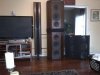
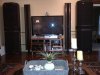
Not with 36 tweeters per side with vertical and horizontal line arrays. The XR19 sits inverted on XRT20 so its elipse of tweeters
are at design intention height. The Vertical array gives pointing the horizontal adss sound stage

Tall, wide and deep. Clarity and bass slam.
 

Attachments

  • IMG-20150110-00010.jpg
    IMG-20150110-00010.jpg
    63.7 KB · Views: 53
  • IMG-20150103-00009.jpg
    IMG-20150103-00009.jpg
    71.1 KB · Views: 40
  • 3ae030a3bc6752f4acd420b7f3cf08dc.jpg
    3ae030a3bc6752f4acd420b7f3cf08dc.jpg
    26.3 KB · Views: 21
Last edited:
Whether stacked or simply used together--I've tried using two pairs of speakers together with the same amp or receiver. Since I don't have identical pairs of speakers, the usual problem is that the pairs I'm trying have different efficiency levels, so I mainly hear the higher efficiency pair. I hadn't thought of using separate amps for each pair. But considering sending the signal from one source through two amps at the same time, I find it hard not to expect inevitable ground loop hum.

People have been connecting multiple amps to multiple speakers for yrs without any ground loop issues, I'm biamping my speakers at this very moment without any problems
 
Back
Top Bottom