• The move to the new server is done. There are some software and database maintenance updates in process. This has us passing the hat around to help out. We appreciate any donations. Seriously, even a dollar helps. The payment page may be found here - https://www.audiokarma.org/support.html

Starting to mod KLF-20 cabinet & crossover

I bet both are at work. seems you could use smaller dimension wood to brace and not lower volume all that much to make a diff. Just my 'non-speaker expert' opinion.
Either that or use lotsa fiberglass batts to eliminate any resonances and air volume stays the same.
 
I don't suppose the braces take up more than ten percent or so and some added damping made things right. The Quartet cabinets came from a wonderful Klipsch fan who is a retired Navy man and they have travelled the world. The cabinet were is such excellent condition and had such a wonderful colour veneer and grain there was no thought of new cabinets though that would be fine. Reflex designs can I am told be pushed to as much as 20% of ideal and still work but as I said the damping did the trick. If you want braces to work they have to be stiff and that requires size and structural integrity so the choice of plywood. I think that one could use a slew of 3/4" strapping to cross brace all the sides and if you tied the strapping together I am sure the results would be very good. Any braces are better than none but it takes little extra effort and to do the job properly. It did not require much additional damping to tune the speakers in fact we remover more than half of what we initially installed. Best regards Moray James.
 
I don't suppose the braces take up more than ten percent or so and some added damping made things right. The Quartet cabinets came from a wonderful Klipsch fan who is a retired Navy man and they have travelled the world. The cabinet were is such excellent condition and had such a wonderful colour veneer and grain there was no thought of new cabinets though that would be fine. Reflex designs can I am told be pushed to as much as 20% of ideal and still work but as I said the damping did the trick. If you want braces to work they have to be stiff and that requires size and structural integrity so the choice of plywood. I think that one could use a slew of 3/4" strapping to cross brace all the sides and if you tied the strapping together I am sure the results would be very good. Any braces are better than none but it takes little extra effort and to do the job properly. It did not require much additional damping to tune the speakers in fact we remover more than half of what we initially installed. Best regards Moray James.

I so agree with you about bracing and of course the correct damping materials give the audio equivelant of adding volume to a cabinet.
 
Moray James,
I got thinking about it and you have a great set-up there with two pairs of KLF-20s. Once you get one pair rebuilt you can do a live side-by-side comparison between the modded 20s and a stock pair. You won't have to try and remember what the stock pair sounded like since you have an actual pair there. Make sure you give us your impressions when you give them a good listening to. It would be nice to hear your initial impressions and then your later opinion once everything gets settled/ burnt-in. You could also tell us what is lacking soundwise in the stock pair. It looks as if you will get yours done long before I get mine finished. Later........

Larry

Larry: just checking in to see if you have been able to schedual any time for your KLF20 project any time soon. Will be very interested to see what you do and to hear of your results. I am going to play with some ABS pipe about half inch or smaller diametre split in half to use as structural braces for the KLF20 mid horn which has thin walls and they really flexes under hard drive from woofer pressure I expect. Please keep us posted as to your progress. All the best regards Moray James.
 
Louis: it would be great to see some pictures of your Dad's DIY work if you have a camera please post some so we can take a look. I am not that far behind you and am trying to make a living off of audio but it gets tougher every year it seems.
Thanks for your kind comments but I am not really a very good wood worker, fair but not good. While I do have training (wood products manufacturing) for me diy has always been a means to an end, to get something I could not otherwise afford. I have never done the DIY stuff because I loved doing it. For me DIY is an effort which requires much energy to see to its end. I do take satisfaction but I could never make a living rebuilding stuff. I guess the point is that with a little help most reasonably handy guys can make significant improvement to their gear with some effort. If you were looking to buy a new set of speakers which were as solid as the Quartets or the KLF's I posted pictures of you would be well into the 10K range. I think that Dan (SET 12) has the right idea in that the networks will be the easiest to upgrade and have a significant impact on the sound. If you can combine the networks and the cabinet you have a super combination and you can do it over time.
Speakers have always been the weakest link in the audio chain so any significant upgrades at the speaker can make a vast improvement in your system.
If you bought a used set of Forte ll or KLF20 for say $500.00 and spent $1500.00 on top quality crossover parts and diaphragms then if you bought a used ASL AQ1003DHT integrated amp for $500.00 you would have a superb basic system for $2500.00. By audiophile standards that is next to nothing. For most guys I know that's not chump change but think what most guys spend over say ten years attempting to upgrade their systems. It is money well spent in my mind. A good friend who has had a set of Harbeth HL5's for a couple of years now was shocked when he heard my brothers Quartets with only minimal work on the crossovers. His Harbeth's set him back $5200.00 plus another $600.00 for the stands. Used Klipsch and some DIY effort can bring a lot of audio satisfaction for a very reasonable outlay. Best regards Moray James.

Moray
I have not for gotten about the pic's of the speakers. They are so big and in the back of the storage room and furniture is in the way. I am having a rotator cup operation soon...sigh 61.... and not able to the furniture or much less turn them around to take photo's of. In the next few weeks I will pay my son's friends to move them into my garage so this winter I can restore them.
It was 104 again today here in Texas...just too hot to work outside for a old Man.
Louis
 
Louis: looking forward to seeing some photo`s of your pop`s handy work. Good luck with the rotator cup, I am looking at a new hip asap myself. 104 degrees is way too hot for me stay cool. Paying your son`s friend to move stuff is money well spent especially in this heat. Best regards Moray James.
 
Great thread, I have a set of KLF-20's (2003 model, I think that's the last year for them) and have ordered the Ti's for the tweeters.
I'll take a good look at the interior when I get them down and apart, I'll try to check for loose or poorly glued boards.
I'm not a woodworker by any means, so I'm afraid if I find some problems, I won't be able to fix them.

Thanks again for this thread.
 
Still hoping to see pictures of the cabinets/speakers - you all have me quite interested after reading through the thread!
 
Heather: here is a good thread with pictures showing a nice rebuild to a set of Klipsch CF3. This is similar though not quite as complex as the Quartet build shown in this thread all the same it is a very good job. Larger cabinets will require larger braces for big jobs panel braces should be a minimum of 1.5" x 3.75" plywood and stringers can be 1" x 2" stock fir or pine or you can use ply if you like. A single panel brace will raise the panel resonance one octave two brace two octaves and three is usually more than you will need but it pushes up the panel resonance by three octaves. Important to make the front baffle as stiff and rigid as possible, a solid brace between the woofer and the horn is a good plan.
Do you have a set of speakers in mind for a rebuild (your JBL's)? Best regards Moray James.

PS: how do you like the smith horns?
 
OK, I'm ready to start! LOL, it's only been a year.

I think I have most of the material.

Just a couple questions.

Any reason not to use Gorilla Wood Glue? I already have a large bottle.

I've looked and looked at the pictures. Looks like a alot of custom cut pieces, all I have is a skill saw and very little in the way of wood-skills. I don't suppose there are more pics or plans or parts list that maybe I haven't seen?

Not clear on how to "tune" the cabinet dampening. I have dynamat for that also.

No changes planned for the ports.

So, it will be baffle\panel re-gluing, bracing, wrapping horns(s) and Crites Crossovers. I already have Ti tweets.

I think that's it.
 
Last edited:
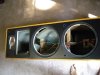
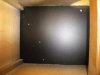
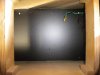
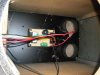
OK, first speaker dissasembled.

Glue is on the light side, a decent bead for about 80% of the front\rear baffle seams. 10% the bead is light and 10% non-existent.

Do ya's think that I can just add glue where there isn't any, and install the bracing. I have whacked on the baffles with my hand and it certainly changes tone depending on where I hit... but there's holes in the thing, that would change the tone, I would think.
 

Attachments

  • Klipsch KLF-20 Pre00.jpg
    Klipsch KLF-20 Pre00.jpg
    73.7 KB · Views: 430
  • Klipsch KLF-20 Pre01.jpg
    Klipsch KLF-20 Pre01.jpg
    33.1 KB · Views: 288
  • Klipsch KLF-20 Pre02.jpg
    Klipsch KLF-20 Pre02.jpg
    63.5 KB · Views: 286
  • Klipsch KLF-20 Pre03.jpg
    Klipsch KLF-20 Pre03.jpg
    66.3 KB · Views: 267
  • Klipsch KLF-20 Pre04.jpg
    Klipsch KLF-20 Pre04.jpg
    70.7 KB · Views: 340
I see the plastic ports are friction fit. Do you guys do anything with that? Seems like a potential source of vibration\rattle?

EDIT: Where do you get something like this? I'm thinking 1.5"x3.75" is essentially a 2x4.
Moray Quote: minimum of 1.5" x 3.75" plywood and stringers can be 1" x 2"

EDIT: Not sure what Constrainted Layer Dampening is. I'm planning on using Dynamat tape for the horns and the flat thick dampening for the cabinet.
"Constrained layer damping also hepls on the tweeter horn as does a patch of dynamat on the back side of the compression motors"

EDIT: Aren't these baffles this melamine crap that you can't get glue to stick to!!??
 

Attachments

  • Klipsch KLF-20 dynamat.jpg
    Klipsch KLF-20 dynamat.jpg
    58.3 KB · Views: 186
Last edited:
man those pictures look like my 30's i did the cabinet repair on back in June. same color, same cobwebs inside, same bracing. Did you add the bracing yourself? mine had none but i added some that look almost exactly like that.

the hardest part of my project was gettting the front and rear baffles off. they were loose, but not completely. rubber mallet + very ridgid painters tool helped a lot.

one of mine is missing its ports, which i'd pay REALLY good money for if anyone happens to not want theirs. :-)
i have read that lengthening them a couple inches adds a wee bit more bass extension. but theres always a compromise. And to be honest i can tell zero difference in sound between teh speaker with the plastic port cuff things and the one with just bare wood holes.

keep posting, i plan to dynamat my mid horns in the near future.

if you have a dremel the grinder bit will peal that melamine off pretty easily. but that stuff is nasty. glasses and mask are almost 100% required.
 
Get a rubber mallet

OK, first speaker dissasembled.

Glue is on the light side, a decent bead for about 80% of the front\rear baffle seams. 10% the bead is light and 10% non-existent.

Do ya's think that I can just add glue where there isn't any, and install the bracing. I have whacked on the baffles with my hand and it certainly changes tone depending on where I hit... but there's holes in the thing, that would change the tone, I would think.

give the baffle a good whacking all around. If the baffle is loose you will hear it slap when you hit it with the mallet. If it is sound you are good to go. If not I suggest you remove it clean it off then remover the melamine and re glue the baffle with white glue. I don't like using adhesives which expand (URETHANE)
Dynamat is constrained layer damping. Don't use dynamat on the cabinet.
You can laminate layers of 3/4 ply to make a grace 1.5" thick by what ever width you like.
 
Moray why not use the Dynamat on the inside walls of speaker cabinet? I have used it to line the inside of a auto door, then installed a upgraded car speaker. It sure helped. With the stereo off the road noise was much less. Crank up the amp and step outside and close the car door, much less music could be heard outside. My neighbor when he replaced the carpet in his Corvette lined the floor with Dynamat after he laid down a heat insulator then new padded carpet.....wow his vette is quiet inside. I read you only used Dynamat to line the woofer spider or maybe wrap a metal K700 horn etc. :scratch2:

What could I use to line the inside walls in my Cornwall I ? Use the same liner Klipsch used on the side walls for the back board or?? . While I have them opened up again to make a brace liked we discussed.
Thanks For All your Advice.
Louis
 
Hey Louis: dynamat is great for steel car parts like hood trunks doors roof floor and such that's what it is designed for. Dynamat is not suited for 3/4" mdf so a waste of money. Better to brace to stiffen speaker panels. I uses dynamat on speaker baskets magnet structures and horn bodies and it works great. I use S.A.E. rated F-11 acoustical felt to damp spider talk and inside compression drivers and to damp hi frequency radiation of woofers as an acoustical filter right over the woofer. Best regards Moray James.
 
Hey Louis: dynamat is great for steel car parts like hood trunks doors roof floor and such that's what it is designed for. Dynamat is not suited for 3/4" mdf so a waste of money. Better to brace to stiffen speaker panels. I uses dynamat on speaker baskets magnet structures and horn bodies and it works great. I use S.A.E. rated F-11 acoustical felt to damp spider talk and inside compression drivers and to damp hi frequency radiation of woofers as an acoustical filter right over the woofer. Best regards Moray James.
Thanks I understand. I will Google F-11 felt...does it matter that my Cornwalls are birch plywood and not MDF like my Heresy II ? Or is this the same principle ...not metal for Dynamat use.. :scratch2:
 
The dynamat I use for baskets is about 1/16" thick or so and not designed for cabinet panels though I am sure it would eat high frequency but that is not the issue in cabinets and the cost would be very high for very little. I use the F-11 felt which is !/8" thick it is very handy to have around. Hope this helps, best regards Moray James.
 
Thanks for the info, Moray.

Looking at your pic,
http://www.audiokarma.org/forums/attachment.php?attachmentid=291474&d=1312607498
it looks like a freakin' rubiks cube. And how to you glue those horizontal braces to the front\rear baffles with the melamine? Do you remove the melamine at those attachement points also?

Have to admit, I'm not going to pull the baffles. I'm not going to scrape the glue, remove the baffles, grind off the melamine, clean and scrape some more and then re-glue the baffles. If I had a woodshop, maybe. In my spare room, I don't think so.

That's simply too much work. I'll sell these bitches and just go buy some speakers that were built properly in the first place.

Ya, they are nice speakers and I thought this would be do-able, but now that I'm looking at the actual details, I'm not so sure.

Unless I have a change of heart, this ain't happening. I'll continue with wrapping the horns, replace the crossovers and *maybe* F11 felt the inside. At this point, there's not going to be any woodworking.
 
Back
Top Bottom