• The move to the new server is done. There are some software and database maintenance updates in process. This has us passing the hat around to help out. We appreciate any donations. Seriously, even a dollar helps. The payment page may be found here - https://www.audiokarma.org/support.html

Strobo vs no strobo

sssboa

Super Member
Hi

I am interested in 1970s gear only. Just bought Yamaha YP-511, it has a strobo light which I wanted.

Could someone tell me why some turntables have it and some not? If a TT doesn't have it does it mean that the RPM is off all the time (especially after 40+ years) or does it mean that it's so stable and excellent that does not require fine tuning?

Thx,
Andy
 
Register to hide this ad
Could someone tell me why some turntables have it and some not? If a TT doesn't have it does it mean that the RPM is off all the time (especially after 40+ years) or does it mean that it's so stable and excellent that does not require fine tuning?

IMO and IME, in most cases, strobes are "eye candy", just like meters on amplifiers. Yes, they can be relevant, but they have no bearing on the ability of the table to hold an accurate and stable speed. Different tables and different drive mechanisms use different types of speed controls. I have DD and belt drive tables (sorry, no idlers--yet) with and without strobes, and they use a variety of speed control implementations--none specifically better or worse than another.

It all depends upon the engineering/build quality/implementation. If you have to constantly "tinker with" or "fine tune" the pitch to match the strobe, then you basically have a poorly designed/built table on your hands.

Being that you are only interested in 70's tables, what is to say that the on-board strobe is 100% accurate? Old xenon or neon strobes have electronic components (capacitors/resistors) that can fail/degrade with age, as can electronic components in some speed control mechanisms. So either the platter speed and/or the strobe could be out of calibration.
 
I personally like a strobe because its an easy way to see if my tables speed is right on.
I use an app on my iPhone called Turntabulator to confirm speed also. All of my tables
with strobes have always been calibrated exactly right. To me it's not just eye candy.
 
A visual platter strobe has nothing to do with any speed control of the table. It's there for the operator to see and if it has pitch controls they can adjust by using it. You can buy a hand held strobe and in most cases they are more accurate and easier to see and use.

How many cars have a built in timing light? You only need the timing light when making adjustments.
 
I personally like a strobe because its an easy way to see if my tables speed is right on.
I use an app on my iPhone called Turntabulator to confirm speed also. All of my tables
with strobes have always been calibrated exactly right. To me it's not just eye candy.

You contradicted yourself all in in one post--if the speed is accurate and consistent via other means of measurement, then the strobe is irrelevant--it is just eye candy. The speed control is apparently effective and the table is running properly (strobe or no strobe). I use strobe discs and phone apps to measure my tables as well, but the table is either accurately calibrated or it is not, regardless of an on-board blinking light.
 
If a table has adjustable speed, it makes sense to build in a strobe so the owner can keep it adjusted. If it doesn't (line operated synchronous motors) a strobe would just highlight the fact that the speed was always a bit off, and annoy people. As for the accuracy of line operated strobes like neon bulbs, they'll be as good as the line frequency, which is usually far better than needed. There's no electronic aging or defect that can make them wrong- they either work or they don't. Old neon bulbs do sometimes get unreliable and flicker or fail to light. I'm not aware of any vintage tables with other than line operated strobes, though they might exist.
 
What's the opposite of eye "candy"? Eye "barf"? I have a Micro Seiki DQX-1000 and a Denon DP80; both have strobes, with bulbs and stripes. The Denon has a discreet little window you check when setting pitch manually, or just to be sure — otherwise it's invisible. That's all you need. The DQX, OTOH, has huge black and silver stripes and bright orange light that's always on (why orange?). I love the design of the DQX but the strobe system is needlessly big and garish, like a billboard in Times Square, a big design flaw IMO. I have mine at the back so I don't have to see it; it's there when I want to check or set speed, invisible the rest of the time. It's only needed occasionally, and only for a few seconds — I'd install on On/Off switch if I could find an elegant place for it.
 
I'm not aware of any vintage tables with other than line operated strobes, though they might exist.

Most of the vintage (70s) quartz lock turntables used Neons and drove them from the divided down quartz reference- not the line frequency, as it wanders way too much for quartz locked DDs. Several Q/PLL Sonys (PSX-5/6/7 etc) Technics did it with the SP10mk2 etc.

psx6.JPG

sp10mk2.JPG


Any single point strobe marking platter meant neons were driven by frequency divided quartz references.

The Technics SL-1200mk2+ is an LED strobe and driven via the quartz oscillator. A bunch of JVCs, Akais and Pioneers from the very early 1980s also used quartz derived LED strobes (sometimes 3 or 4 LEDs in the reflector) with adjustable pitch and often a single point strobe.

Once LEDs got bright enough to illuminate strobes- Neons were of course ditched- good riddance if you ask me.
 
Last edited:
Most of the vintage (70s) quartz lock turntables used Neons and drove them from the divided down quartz reference- not the line frequency, as it wanders way too much for quartz locked DDs. Several Q/PLL Sonys (PSX-5/6/7 etc) Technics did it with the SP10mk2 etc.

View attachment 1209358

View attachment 1209359


Any single point strobe marking platter meant neons were driven by frequency divided quartz references.

The Technics SL-1200mk2+ is an LED strobe and driven via the quartz oscillator. A bunch of JVCs, Akais and Pioneers from the very early 1980s also used quartz derived LED strobes (sometimes 3 or 4 LEDs in the reflector) with adjustable pitch and often a single point strobe.

Once LEDs got bright enough to illuminate strobes- Neons were of course ditched- good riddance if you ask me.
The quartz locked strobe on a quartz pll table indicates motor pll lock when such mode is in operation. Otherwise with a quartz pll table with variable speed, it shows relative variance from perfect reference speed.
On a non-quartz pll table, the strobe light reference is the power line frequency, and provides a relative standard to adjust platter speed to nearly exact correct rate.
 
Interesting! As you can see, I haven't worked on the quartz pll tables. IMO, neons were OK when new, but suck when they get old. You can make a really nice strobe light with two bright white LEDs and an AC wall transformer. Run the LEDs in parallel, in opposite directions with a limit resistor. To really sharpen up the bars, add a zener in series with each LED so they only turn on for a small time at the peak of each cycle, rather than most of the cycle.
 
I like eye candy. My strobe on my table is eye candy. I can't get enough eye candy. I use a record weight too, which some say is eye candy. The more eye candy the better.
Did I say eye candy?
 
Something tells me fredjones uses insulin eye drops :)

I have stuff with strobes but more without. Its a handy thing but its also not something I can't live without. Considering most of my stuff has no ability to adjust speed anyway, the strobe is not exactly all that critical for me.
 
Most of the vintage (70s) quartz lock turntables used Neons and drove them from the divided down quartz reference- not the line frequency, as it wanders way too much for quartz locked DDs. Several Q/PLL Sonys (PSX-5/6/7 etc) Technics did it with the SP10mk2 etc.

View attachment 1209358

View attachment 1209359


Any single point strobe marking platter meant neons were driven by frequency divided quartz references.

The Technics SL-1200mk2+ is an LED strobe and driven via the quartz oscillator. A bunch of JVCs, Akais and Pioneers from the very early 1980s also used quartz derived LED strobes (sometimes 3 or 4 LEDs in the reflector) with adjustable pitch and often a single point strobe.

Once LEDs got bright enough to illuminate strobes- Neons were of course ditched- good riddance if you ask me.
Hi John,

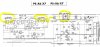
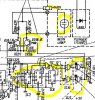
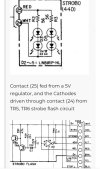
Please find below the schematic for my Denon dp-80 .. I read that it uses the magnetic strip in the inner side wall of the platter to strobe.

How are then its neon bulb driven ? I am not electronics savy but hope to learn what I have.

Thanks and cheers.

Screenshot_20240222-203515_Drive.jpg20240222_184447.jpg
 
"How are then its neon bulb driven ? I am not electronics savy but hope to learn what I have."

Neon bulbs are unfailingly accurate. They flicker with the mains line frequency. The range is usually held within ±0.5%, so its from 59.7Hz to 60.3Hz for a 60Hz grid. Any bulb that flickers (incandescent, fluorescent or neon) "turns on and off" 60 times a second if your line frequency is 60 Hz.
Strobe lamps are "Stupid Simple".

Quartz lock circuitry is more complicated.
It can and will fail as components (capacitors) age. Failure is not uncommon.
 
Last edited:
None of my tables with strobes (a couple of Technics DD, Thorens TD124, Revox 795, Dual 1229) hold 100% at 33.3333 RPM anyway and there's nothing I can really do about that. I don't hear the speed fluctuations the strobe is telling me are there, and comparing music on the TT to CD I don't hear it either.

Looks cool though. Maybe that's the point.
 
IMO and IME, in most cases, strobes are "eye candy", just like meters on amplifiers. Yes, they can be relevant, but they have no bearing on the ability of the table to hold an accurate and stable speed. Different tables and different drive mechanisms use different types of speed controls. I have DD and belt drive tables (sorry, no idlers--yet) with and without strobes, and they use a variety of speed control implementations--none specifically better or worse than another.

It all depends upon the engineering/build quality/implementation. If you have to constantly "tinker with" or "fine tune" the pitch to match the strobe, then you basically have a poorly designed/built table on your hands.

Being that you are only interested in 70's tables, what is to say that the on-board strobe is 100% accurate? Old xenon or neon strobes have electronic components (capacitors/resistors) that can fail/degrade with age, as can electronic components in some speed control mechanisms. So either the platter speed and/or the strobe could be out of calibration.
A lot of strobes just use the line frequency as a reference, such as neon ones. Works fine that way.
 
Neon bulbs are unfailingly accurate. They flicker with the mains line frequency. The range is usually held within ±0.5%, so its from 59.7Hz to 60.3Hz for a 60Hz grid. Any bulb that flickers (incandescent, fluorescent or neon) "turns on and off" 60 times a second if your line frequency is 60 Hz.
Strobe lamps are "Stupid Simple".

Quartz lock circuitry is more complicated.
It can and will fail as components (capacitors) age. Failure is not uncommon.
Thanks !

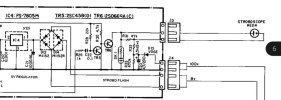
Can I then conclude that my dp-80 seen here from the strobe schematic is NOT quartz lock circuitry but simply strobed neon tied to mains frequency with one end to the anode with SK1 denoted "spark killer" after the 100v mains?

But what then are the function of the 2 transitors and bunch of electronic components for that are connected to the cathode of the neon lamp ? I had thought that this "strobes" i.e. quartz locked and not the mains frequency and yes, dp-80 has a selectable 50/60hz switch. Or they are still needed to convert mains frequency to strobe the neon i.e. not quartz lock?

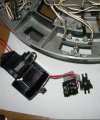
Further query is that main frequency driven strobe can be with both neon and also led ? Reason I asked is that later similar denon dp-75 uses leds still with the same transistors etc. with added 5v supply IC to power the leds as shown below ..and not neon in the dp-80m

Thanks again and cheers.

20240223_000835.jpg
 
Last edited:
I'm not sure what's going on with that circuit.
Easy enough to check accuracy using an external light source against the strobe dots.
 
Back
Top Bottom