• The move to the new server is done. There are some software and database maintenance updates in process. This has us passing the hat around to help out. We appreciate any donations. Seriously, even a dollar helps. The payment page may be found here - https://www.audiokarma.org/support.html

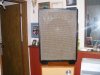
Stromberg-Carlson? Anyone?

As for the sound... It's pretty damn good, if I do say so myself. The bass is clear and very tight and the high end is much better than I was expecting from the co-axial tweeter.

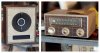
So now my new basement/shop system is a sweet old Stromberg-Carlson tuner (model 404) running through the AR-415 amplifier and powering this Jensen K210-based speaker. To quote Ronald McDonald: "I'm loving it!"

four.jpg

three.jpg
 
That thing was probably operated in an open baffle type arrangement anyway. If it gets funny, just pull the back off and let it go. Thats a very similar looking driver to the factory one in my EH Scott 800B. That thing has better LF response than you'd probably expect, and its in a big open cabinet.

While the tools are out, I'd make a 3/4 size back panel to try if the driver doesn't like a closed box. It will allow it to breathe without looking unfinished.

Those old drivers benefit from a bass reflex port in the front baffle when installed in a sealed box.May want to supliment the top end with an added compression horn,married together they would sound great.I will be driving vintage co-axials {Stephens} with my SC ap55 mono block..there getting close to finished on the bebuild

hunter

Thanks to everyone here for the VERY helpful comments. They saved me from wasting a lot of time.
 
One of the best features of the AR-415 amp is the magical, jewel-like power indicator light. In a dimly lit room this ruby pinpoint looks like the gateway to another world. It reminds me a bit of a short story by Jorge Luis Borges, The Aleph, in which the author finds a point on the underside of a stairway in which everything happening in the world at that moment can be seen.

There is very little magic left in the modern indicator lights.

five.jpg
 
Last edited:
I like jewel lights. Much cooler looking than an LED. Its the reason I retained the original light on my Dyna PAS2 actually. LED is easier, but doesn't look as cool.
 
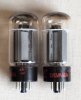
I have more or less left the AR-415 amplifier untouched. I haven't replaced any tubes or capacitors yet, mainly because it sounds really really good as it is. It turns out to be running on a beautiful old pair of Sylvania 6L6-GC's:

6L6_GC.jpg

In addition to powering the radio in my shop, I also occasionally hook the old Stromber-Carlson up to a Brookstone pocket LCD projector and a Polk monitor 5 jr (92 dB sensitivity) to make a compact home theater set up.

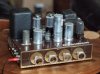
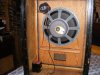
Here is a shot taken when I was cleaning up the insides.

cover_off_front.jpg
 
Lovely restoration ! To add to their list of engineer - experts - Stew Hegeman worked for them for quit awhile as well.About forty years ago I heard one of the the labyrinth (TL) speakers from that era -sorry I didn't buy it (probably would still be looking for a mate).
 
I got the impression from your first report that the amp was still being used regularly, hooked up to a turntable. Maybe that's why the electrolytics are still good. (For now!)
 
As for the sound... It's pretty damn good, if I do say so myself. The bass is clear and very tight and the high end is much better than I was expecting from the co-axial tweeter.

I have now listened to this Jensen 210-based speaker in the basement/shop (a.k.a. the REAL man cave) for a couple of months. Initially, I found the sound acceptable, but the longer I listened the more its flaws began to bother me. There is no problem with the amp or tuner, because when I hook them up to a nice, store-bought speaker they sound fantastic. When hooked up to the Jensen-in-a-box, however, the highs are blunted and the mids and lows sound 'boxy'. By pressing on the cone, twiddling the tone controls, and putting my ear down into the heart of the speaker I determined that almost no sound was coming out of the coaxial tweeter. Maybe the tweeter was doing more in the beginning, when I first mounted it in the box, or maybe my opinion was biased by the fact that I was surprised to hear anything come out of that old driver.

At any rate, I finally decided to do a few tweaks and upgrades to this speaker. I removed the front baffle and exposed the crossover components by pulling the back cover off the driver. The cover was attached by metal tabs pushed into slots on the basket and then bent to prevent them from sliding out. I couldn't easily get to the tabs from the inside without removing the cone, so I used a screwdriver and CAREFULLY pried them out. The cover came off with minimal damage to the slots.
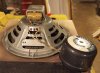
cover_off_sm.jpg

It was like opening an Egyptian tomb. Inside the cover was an ancient wax paper capacitor and two derelict resistors. The resistors were positioned in an attitude of prayer, as if paying homage to the great yellow capacitor god. One resistor was so corroded that the ceramic housing broke in two when touched (red arrow in photo below). The wires were green with verdigris and corrosion and they also disintegrated at a slight touch. I worried that maybe I had unleashed the Curse of the Forbidden Crossover.
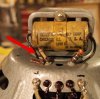
blown_resistor_sm.jpg

The resistors and their leads were so decrepit it was impossible to measure a stable resistance, but the color coded hieroglyphs said they were 3.3 Ohm +/- 10%. The capacitor was nominally 2 µF but metered at 3.8 µF, and the solder joint between the two resistors had been pressed into the side of the capacitor so hard that the wax deformed and flowed around it.
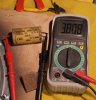
metered_cap_sm.jpg

I replaced the (3.3 + 3.3 =) 6.6 Ohm resistance with a single 7.5 Ohm power resistor and the 2 µF capacitor with a pair of 1 µF Dayton Audio caps left over from a previous recapping job. I soldered and heat-shrinked everything together and stuffed the components back into the original sarcophagus ... I mean mounting strap. I used a couple of dollops of hot glue to hold the parts together and stabilize the connections.
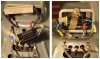
CR_stuffed_sm.jpg

I then carefully fitted the cover tabs back into the slots and tapped them into place with a wooden mallet. The tapping helped bend the margins of the slots back toward their original shape, and the cover ended up fitting pretty tightly. The connection had no play and didn't feel like it would come apart spontaneously, but I add a couple more dollops of hot glue to make sure nothing worked loose.

Finally, I increased the amount of stuffing inside the cabinet. Initially, I just stapled some polyester batting to the walls but this time I packed the insides full (additional stuffing not shown in the photo below). Finally, I said a few verses from the Egyptian book of the dead, drew a few protective hieroglyphs, and remounted the front panel .
stuffed_cabinet_sm.jpg

The sound out of the Jensen-in-a-box is now VASTLY improved. The lows have always been pretty sweet, but with the extra stuffing they no longer sound so boxy. More importantly: the tweeter is IN THE HOUSE. I sat down in the basement with a beer for about an hour, just listening to the local jazz radio station and marveling at how the brushed snare drums no longer sound like white noise and Miles Davis no longer sounds like he is trapped in a refrigerator box.

 
Last edited:
Very nice project and entertaining write-up!

I read somewhere that increasing the amount of insulation in ported enclosures decreases efficiency. Have you noticed any difference before and after?
 
Very nice project and entertaining write-up!

I read somewhere that increasing the amount of insulation in ported enclosures decreases efficiency. Have you noticed any difference before and after?

Thanks!

I haven't done anything to check the efficiency but that is a good question. I should try and figure that out since the power budget of this amp is only twelve watts.
 
Enjoyed reading your project. Would be nice if we could hear the results to yours and other projects on AK. Like being able to taste the food on tv cooking shows.
 
Yes was an interesting read Dyche ,always good to get the updated opinion after recapping/modifications take place.
If I could make a suggestion my experience with the co-axials/full rangers is they realy shine when a compression horn is integrated in the cabinets like I did with my Stephens FR150's in my pic.
I just completed another speaker build with a Goodwin find,a lovely mint pair of JBL D130F full rangers in well built pro cabinets,the drivers were untouched/mint condition bought for small change.I removed the front baffles and installed another pair of JBL 075 {mirror imaged}horns into each cabinet and the speakers were transformed!!I smile every time there fired up with my old HHscott tube amp
a suggestion anyways they would compliment those Jensens for sure

hunter
 
Yes was an interesting read Dyche ,always good to get the updated opinion after recapping/modifications take place.
If I could make a suggestion my experience with the co-axials/full rangers is they realy shine when a compression horn is integrated in the cabinets like I did with my Stephens FR150's in my pic.
I just completed another speaker build with a Goodwin find,a lovely mint pair of JBL D130F full rangers in well built pro cabinets,the drivers were untouched/mint condition bought for small change.I removed the front baffles and installed another pair of JBL 075 {mirror imaged}horns into each cabinet and the speakers were transformed!!I smile every time there fired up with my old HHscott tube amp
a suggestion anyways they would compliment those Jensens for sure

hunter

Funny you should mention this. I have been planning to build a new speaker for this system for a while, using a Bozak B-199 bass driver and a B-209 midrange. I am not impressed by the B-200Y tweeter, however, so I was planning to incorporate a compression horn, a la the econo-wave movement. I just bought a JBL horn and compression driver from Parts Express. I have all the pieces except for the crossover and the cabinet.
 
What I did concerning the x-over is I used a pair Electrovoice x-36 crossovers with my d130'/075's they xover a bit higher then the stock jbl n2600 xover network.My speakers are now basically c38 cabinets with a system 30 (d130; 075; n2600 16 ohm) configuration minus the jbl xover. These sound stunning now as is indicated with going prices on JBL C-38's driven by my tube amps..As far as cabinets you will want something with a bit more volume..a few pics of my jbls

hunter
 

Attachments

  • DSCF1911.JPG
    DSCF1911.JPG
    106.7 KB · Views: 28
  • DSCF1904.JPG
    DSCF1904.JPG
    123.1 KB · Views: 25
  • DSCF1908.JPG
    DSCF1908.JPG
    106.5 KB · Views: 29
Oooh! Very handsome speaker. I like the grill cloth.

I have components to make a bespoke crossover but I will have to put this project on hold for a couple of months.
 
UPDATE: The ever-excellent @royzilla just hooked me up with a sweet old pair of 12" Rek-o-Kut (Audax) A-12D coaxial drivers. One is entirely mint while the other is...well... let us say: not.

So, what to do with only one driver? Oh, I know! Upgrade the monophonic system speaker. Some months ago I moved this system up from the basement and into 'writing nook' at the back of the house. I have had a complicated plan for replacing or upgrading this speaker for a long time but, since I sit almost on top of it when I am working, I have been reluctant to build something with separated drivers. The Rek-o-kut was perfect, not only because it was coaxial but because the mounting holes line up exactly with the holes drilled for the old Jensen driver.

I run the old S-C tuner, which gets great reception here, and the line audio out of the computer into the Stromberg-Carlson amp. With the new driver, the system sounds fantastic. The main improvement over the old Jansen is the extended and super-clean bass.

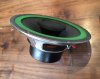
Here is the new driver. Note the excellent 'kermit-the-frog' green surrounds.

driver_table.JPG

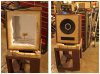
Here is the system in situ, with the old Jensen coaxial driver.

speaker_before.JPG

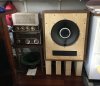
...and here it is with the new driver.
speaker_after.JPG
 
Last edited:
Back
Top Bottom