• The move to the new server is done. There are some software and database maintenance updates in process. This has us passing the hat around to help out. We appreciate any donations. Seriously, even a dollar helps. The payment page may be found here - https://www.audiokarma.org/support.html

stromberg carlson rp 721

Yea, I assumed that high efficiency speakers would really be necessary. Am I correct in the understanding that the 110 is a single ended triode amp?

Not single ended triode, just single ended. The 6V6 is a beam power tube, not a triode.

Single ended just means it uses one output tube per channel. Your amp chassis was actually used for 3 different models: The ASR-110, 120, and 130. Never seen a 130 but you can see on yours the extra tube sockets that are plugged. If yours was the 120, it would be using four 6V6 (7408) tubes, two each per speaker which is called push pull operation. Just look up "single ended and push pull" to learn more.

Single ended triode would be an amplifier which uses triode type of tubes for the speaker output.

This should help you out in your tube journey:

https://en.wikipedia.org/wiki/Vacuum_tube
 
Last edited:
Yes, it is the provincial/fruitwood version. Super heavy. I will make a new thread for it once I have it and can take some pictures of it.

Congrats! on your find and if it were me I would be keeping that one as opposed to the S-C. Don't get me wrong the SC is nice but that Fisher looks very nice!

Look forward to the thread and of course the pics, I'm the Fisher folk will too.
 
The Fisher Philharmonic is a receiver chassis, doesn't look quite so nice out of the box. I've got one from a slightly later Philharmonic. The IV I think? The Fisher is probably the better performer. I might rehab the S-C for practice and sell it for enough to pay for the refresh on the Fisher. Its a simple unit to rehab and the experience is worthwhile.

I personally like to use a wood revitalizer like Older English to bring it up.

Restore-A-Finish is pretty similar, but with a smidge of stain to blend out scratches and water spots. Its usually applied with 0000 steel wool. Ends up doing a nice job of buffing out minor finish issues without having to do a full strip and re-work.
 
Not single ended triode, just single ended. The 6V6 is a beam power tube, not a triode.

Ahh I see now, thanks! Very cool.

The Fisher Philharmonic is a receiver chassis, doesn't look quite so nice out of the box. I've got one from a slightly later Philharmonic. The IV I think? The Fisher is probably the better performer. I might rehab the S-C for practice and sell it for enough to pay for the refresh on the Fisher. Its a simple unit to rehab and the experience is worthwhile.

Thats a great idea! I think I will do that. The thought of lugging around the much heavier fisher is already making me tired; I love how light the S-C is, even if that does come at the expense of console quality.
 
the more gravity in the cabinet, the better it usually sounds. I have a 1947 EH Scott 800B console that probably weighs as much as a refrigerator. Fantastic sounding thing, but it nearly killed me getting it up the stairs. Got it most of the way and I almost slipped and had the thing crush me to death. If I ever move out of this house the next occupant might get a gorgeous radio.
 

Update! I completely disassembled the console. The cabinet, while in decent condition, was honestly a bit of a challenge to break down gently; the quality was not nearly as high as the '70s Zenith I worked on previously. The "wood" is easily marked, in some places glued instead of screwed into place, and a couple of screws looked basically stripped from factory installation.

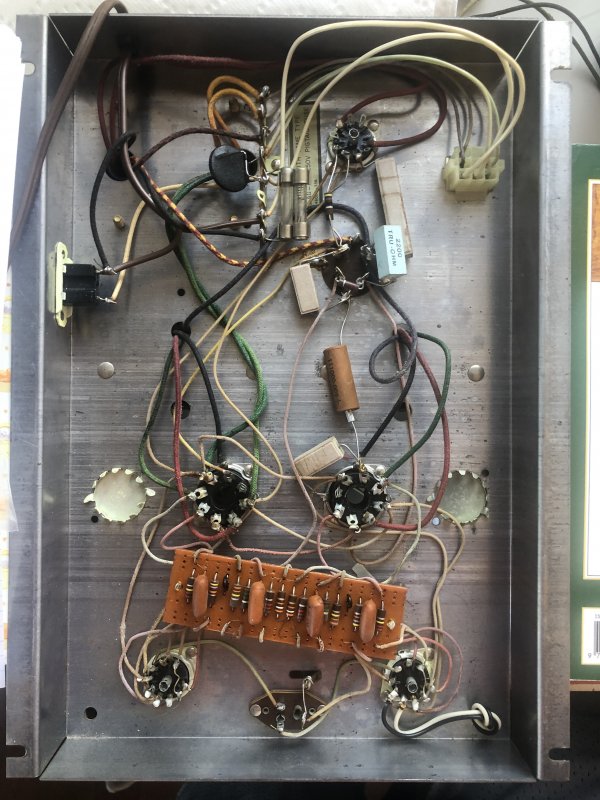
The amp looks nice now that its a little cleaner though, and I am very happy with it. I think it will be a good introduction to tube amplifiers. I am ordering all new ceramic capacitors and will replace the can capacitor with electrolytics of the same values. My modifications list is:

-convert to a grounded 3-prong power cord
-add inrush thermistor
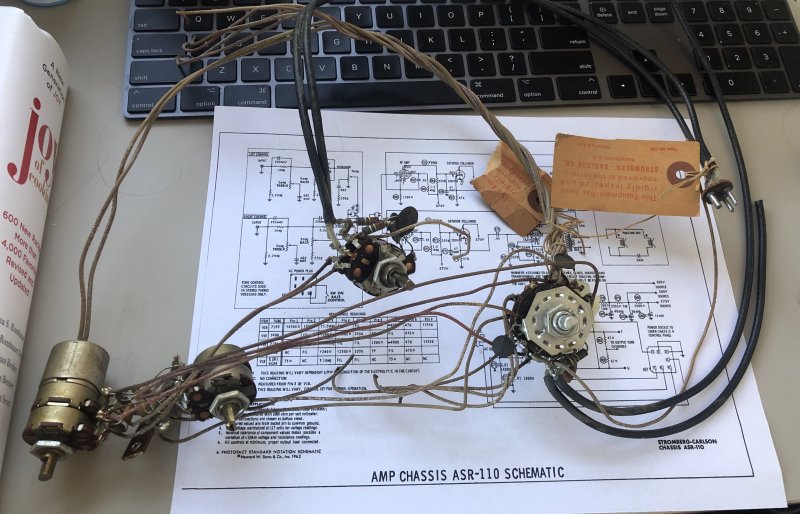
-add volume, treble, bass, balance, and function controls to the chassis

I had some questions for the community:

1. What size thermistor is generally used for an amp of this power?
2. What resistance potentiometers should I use for the controls? I'm finding answers online but I am still a little weak on my electronics understanding and could use some help with selection. The pots from the console are quite large and probably wouldn't fit on the amp chassis.
3. There is currently a small light wired in which I would like to change to an LED, could I just drop in an LED, or would that change the resistance too much? I assume that LEDs are much more efficient than an older style light.

thanks so much!
 

Update! I completely disassembled the console. The cabinet, while in decent condition, was honestly a bit of a challenge to break down gently; the quality was not nearly as high as the '70s Zenith I worked on previously. The "wood" is easily marked, in some places glued instead of screwed into place, and a couple of screws looked basically stripped from factory installation.

The amp looks nice now that its a little cleaner though, and I am very happy with it. I think it will be a good introduction to tube amplifiers. I am ordering all new ceramic capacitors and will replace the can capacitor with electrolytics of the same values. My modifications list is:

-convert to a grounded 3-prong power cord
-add inrush thermistor
-add volume, treble, bass, balance, and function controls to the chassis

I had some questions for the community:

1. What size thermistor is generally used for an amp of this power?
2. What resistance potentiometers should I use for the controls? I'm finding answers online but I am still a little weak on my electronics understanding and could use some help with selection. The pots from the console are quite large and probably wouldn't fit on the amp chassis.
3. There is currently a small light wired in which I would like to change to an LED, could I just drop in an LED, or would that change the resistance too much? I assume that LEDs are much more efficient than an older style light.

thanks so much!

One thing I've always liked about S-C is their use of small boards to put the circuitry on. Much easier to work on.
 
A CL-90 should be plenty. This won't pull all that much current.

Honestly I'd change the tubular cardboard cap and the ones in the can. The other caps might be fine. They look like some flavor of film or ceramic.

I wouldn't bother with the tone controls though. Honestly tone controls are hard to get right, and most of them didn't. Running this as a straight power amp, or maybe as an integrated with just a selector and a volume pot would be a whole lot easier.
 
You can use those stock volume and tone controls as they are separate from the tuner however they are not active but rather passive controls
 
it'll need the tube(s) associated with the controls moved over too. Passive controls have a lot of loss, and it needs a gain stage or two to make up for it.
 
A CL-90 should be plenty. This won't pull all that much current.

Honestly I'd change the tubular cardboard cap and the ones in the can. The other caps might be fine. They look like some flavor of film or ceramic.

I wouldn't bother with the tone controls though. Honestly tone controls are hard to get right, and most of them didn't. Running this as a straight power amp, or maybe as an integrated with just a selector and a volume pot would be a whole lot easier.

Thanks for the advice. The tubes associated with the controls are the 6AU6A tubes on the tuner?

To simply make it an integrated amp with a volume pot, could I just wire the volume and selector pots in series to the leads coming out of the 7199 tubes which would have normally fed to the tuner?
 
don't have a schematic of the tuner so I don't know. 6AU6 could be IF strip or audio, I've seen them used for both tasks.

input jacks to the selector. Output from the selector to the "top" of the volume pot, wiper of the volume pot to the grid of the 7199, which is what should have originally connected to the input jacks. "bottom" of the volume pot goes to ground. You could probably use a 100k-250k volume pot.
 
don't have a schematic of the tuner so I don't know. 6AU6 could be IF strip or audio, I've seen them used for both tasks.

input jacks to the selector. Output from the selector to the "top" of the volume pot, wiper of the volume pot to the grid of the 7199, which is what should have originally connected to the input jacks. "bottom" of the volume pot goes to ground. You could probably use a 100k-250k volume pot.

Hello gadget,

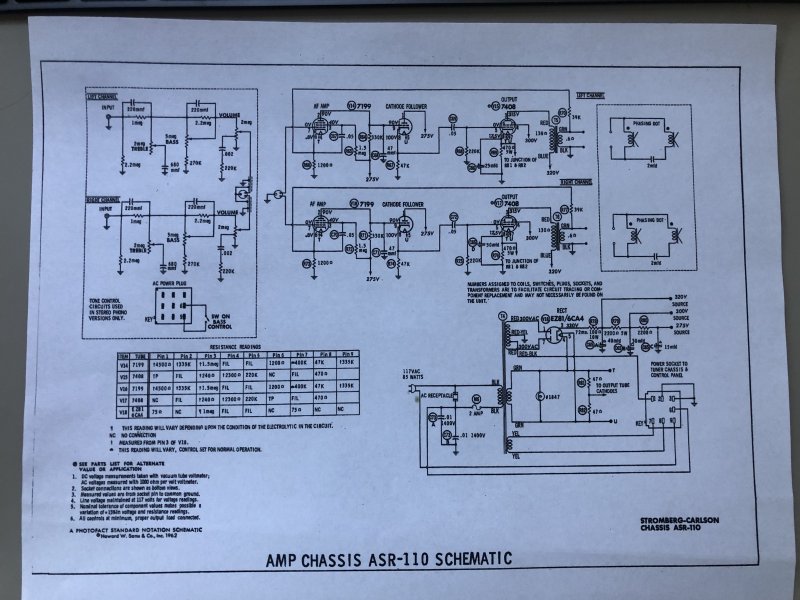
Thanks for the tips, that sounds very doable for me. I have a photofact for the amp:


I am very new to reading schematics, but from my understanding, it does not look like there are any more tubes in the tone control circuit which is after the 3 prong connector downstream of the 7199's. I believe that the entire tone control circuit is actually wired straight onto the pots.


Does this design mean loss of gain? I'm assuming that the capacitors and resistors are required to isolate the parts of the signal which will be controlled by the bass and treble pots.

Also, the speaker leads go directly from the top of the output transformer. Is there something I can do to make this less messy and route it through the underside of the chassis to some banana plugs I will install? If worse comes to worse I can thread them through the hole all the other wires coming out of the transformer bottom go through, and maybe get some transformer bell covers I guess.

Thanks!
 
ah, so its fully passive then. That might work with other sources but I'd give it a listen first before drilling any holes. I'm generally not a huge fan of tone controls just because so many of them sound bad. Best I can suggest is to judge for yourself.

The caps are where it sets the turnover points. It ends up forming high and low pass filter networks so when you adjust the treble it affects frequencies above some point, or below some point with the bass control.

and yeah its very lossy. This can't boost anything, so the way it works is when the controls are centered you get an approximately flat cut of so many db. Spitball, probably something like 6db, which is a 50% loss. The "boost" function simply cuts less. The pentode part of the 7199 is a high gain section so they may be making up for the loss there. Doesn't look like there is a whole lot of global feedback in this amp, so it probably doesn't need very much signal to get full output power.

should be able to loop the wires down underneath to clean it up.
 
I'm generally not a huge fan of tone controls just because so many of them sound bad

Did some reading on this subject, and it seems like quite an argument.

and yeah its very lossy. This can't boost anything, so the way it works is when the controls are centered you get an approximately flat cut of so many db. Spitball, probably something like 6db, which is a 50% loss.

If I understand that statement correctly, I would rather not have the over loss in signal, as this is a rather low powered amp already, and perhaps this will make my need for high efficiency speakers less severe?

Also, as I understand this schematic, there is no prea-amp inside the amp chassis correct? Does this mean that I would need a separate preamp to run a turntable?
 
it won't reduce output power, it just increases the amount of signal from the source needed to get to full output power. If this has any sort of sane design even with the loss in the controls it probably doesn't need crazy levels of signal to get to full output power. Those phono cartridges typically had output in the 1/2v range, so you shouldn't need more than that to get all 3 watts of power it can deliver. Without the tone controls it might be closer to 0.1 volts to hit full power.

again thats mostly just educated guesses but I doubt its completely off the mark. One accurate measurement is worth a thousand expert opinions though.

If you want to use a magnetic phono cartridge, you need a phono preamp. THe stock setup would be ceramic which has a much higher output level. Some 500mv vs 5mv like a mag cart has. There is an EQ curve involved too, ceramics more or less self-equalize.
 
If you want to use a magnetic phono cartridge, you need a phono preamp.

Ok, after reading your comments and doing some more research, I think the best and easiest thing to do will be to follow your advice and wire in one selector switch and one volume pot. If I feel like I need tone controls I can always add in an equalizer at some point in my system. Ditto for a phono preamp.

Once I have this reliably working, I think I will turn my focus towards perhaps using the original speakers in a diy open baffle design, though I really don't know if these speakers are worth saving or not (two 6x9 and two 3x5).

I have a vision of turning the console cabinet into a console with which I can put the associated parts of the av set up. Just need couple shelves put in.

Thanks so much for all the advice!
 
Good luck with it

Lots of consoles had fairly efficient speakers, possible one has a better driver setup. Many had 12 and 15" drivers. Horns also tend to be efficient. You might find this pairs nicely with Altecs or Khorns or something of that nature.

stock speakers left in the original cabinet might work out decently as the center channel.
 
The controls are passive. No tubes. Any powered preamp (tubes or not) will add gain especially needed for things like tone controls, magnetic cartridges, microphones and guitars. If the amp itself has enough gain input (which it does), then any line level device will work with it.

The amplifier itself only has a preamp gain stage which are the 7199 tubes.

Being a single ended 6V6 amp, you are only going to get about 5-7 watts per channel. Since those stock speakers were made for that amp, I would think that they would sound great especially if you were to build them into their own boxes like bookshelf types.
 
Being a single ended 6V6 amp, you are only going to get about 5-7 watts per channel. Since those stock speakers were made for that amp, I would think that they would sound great especially if you were to build them into their own boxes like bookshelf types.

Yea I am thinking that is the route I will go, though I might try open baffle first. I'm unsure as to what to do with the Glaser Steers turntable, as though I confirmed it works for 33's, I think I would be happier with a modern turntable with a lighter tonearm. Not sure if its even worth trying to put on craigslist as it does not have a real base it sits in right now. Any idea if someone would want it?
 
Back
Top Bottom