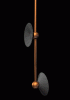
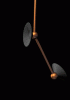
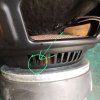
I'm not necessarily trying to doubt that you weren't pushing them beyond their limits. It certainly could have been the previous owner. In a setup with a passive radiator however (and similarly with many ported systems), it can be difficult to judge how hard a driver is working simply by looking at cone movement. In the case of the Rel T3, it's 8" driver is downward firing, and it has a front mounted passive radiator. So unless you had your head on the ground or were operating the subwoofer on it's side, you were probably looking at the cone of the passive radiator. Depending on the frequency of the bass, there are times when either the active driver or the passive radiator will show very little movement despite the subwoofer still producing significant output. As a brief example, in these GIFs, the top cone represents the subwoofer driver, the bottom cone represents the passive radiator, and the beam connecting them represents the air in the cabinet:
Above the resonant frequency, the active driver will be directly responsible for almost all of the output and the cone will display significant movement. The cone of the passive radiator will show very little movement.
View attachment 2903230
At the resonant frequency, the active driver cone will show very little movement. The cone of the Passive Radiator will show significant movement and be responsible for most of the output.
View attachment 2903229
Below the resonant frequency, the driver unloads and both cones show significant movement; high output at these frequencies will usually bottom-out the woofer.
View attachment 2903228
Note that when a driver "bottoms out" (reaches the physical limits of it's excursion), the voice coil will often physically impact the pole piece of the magnet. This can also potentially deform the edge of the voice coil and cause scratching/rubbing.