• The move to the new server is done. There are some software and database maintenance updates in process. This has us passing the hat around to help out. We appreciate any donations. Seriously, even a dollar helps. The payment page may be found here - https://www.audiokarma.org/support.html

Suggestions for a DIY AM Antenna?

If you are talking about MW band, best antenna is a REALLY LONG wire. These waves are in hundreds of meters. Optimal antenna is between 1/4 and 1/2 of wave length. Now do your calculation. Anything of small size is a poor compromise.

These days a typical long wire AM antenna will allow you to listen to every non-incandescent light in the neighborhood along with all kinds of hash coming in from broadband data lines, etc. Pure hell. Go with the loop.
 
Very true Pio but I've read of extreme DX'ers on the West Coast who string out these mega-long wire antennas on some bluff over the Pacific and basically bore-sight commercial MW in Japan, etc., "ground" wave IIRC. That's hard core.
I've a steerable dual long wire thingus somewhere I've never set up, can't remember what they are called. Works better I'm told with a regular active receiver than the high performance competition passive bcb sets I was fooling with then. I'd probably be using it on a Hammarlund Super Pro BC-1004-C or ICOM R-75 if I set it up.
 
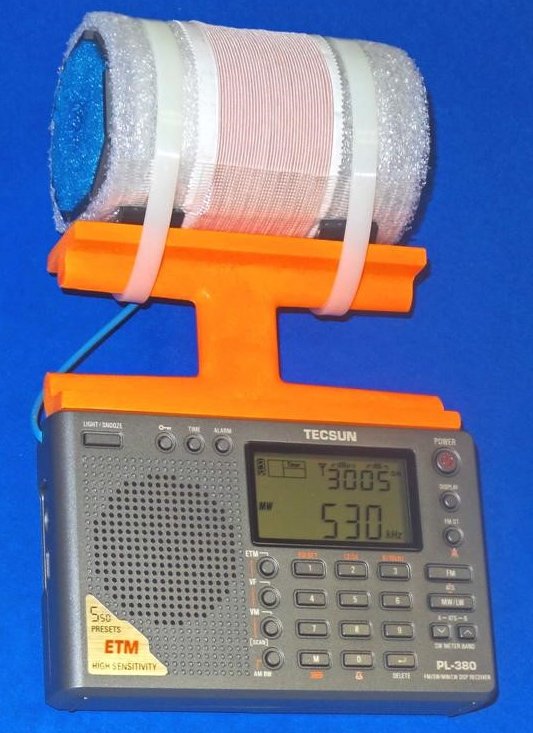
This needs a little wider audience. This guy does the same thing (Far East dx)
with a (comparatively) tiny little loop and a hand-held portable.

Tecsun-PL-380-FSL-1-1.jpg
 
The real test of any AM antenna is how it does in the middle of daytime - when everything is ground wave. What kind of SNR can you get from that weak distant station - especially with strong local stations. IIRC a typical AM antenna gets more "traction" on the signal by being oriented parallel with the wave's direction of travel rather than perpendicular to it.

Typical SW, HF, VHF, UHF, etc., antennas can pick up good variations in field when oriented perpendicular (broadside) to the direction of travel - but that's because the wavelengths are short enough to allow that orientation to be effective. A typical AM receive antenna depends on the actual travel of the wave along the length of the antenna for the development of induced current - not instantaneous variation in field strength across a wave front.

So with antennas having dimensions much less than signal wavelengths you want the antenna aligned with the direction of wave travel. You want a big aperture to capture more signal. The cylinder configuration replacing the stock loopstick (also a cylinder) seems to increase the aperture a small bit but I don't get how it's supposed to be amazing?
 
The gain (as well as the selectivity)... Here's an excerpt:

If your FSL antenna transplant is working properly you should notice
an EXCEPTIONAL increase in the signal strength of weak fringe
stations relative to the stock PL-380 model, and a very significant
increase in fringe station strength relative to a 7.5” loopstick PL-380
model. Check fringe station strength across the band, and you should
notice MW reception far superior to that of any stock portable in your
collection.

His home group is the ultralightdx Yahoo group, where he describes
construction and modification of his designs. As I said, he also literally
hangs out on a Pacific cliff side on a fairly regular basis, pulling in Far
East stations on a regular basis, among other unusual dx feats.

One of his test criteria is the ability to null out a local blowtorch, and
this iteration seems to be doing a good job of it.
 
Back
Top Bottom