• The move to the new server is done. There are some software and database maintenance updates in process. This has us passing the hat around to help out. We appreciate any donations. Seriously, even a dollar helps. The payment page may be found here - https://www.audiokarma.org/support.html

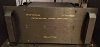
Sumo Polaris Power Amplifier - What a Surprise!

Thanks. Mine produces a minor hum that gets a bit louder when things are attached to it. Did yours exhibit this trait?

I understand the concept of using larger filter caps to better suppress noise and reduce distortion when the system comes under a load. But there comes a point where the caps become too big such that it causes too much draw on the transformer when they charge up.

My 300x4 also uses +- 70 volt rails and 11,000 mfd caps. It is actually two stereo amps in one cabinet so I need to buy twice as many parts. I note that you went to 15,000 mfd. Did you note any problems with the power supply or make any other modifications to the power supply to compensate (e.g., inrush suppressor) other than recap?
Mine never had a hum. It’s super quiet, great amp
 
Welp, I just bought a Polaris on BT, thanks in part to this thread. Don't have it yet, but I'll post a report when I do. BTW it's going to be driving Klipsch Kg-4.2's. Hope I like the result as much as Schmidlapper did.
 
Thanks. Mine produces a minor hum that gets a bit louder when things are attached to it. Did yours exhibit this trait?

I understand the concept of using larger filter caps to better suppress noise and reduce distortion when the system comes under a load. But there comes a point where the caps become too big such that it causes too much draw on the transformer when they charge up.

My 300x4 also uses +- 70 volt rails and 11,000 mfd caps. It is actually two stereo amps in one cabinet so I need to buy twice as many parts. I note that you went to 15,000 mfd. Did you note any problems with the power supply or make any other modifications to the power supply to compensate (e.g., inrush suppressor) other than recap?
Mine is super silent. No noise, even when something is connected to it. I haven't done anything to it either.
 
Welp, I just bought a Polaris on BT, thanks in part to this thread. Don't have it yet, but I'll post a report when I do. BTW it's going to be driving Klipsch Kg-4.2's. Hope I like the result as much as Schmidlapper did.
Please, Let us know how you like it!
 
Transitioning from some of the best amplifiers to come out of the 70's, I ran across this little gem. I've had it stored for about a month in my closet after I scored it in a package deal.
I hooked this tiny power amplifier up to my daily drivers - the Canton Ergo 70's - and my jaw immediately dropped! To the best of my knowledge, the inside of this amplifier hasn't seen the light of day, let alone had an overhaul, yet his thing sings! Almost everything I'm hearing is superb! Total control over the speakers in my system - A damping factor of 525 (!!!), A S/N ratio of 103db, and a THD of 0.05%. Plus the ability of driving loads down to 2 ohms with ease, straight from the manufacturer. This thing is a total sleeper and it's blowing my mind! Anyone else have experience with Sumo gear?

Here are a couple snippets from their brochure:
View attachment 1369972 View attachment 1369977

Hello all, I have a Polaris 310 and have been looking for a service manual or if nothing else, details on setting key adjustments like bias, dc offset, etc. Does anyone out there have a copy or a link for this info? I'd like to update the electrolytics on the amp boards, plus anything else that's off spec. Thanks in advance!
 
Rich May, the designer of the Polaris, says 100ma per output device. That would be 25mv across the .25 Ohm source resistors, adjustment is by VR2. The second adjustment VR1 requires a distortion analyzer, do you have one? DC offset is handled by a DC servo, no adjustment needed if working.

Craig
 
Rich May, the designer of the Polaris, says 100ma per output device. That would be 25mv across the .25 Ohm source resistors, adjustment is by VR2. The second adjustment VR1 requires a distortion analyzer, do you have one? DC offset is handled by a DC servo, no adjustment needed if working.

Craig

Craig, many thanks for the info. I can do the bias with this info. Regarding the distortion analyzer, is that harmonic, intermod, or both? I have an old Heath Audio Analyzer that does IM, but not sure if I'd trust. I do have signal gens and o'scopes, but just not as familiar with solid state gear as I am with tube.
 
I used a Sound Technology 1700B, THD with IM mod. when aligning an Andromeda II. Using it in the THD mode I was able to null out some distortion in the output. The Andromeda II has the same nulling circuit as the Polaris. I don't think the Heathkit AA-1 has low enough residual distortion to work even if the adjustment could be done with an IM analyzer.

Maybe track down Rich May and ask him. He's got to be somewhere.

Craig
 
I used a Sound Technology 1700B, THD with IM mod. when aligning an Andromeda II. Using it in the THD mode I was able to null out some distortion in the output. The Andromeda II has the same nulling circuit as the Polaris. I don't think the Heathkit AA-1 has low enough residual distortion to work even if the adjustment could be done with an IM analyzer.

Maybe track down Rich May and ask him. He's got to be somewhere.

Craig
Thanks Craig.
 
Rich May, the designer of the Polaris, says 100ma per output device. That would be 25mv across the .25 Ohm source resistors, adjustment is by VR2. The second adjustment VR1 requires a distortion analyzer, do you have one? DC offset is handled by a DC servo, no adjustment needed if working.

Craig

Hi Craig, one more question - should the 25 mv reading across the .25 ohm resistors be the same across each resistor? If not, would I set vr2 based on the highest reading and let the others fall where they may? It may be differences in the resistor tolerance, and my meter isn't accurate at fractional ohm levels. Thanks!
 
Hi Craig, one more question - should the 25 mv reading across the .25 ohm resistors be the same across each resistor? If not, would I set vr2 based on the highest reading and let the others fall where they may? It may be differences in the resistor tolerance, and my meter isn't accurate at fractional ohm levels. Thanks!

I'll usually measure one of the emitter resistors on a P channel device and then one on an N Channel and then average the two. If you measure all of them then average them out for your bias setting.
 
I'll usually measure one of the emitter resistors on a P channel device and then one on an N Channel and then average the two. If you measure all of them then average them out for your bias setting.

Thanks! If nothing else that helps with variations in the resistors.
 
Are there any markings on the outputs to suggest that they were matched? Find the one with the highest reading and set that one to 25mv and see where the others fall.
 
Rich May, the designer of the Polaris, says 100ma per output device. That would be 25mv across the .25 Ohm source resistors, adjustment is by VR2. The second adjustment VR1 requires a distortion analyzer, do you have one? DC offset is handled by a DC servo, no adjustment needed if working.

Craig
I have tried to track Rich down to say hi. Do you know how to get in touch with him, or if he is still alive?
 
I thought I would throw my hat in the ring. I own a Sumo Andromeda amplifier and Sumo Electra preamplifer designed by Sumo founder James Bongiorno. I was too young to buy them back in their day, but I did manage to buy them from the original owners son. They are each fully restored by Soundstream (of phono cartridge fame) in New York. Original boxes, but manuals are gone to the ages. I am now using this equipment in my JBL room. Currently hooked up to a pair of JBL L200T3. Bet you never heard of them before.
2018-09-27 09.51.46.jpg 2018-09-27 09.51.33.jpg
 
One of the pieces I've never had, the Electra. I think it's the only SUMO pre that made it to market. The Itsy preamp along with the Bitsy power amp never made it as far as I know. Had two Andromedas back in the late 80s/early 90s.

Craig
 
Sumo also had the Athena preamp, reviewed by Stereophile in 2014.

https://www.stereophile.com/content/sumo-athena-preamplifier

Odd that the review specifies 1988 (presumably the model release date?) and that it was no longer available in 2014. Maybe the review was much earlier and just published on the website in '14.

I'm liking my 'new' Polaris amp so much that I'd love to find one of their preamps to go with it.
 
Back
Top Bottom