• The move to the new server is done. There are some software and database maintenance updates in process. This has us passing the hat around to help out. We appreciate any donations. Seriously, even a dollar helps. The payment page may be found here - https://www.audiokarma.org/support.html

Switch lever repair

richardpp

Well-Known Member
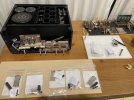
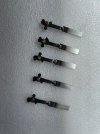
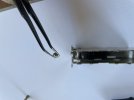
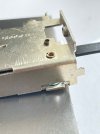
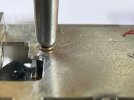
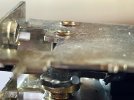
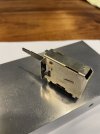
Hi, I thought I would share some photos from a earlier restoration in which I had to the repair some switch levers that had been cut short. I hope useful for anyone wanting to replace or repair a broken or bent lever arm, or a sheared pivot pin on an Alps lever switch.


not just the missing knobs
IMG_1555.jpg

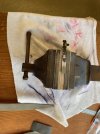
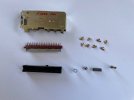
removing the switches
IMG_1523.jpg

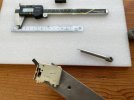
removing the contacts
IMG_1401.jpg

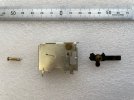
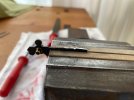
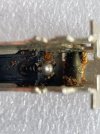
I used a fine punch to drive the pivot pin from the housing
IMG_1405.jpg


IMG_1406.jpg

IMG_1409.jpg
 
Register to hide this ad
replacing the stop cushion

Over 50 years, the grease has hardened and stop cushion disintegrated
IMG_1973.jpg

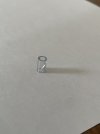
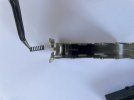
The cushion was replaced with a piece of soft flexible PVC tubing, 5mm O.D. x 3mm I.D., slit diagonally across its length then fed onto the stop.
IMG_6449.jpeg

It makes the switch quieter, prevents over-travel and wear and is durable. It can also be fitted with the lever in situ.
IMG_2025.jpg
 
Lastly

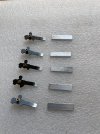
If the pin can’t be reused for any reason then it’s possible to make a new pin out of 2.5mm brass rod. Cut a shoulder, insert and peen both ends.

IMG_6350.jpeg


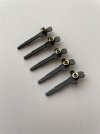
once restored, the switch should feel smooth and balanced. They are a small, but wonderful, example of fine mechanical engineering.
IMG_6355-1.jpeg
 
That is a phenomenal pictorial on the proper tear down and restoration of these switches. Seeing how these right angle lever/toggle type switches were made, this brings home just how much quality of feel was lost when Sansui abandoned their use about 1980, starting with the AU-X1, and began using exclusively push and rotary switches from that point onward. Their use on the professional and definition series line lent those models a particularly satisfying and solid feel in operation.

This type of switch had far superior tactile properties, and just exuded quality that isn't found with other more common and less costly types. And to think that at one time nearly all the Japanese majors made extensive use of these in their tuners, amps and receivers. Then about 1979-1980, they were phased out entirely.

I do wonder if it was forced on them by the supplier (most often being Alps) choosing to discontinue their manufacture, or if they had just become too costly to justify their continued use in new designs. Either way, it was a loss to the overall quality of the human interface factor.

I've also wondered if these switches were dropped because the original tooling used in their manufacture was near EOL after many millions of such switches being produced during the 1970's, and it was decided not to incur the cost of replacing it all. I would love to know, as they went away quite abruptly.

 
Last edited:
Thanks @DB-7, that's very kind. If I had just one switch to repair I may have looked for a replacement instead. On the upside, all the switches are now working beautifully although I still need to find some original knobs. As you know they're rare as hen's teeth, especially the silver ones.
 
This is absolutely amazing! Your work is a labor of love. Do you want to start doing a switch repair gig? Not sure the labor involved would be worth it. Get job in keeping vintage stuff alive!
 
That really is incredible.

How did you weld the new steel to the old levers? Any particular welding gear you used? I've never welded anything in my life but I have a broken switch lever
 
That is a phenomenal pictorial on the proper tear down and restoration of these switches. Seeing how these right angle lever/toggle type switches were made, this brings home just how much quality of feel was lost when Sansui abandoned their use about 1980, starting with the AU-X1, and began using exclusively push and rotary switches from that point onward. Their use on the professional and definition series line lent those models a particularly satisfying and solid feel in operation.

This type of switch had far superior tactile properties, and just exuded quality that isn't found with other more common and less costly types. And to think that at one time nearly all the Japanese majors made extensive use of these in their tuners, amps and receivers. Then about 1979-1980, they were phased out entirely.

I do wonder if it was forced on them by the supplier (most often being Alps) choosing to discontinue their manufacture, or if they had just become too costly to justify their continued use in new designs. Either way, it was a loss to the overall quality of the human interface factor.

I've also wondered if these switches were dropped because the original tooling used in their manufacture was near EOL after many millions of such switches being produced during the 1970's, and it was decided not to incur the cost of replacing it all. I would love to know, as they went away quite abruptly.
Interesting question on the demise of these switches. It's likely it was a combination of reasons. Another one to consider is the rise in value of the Japanese yen around this time and the declining market for high end electronics. Higher cost and lower demand is a big reason for the overall decline in quality in the early to mid 80s.

- Pete
 
Back
Top Bottom