• The move to the new server is done. There are some software and database maintenance updates in process. This has us passing the hat around to help out. We appreciate any donations. Seriously, even a dollar helps. The payment page may be found here - https://www.audiokarma.org/support.html

SX-626 problem, at half volume DBT kicks in

bradfro

Active Member
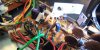
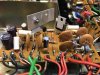
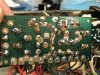
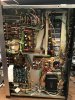
I've got a sx-626 that will light up the bulb on my DBT starting at half volume. Before I reach half volume, the receiver works and sounds fine. Something goes to a dead short. I have verified it's the power amp that is failing. I've replaced all the transistors and diodes on the amp and power supply boards. The Bios and half voltages for both channels are correct. The receiver has been completely restored. I learned, later, that this was a problem with the receiver before I started the restoration. I'm wondering if the transformer maybe the problem. I'm hoping that someone could help me with this issue as I'm out of ideas. Here are the images of the amp and power supply.
IMG_0331.JPG

IMG_0332.JPG
 
Register to hide this ad
This is likely a power supply or bias problem. Don't bother to try and play music on the DBT, it will never work properly that way.
Which version of the SX-626 do you have, early or '73 & later?
With power off, first thing to do is turn the bias VRs (3 & 4) to 0Ω, measure with your ohmmeter to verify. I see from the picture some customization has been done. What are the values of the pots that are the replacements. Did you do the work or a previous owner? I see the output transistors have been replaced with modern ones. What else has been replaced, changed or modified that you know of?
Meter on dc volts, black to ground, measure with red.

While it is on dbt measure dc volts:
+ side of C3, main power supply filter cap, should be about +50vdc:
+ side of C13, left output cap:
+ side of C14, right output cap:
Emitter of Q11:
Emitter of Q12:

Can you post a picture of the bottom side of the heatsink, please?

EDIT: more
 
Last edited:
Merlynski, I'm at my day job and I won't be able to check these things till later tonight. I can tell you a few things now.

I believe I have the new version of the SX-626, but I will verify
I did all the work on this. New outputs, plus all new transistors on the amp and power supply board, new diodes on power supply board. All electrolytics have been replace with new, including the filter cap. I put in the trimer pots
VR1,2 are 100ohm and VR3,4 are 100k
 
Merlynski, I'm at my day job and I won't be able to check these things till later tonight. I can tell you a few things now.

I believe I have the new version of the SX-626, but I will verify
I did all the work on this. New outputs, plus all new transistors on the amp and power supply board, new diodes on power supply board. All electrolytics have been replace with new, including the filter cap. I put in the trimer pots
VR1,2 are 100ohm and VR3,4 are 100k
Thanks for the swift reply, I just want to get up to speed so I can help the best way possible. I am glad the previous work was done by you, correct history ALWAYS make for better repairs. See you when you are ready!
 
On my schematic (later model) VR1 & VR2 are 30kΩ, and VR3 & VR4 are 100Ω. Please verify your replacements.
 
Serial number starts with TG, which is 1973

yes, I listed the trimmers backwards in my previous post, vr1,2 are 100k and vr3,4 are 100 ohms
 
On the Power Supply pcb AWR-006, measure dcv:
Pin 10, should be +24vdc:
Pin 7, sb +12.5vdc:
Pin 5, sb +30vdc:
These may be low because of the dbt.
 
OK, volume to minimum, input to AUX, no input signal, then try it on full mains,
On the Power Supply pcb AWR-006, measure dcv:
Pin 3, sb +53 to +60vdc:
Pin 10, sb +24vdc:
Pin 7, sb +12.5vdc:
Pin 5, sb +30vdc:
 
Last edited:
Full mains, no more blown fuse?
There may be a problem in the power supply, AWR-006, output voltages are low
Measure vdc.
+ side of C12:, sb +14.dc:
+ side of C9, sb +23vdc:
+ side of C10, sb +23vdc:
+ side of C5, sb +31vdc:

Test Q1, Q2, Q3.
What did you replace those transistors with?
Q1, Q3: 863-MJE15032G?
Q2: 512-KSC1845FTA?

Did you replace D7? 14v zener?
 
The fuse only blows when volume hits the halfway point on the volume control playing music, FM white noise, or a 1khz tone. If you keep the volume below the halfway point the receiver works fine.

I will go home over my lunch break and check voltages and what new parts I put in. All three transistors, Zener diode and 6 rectifier diodes are brand new.
 
The fuse only blows when volume hits the halfway point on the volume control playing music, FM white noise, or a 1khz tone. If you keep the volume below the halfway point the receiver works fine.

I will go home over my lunch break and check voltages and what new parts I put in. All three transistors, Zener diode and 6 rectifier diodes are brand new.
OK, I'll be around . . .
 
power supply measurements
C6=12.6v
C9=24v
C10=23v
c5=27v

New zener diode 1N5243 13v (This looks to be incorrect, I was using the wrong service manual)
Q1,Q3 ksc2073 (see picture)
Q2 ksc1845

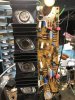
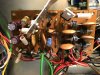
Here are more pictures

IMG_0336 (2).JPG IMG_0339 (2).JPG IMG_0340.JPG IMG_0341.JPG IMG_0342.JPG IMG_0343.JPG IMG_0344.JPG
 
Last edited:
In the 1973 & later SM D7 is shown as a 14v zener diode (on page 42), if you have one put it in instead of the 13v one, that should bring them all up. The earlier model has a 13v zener.
 
I see that, thanks for your help on this. I will get this fixed, but sadly, I don't think this is the main problem. I replace most of the components on the power supply board after I was told of the fuse blowing problem.

Here is the full story on this. I received this receiver with the task of doing a recap. When I first looked at it, the right channel fuse on the back was blown. I replaced it and spent time listening to it. I did not notice any problem, that's because the receiver only fails when the volume goes beyond the half way point, which is damn loud. I replaces all the caps and the problematic transistors on the amp board. I played it for a long time and never had a problem. My mistake was I never played it loud enough. I gave it back to the owner and within 2 days he blew out the fuse. I was then able to replicate the problem. So in my troubleshooting of the problem I replaced every transistor and diode on the power supply board and bought new output transistors (I thought, for sure that the new outputs would fix the problem), but none of this changed the problem. So what would go to a dead short at high volume?
 
Back
Top Bottom