• The move to the new server is done. There are some software and database maintenance updates in process. This has us passing the hat around to help out. We appreciate any donations. Seriously, even a dollar helps. The payment page may be found here - https://www.audiokarma.org/support.html

T03 vs standard 3 lead transistors

Racingh11

Super Member
Does anyone have any information on the differences of using metal case mount transistors such as the T0-3 style; compared to the popular current three leg transistors such as the T0-264? Is it just a cost decision the T0-3 aren't used as much now, or is there a difference in performance?
 
Register to hide this ad
IMO primarily cost. TO-3 are also more complicated to properly mount (especially the electrical connections to the pins on the TO-3). The only performance factor (again IMO) is the surface area of the case mounting to the heatsink. and it isn't much (if any)l. My 2 cents.
 
You can buy TO-3 mounts. TO-3 placed on one side of the heat sink and the mount, connecting plate on the other side. The two mounting screws hold them both to the heat sink. You would solder the wires to the mount, connecting plate. The TO-3 would just plug into the connector plate. This is how I see them mounted in many amps. It also makes it easy to replace one should it fail. I've found it much easier to unplug a TO-3 verses desoldering the other type.
 
I believe the TO-220 was specifically design to replace the TO-3 and TO-66. I don't recall the reason being stated in the datasheets and ref guides and I've scanned what was published there.

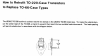
Retrofitting TO-66 and TO-3 with TO-220 00.png
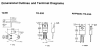
Retrofitting TO-66 and TO-3 with TO-220 01.png
Retrofitting TO-66 and TO-3 with TO-220 02.png
 
I wasn't sure if there was any performance differences that were better about the T03. I am looking for some of those sockets that were mentioned. They are not real easy to find either. I've had to repair some that I would have rather replaced.
 
I wasn't sure if there was any performance differences that were better about the T03. I am looking for some of those sockets that were mentioned. They are not real easy to find either. I've had to repair some that I would have rather replaced.

I haven't seen any reference to better or worse performance. The dissipation handling parameter on the TO-220 devices should be a good indication of their performance, when properly heatsunk, to compare with whatever the original TO-3 or TO-66 device you're replacing.

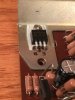
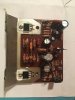
There wasn't any need for a socket in the TO-66 to TO-220 replacement that I did on a Sansui 7000.

IMG_7450.JPG
IMG_7440.JPG
 
I haven't seen any reference to better or worse performance. The dissipation handling parameter on the TO-220 devices should be a good indication of their performance, when properly heatsunk, to compare with whatever the original TO-3 or TO-66 device you're replacing.

There wasn't any need for a socket in the TO-66 to TO-220 replacement that I did on a Sansui 7000.

View attachment 1317855
View attachment 1317856
That looks really good. Thanks for all the info.
 
I wasn't sure if there was any performance differences that were better about the T03. I am looking for some of those sockets that were mentioned. They are not real easy to find either. I've had to repair some that I would have rather replaced.
I think the last ones I bought were from Mouser. I buy most of my replacement TO-3's from them so that's probably where I got them. I remember them being a blue plastic instead of phenolic like the old ones.
 
I think the last ones I bought were from Mouser. I buy most of my replacement TO-3's from them so that's probably where I got them. I remember them being a blue plastic instead of phenolic like the old ones.
Oh yeah, they do have 1 type. I looked before and couldn't find any. I'll have to stock up a few.
 
I like the phenolic black ones.
I see they are quite expensive.
I haven't seen blue ones yet in old stuff.
 
The plastic devices are available at 200 watts or higher. So, no power disadvantage. The big advantage is that they can be stuffed into a circuit board with automated equipment, same as any resistor or capacitor.
 
The plastic devices are available at 200 watts or higher. So, no power disadvantage. The big advantage is that they can be stuffed into a circuit board with automated equipment, same as any resistor or capacitor.
Good point. That probably saves a lot more cost than a less expensive case.
 
Some of the most commonly used TO3 output devices are still plenty available from the major supplier - ie: the MJ150XX series. These can be subbed-in for many other TO3 type outputs.
 
Yes on the MJ150xx devices, however, the MJ21193-96 are newer and have even better ratings, including lower beta droop at high currents.
 
Back
Top Bottom