• The move to the new server is done. There are some software and database maintenance updates in process. This has us passing the hat around to help out. We appreciate any donations. Seriously, even a dollar helps. The payment page may be found here - https://www.audiokarma.org/support.html

Taming the Heil..., When Only the Best Is Good Enough!

toddalin

AK Subscriber
Subscriber
I decided to do a bit more work on my Heil reflectors, and may now have the smoothest Heils out there. I have no idea why ESS research stalled out in the late 70s, other than they could rest on their laurels.

Anyway, true hobbyists are not always satisfied with the everyday and try to find ways to improve on them.

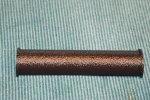
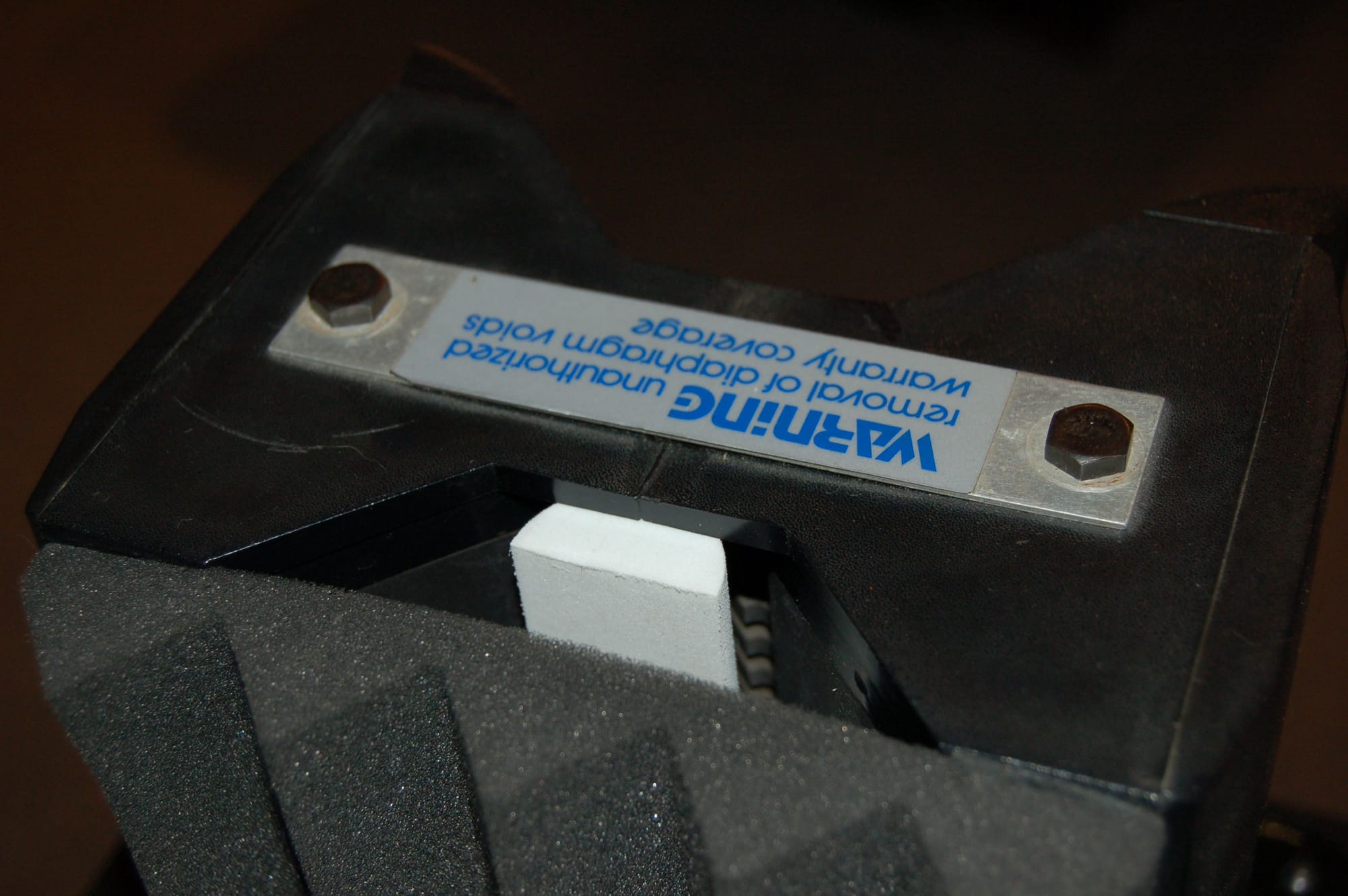
I recently promised someone a pair of Heil wings and figured I would give him a pair of reflectors to try out. So I set about improving the breed 3D printing a few variations before settling on one. Spacing is everything and this is not the final, but very similar

DSC_2132.JPG

And we have to account for those sloppy ESS glue joints.

DSC_2133.JPG

Yeah, they don't look like much. But looks can be very deceiving:
DSC_2129.JPG

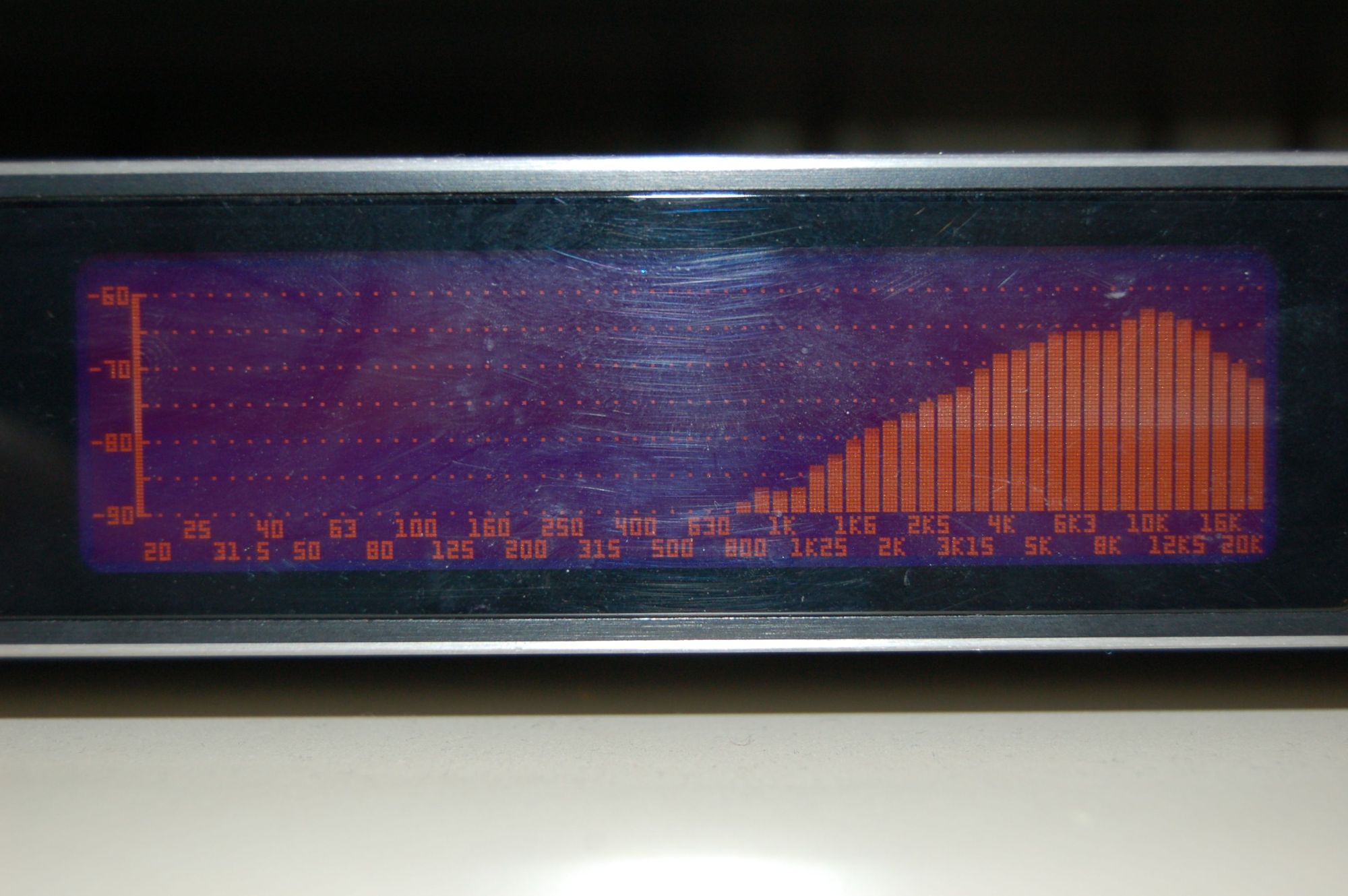
Typical response through ~3,000 Hz crossover:
80-dsc_0001_af6a58820093db9b30e95c14f737e066fcbe463f.jpg

This is with the current reflectors. Obviously this is another way to compensate for the rising response and bring in a world of detail in doing so. As an added bonus, sound from the rear is greatly attenuated and imaging is greatly enhanced. And note that they still go plenty high. I just may have to market these.
DSC_2131.JPG
 
Last edited:
Register to hide this ad
I have no idea what that is but I'm interested to learn more.
Initially, I was using available " half-round, closed-cell foam molding" covered in felt so was limited to just one diameter and this is what I have been using. But with a 3D printer, I can now tailor the diameters of the reflector and the "stand-offs" top and bottom to let just a bit of air pass, and I don't mess things up cutting the molding.

I am currently printing another set but unlike the piece shown, I've selected a "fuzzy" skin that better simulates the felt.

https://audiokarma.org/forums/threads/im-fixing-a-hole-heil.1025205/
 
Last edited:
Fascinating!

Is it just the thing on top of the tweeter?
Nothing is on top of the tweeter. What you see is a rear "soundwall" with foam lining to block any sound that may get through the half round. I don't want the rear signal bouncing around the room willy-nilly screwing with the soundstage and imaging.

The shown "half round" sits in the open space where the microphone is shown, but on the back side. The size and distance of the curvature have a direct impact on what comes out the front.
 
Last edited:
Here is a reflector with a "fuzzy" finish. The reflection pattern will obviously be a bit different but how will that impact the sound? Guess I'll find out tomorrow.

DSC_2134.JPG
 
OK, this shows how small changes can have large impacts. This shows the spectrum with the fuzzy skin and I had decreased the radius by just 0.1mm. Guess the last smooth skin was the best, so far, and is pretty damn good.

DSC_2136.JPG
 
I printed out another set of reflectors like the ones I'm giving Jon, for myself (a smooth set) and did some listening.

Just wow! As good as things were, they've gotten notably better with the new reflectors. The clarity went way up and there are no dips or peaks in the sound. It's never been this smooth! Everything sounds so natural and here/there.

I had gotten a new Paul Simon CD just the other day and listened to it again today and words that were previously hard to distinguish were plain and clear.
 
Nothing is on top of the tweeter. What you see is a rear "soundwall" with foam lining to block any sound that may get through the half round. I don't want the rear signal bouncing around the room willy-nilly screwing with the soundstage and imaging.

The shown "half round" sits in the open space where the microphone is shown, but on the back side. The size and distance of the curvature have a direct impact on what comes out the front.
Thank you!

Those changes are amazing!
 
Interesting experiment!!

What spectrum analyzer is that?

What is the measured response further out in the room as opposed to right up against the driver?
 
Interesting experiment!!

What spectrum analyzer is that?

What is the measured response further out in the room as opposed to right up against the driver?
Behringer DEQ2496

??? Haven't tried it. But I was showing the Behringer to Jon who came over today and even near tweeter level about half way back, it was pretty smooth with no obvious peaks or dips.

The idea was to take the rising response and dips out of the Heil, regardless of the room. They now integrate seamlessly without being bright. Jon gave me a few really nice small value caps and I may try to do a selective "by-pass" if I want to brighten them up a bit for those times when you want that bit of "bite."

Wow, just noticed that these are AMPOHM and Jupiter caps! Jon has good taste! Thanks Jon!

https://www.bhphotovideo.com/c/prod..._lar&msclkid=0eb98e2d6a3e12de8d7de49d4e30869f
 
Last edited:
When I showed up today at toddalin's, I certainly didn't know what I was walking into :D

I will be doing my own experiments with the waveguides and reflectors todd so graciously shared with me, but his system really needs to be heard in order to understand the obvious thousands of hours spent optimizing tiniest details and every component, resulting in the most finely-textured, smoothest, yet most dynamically effortless system I have probably ever heard in a real listening room.

We were cranking it to 100dB peaks at listening seat, verified by dB meter, in a large room, and there was zero hardening, brightening, or uneasyness to the sound compared to 80dB volume levels. This was going on while maintaining gorgeously dense, 3-D vocalist imaging rock-solid in the center, with 3 drivers melting into each other seamlessly, with 3 drivers being Heil AMT (modified with the new reflector), JBL 2253H 10" midrange, and JBL 2241G 18".

Congratulations to toddalin for a superb system, and you should really post some photos and system details after the latest modifications! :beerchug:
 
When I showed up today at toddalin's, I certainly didn't know what I was walking into :D

I will be doing my own experiments with the waveguides and reflectors todd so graciously shared with me, but his system really needs to be heard in order to understand the obvious thousands of hours spent optimizing tiniest details and every component, resulting in the most finely-textured, smoothest, yet most dynamically effortless system I have probably ever heard in a real listening room.

We were cranking it to 100dB peaks at listening seat, verified by dB meter, in a large room, and there was zero hardening, brightening, or uneasyness to the sound compared to 80dB volume levels. This was going on while maintaining gorgeously dense, 3-D vocalist imaging rock-solid in the center, with 3 drivers melting into each other seamlessly, with 3 drivers being Heil AMT (modified with the new reflector), JBL 2253H 10" midrange, and JBL 2241G 18".

Congratulations to toddalin for a superb system, and you should really post some photos and system details after the latest modifications! :beerchug:
I really admire his approach and can do thinking!
 
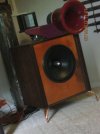
My humble Heil setup with the waveguides and 12" Alnico Jensen drivers in U-fram open baffle, crossed at 1kHz.

P.S. I also found out that current ESS Labs Heil AMT they sell are about 0.5" shorter in the ribbon opening than some of the older Heil AMT's, Toddalin's reflector not fitting due to being 0.5" too long :dunno:

IMG_E1447.jpg
 
My humble Heil setup with the waveguides and 12" Alnico Jensen drivers in U-fram open baffle, crossed at 1kHz.

P.S. I also found out that current ESS Labs Heil AMT they sell are about 0.5" shorter in the ribbon opening than some of the older Heil AMT's, Toddalin's reflector not fitting due to being 0.5" too long :dunno:

View attachment 3840577
That would also explain the gap at the top of the waveguides. My Heils came from an AMT-1D.

Minor correction, my speakers are 2241H (8 ohm) 18", 2251J (16 ohm) 10" and the Heil. I feel that accordion edge speakers provide better "texture/detail" than foam edged speakers and never need refoaming.

And, those were not the peaks we were seeing. Meter was in dBL (linear), fast response. If I put the meter in Peak mode, the readings would have been over 10 dB higher. :naughty:

To demo to a certain someone else that there is no longer any peakiness in the Heils, and that they are not overly bright, this one is for you Jon. In this case, they are up all the way. If something sounds bright, it's because it is bright.

As usual, this is a CD on an Oppo-95 through a Yamaha RX-Z9 RECEIVER through the two inner speakers with no eq or room correction, either electronic or physical. Recorded on a Nikon D750 DSLR in the approximate sweet spot.
 
Last edited:
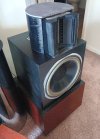
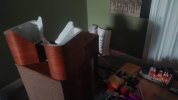
Here's my humble attempt at taming the Heils. I haven't done any audio measurements, but they sound much better to me. I have 4 big Heils in a pretty small room (16X24) I have AMT1Ds in front and AMT IIs for rear surround. The first picture was a quick experiment. The cylindrical part of the finished piece is a cardboard concrete form.20260526_155404.jpg20260530_131723.jpg20260530_131124.jpg
 
Hmmm. I wonder if the older Heils that are taller measure and/or sound a bit different from the current Heils.

I have been on horn binge of late, but these Heils with the waveguides had me listening to music for hours into the evening today, with Heils powered by 5 watts single-ended 829B dual-beam tetrode via active crossover.

0920261849.jpg
 
Where do you place those half-rounds? These are speakers I built. Lambda TD15m woofers, round tractrix horn with JBL 2441 compression drivers, and big ass Heil AMTs. I cross at 700hz and 7khz.
002_zpsb6f81728.jpeg
 
Back
Top Bottom