'The Chinese have done it, my friend. The Chinese have done it!'
-- Ancient Seinfeldian Proverb
I got this old CD player from my uncle a few months ago; it's a PHILCO CD2471 with the venerable TDA1541A DAC inside
The damm thing sounded fantastic and I spun many a CD on it until it started to crap out. I tried to fix it myself - but what do I know about CD players? They're the devil's device, filled with all sorts of evil electrical gremlins. I recapped it to no avail, and I also tried my hand at readjusting those potentiometers for laser power and laser focus via a service manual. No luck.
The board is a mess to begin with. There are all kinds of teeny tiny surface mounted resistors (or capacitors?) soldered to the underside near the DAC and oversampling IC chip. Crap everywhere. If you were to design a CD player that would be prone to failure, then this would be it. Jeez.
I have a feeling the CDM-4/11 transport and laser are still good, and the problem lies somewhere on the board, but could never figure it out. Oh well. I'm gonna keep the transport for perhaps a future PHILIPS CD player project.
I ended up unsoldering all of the new caps I put on this CD player, and repurposed them for another vintage CD player I had. You'd be surprised at how many of them I was able to reuse. That CD player sounds great now.
You should always have a backup plan - which brings me to why I'm here now typing this post:
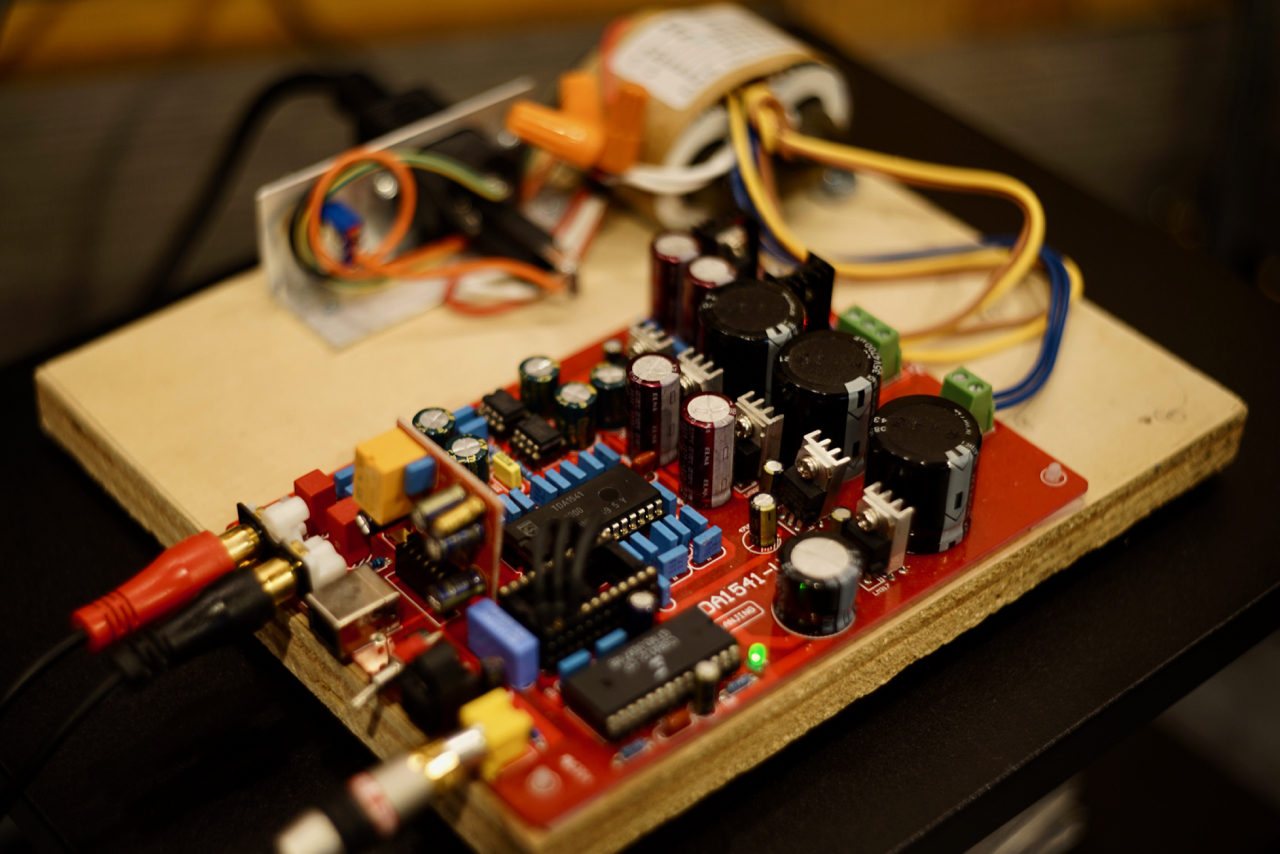
I scoured the Interwebs for any diy DACs that use the TDA1541 IC chip and SAA7220P IC filter chip. I found someone's diy project on the DIYAUDIO website, and another one on the PINK FISH MEDIA website. That made two successful projects that I found online. So a few weeks ago, I pulled the trigger and bought the same (or very similar anyway) diy DAC board (and a power supply), both off eBay, both products originating from CHINA (PHOTOS BELOW).
The power supply is an R-core type. It seems to be a quality product. So far so good with it. I have a feeling it's gonna be a keeper. I know a little about these types of power supplies, because there's one in my ELEKIT TU-8500 tube preamplifier kit I built six months ago.
The DAC board looks great. I thought I was gonna have to solder all the components on it, but to my surprise, the damm thing came already assembled; for the price (75 bucks!) I couldn't be happier.
It comes assembled with what looks like a counterfeit SAA7220P/C filter chip, though I could be wrong. And a CS8412 CMOS digital audio interface receiver (whatever that is). And four (4) NE5534 op-amps. You have to supply the TDA1541 DAC chip.
I have a TDA1541A-R1 DAC IC, and a SAA7220P/A filter IC. Both pilfered from the PHILCO CD2471 CD player I spoke about above, and now reside on the new DAC board.
Next I'm gonna buy or find an enclosure for it. I haven't done that before, build an enclosure, so it should be fun!
HOW DOES IT SOUND?
I have a TOPPING D20 DAC with an upgraded power supply, and I always thought it sounded really good. It's what I've been using for years and years as the means for listening to my collection of 1000s of CD rips I have in APPLE LOSSLESS FORMAT. I use a PC to play these music files through the D20 DAC.
The new TDA1541 DAC simply sounds better. It does everything better. There's a better sense of openness, and more of a 3-D wrap around effect with some of my better audio recordings. Audio tracks make more sense now. I've had some A-HA moments already where I'm like: 'Oh, that piano and that guitar sound more cohesive now, I get it!' It just has a very nice, very pleasing sound. I like listening to music with it now more than I do with the TOPPING D20.
This whole experience has been a lot of fun and I think the results have been highly successful. Here're the links to the eBay webpages:
TDA 1541 DIY DAC: https://www.ebay.com/itm/273808925090
Power Supply: https://www.ebay.com/itm/273790508088
-- Ancient Seinfeldian Proverb
I got this old CD player from my uncle a few months ago; it's a PHILCO CD2471 with the venerable TDA1541A DAC inside
The damm thing sounded fantastic and I spun many a CD on it until it started to crap out. I tried to fix it myself - but what do I know about CD players? They're the devil's device, filled with all sorts of evil electrical gremlins. I recapped it to no avail, and I also tried my hand at readjusting those potentiometers for laser power and laser focus via a service manual. No luck.
The board is a mess to begin with. There are all kinds of teeny tiny surface mounted resistors (or capacitors?) soldered to the underside near the DAC and oversampling IC chip. Crap everywhere. If you were to design a CD player that would be prone to failure, then this would be it. Jeez.
I have a feeling the CDM-4/11 transport and laser are still good, and the problem lies somewhere on the board, but could never figure it out. Oh well. I'm gonna keep the transport for perhaps a future PHILIPS CD player project.
I ended up unsoldering all of the new caps I put on this CD player, and repurposed them for another vintage CD player I had. You'd be surprised at how many of them I was able to reuse. That CD player sounds great now.
You should always have a backup plan - which brings me to why I'm here now typing this post:
I scoured the Interwebs for any diy DACs that use the TDA1541 IC chip and SAA7220P IC filter chip. I found someone's diy project on the DIYAUDIO website, and another one on the PINK FISH MEDIA website. That made two successful projects that I found online. So a few weeks ago, I pulled the trigger and bought the same (or very similar anyway) diy DAC board (and a power supply), both off eBay, both products originating from CHINA (PHOTOS BELOW).
The power supply is an R-core type. It seems to be a quality product. So far so good with it. I have a feeling it's gonna be a keeper. I know a little about these types of power supplies, because there's one in my ELEKIT TU-8500 tube preamplifier kit I built six months ago.
The DAC board looks great. I thought I was gonna have to solder all the components on it, but to my surprise, the damm thing came already assembled; for the price (75 bucks!) I couldn't be happier.
It comes assembled with what looks like a counterfeit SAA7220P/C filter chip, though I could be wrong. And a CS8412 CMOS digital audio interface receiver (whatever that is). And four (4) NE5534 op-amps. You have to supply the TDA1541 DAC chip.
I have a TDA1541A-R1 DAC IC, and a SAA7220P/A filter IC. Both pilfered from the PHILCO CD2471 CD player I spoke about above, and now reside on the new DAC board.
Next I'm gonna buy or find an enclosure for it. I haven't done that before, build an enclosure, so it should be fun!
HOW DOES IT SOUND?
I have a TOPPING D20 DAC with an upgraded power supply, and I always thought it sounded really good. It's what I've been using for years and years as the means for listening to my collection of 1000s of CD rips I have in APPLE LOSSLESS FORMAT. I use a PC to play these music files through the D20 DAC.
The new TDA1541 DAC simply sounds better. It does everything better. There's a better sense of openness, and more of a 3-D wrap around effect with some of my better audio recordings. Audio tracks make more sense now. I've had some A-HA moments already where I'm like: 'Oh, that piano and that guitar sound more cohesive now, I get it!' It just has a very nice, very pleasing sound. I like listening to music with it now more than I do with the TOPPING D20.
This whole experience has been a lot of fun and I think the results have been highly successful. Here're the links to the eBay webpages:
TDA 1541 DIY DAC: https://www.ebay.com/itm/273808925090
Power Supply: https://www.ebay.com/itm/273790508088
Attachments
![1204190820[1].jpg](/forums/data/attachments/1564/1564444-ec9a37df7475168446a4c2d7c3d7bab5.jpg?hash=7Jo333R1Fo)
![1204190822[1].jpg](/forums/data/attachments/1564/1564446-5fc40346098e17a597b1caa07654a3f8.jpg?hash=X8QDRgmOF6)
![1204190819[1].jpg](/forums/data/attachments/1564/1564448-fa4b69f13b0a1fc9a6e577d86934315d.jpg?hash=-ktp8TsKH8)
Last edited: