• The move to the new server is done. There are some software and database maintenance updates in process. This has us passing the hat around to help out. We appreciate any donations. Seriously, even a dollar helps. The payment page may be found here - https://www.audiokarma.org/support.html

Technical differences in Sansui AUD 11II vs aud707x ?????

Have you done any comparison of your AUD-11-II next to the AU 9500 ?
im interested in your views on that one
Sorry, never seen an AU-9500. :(

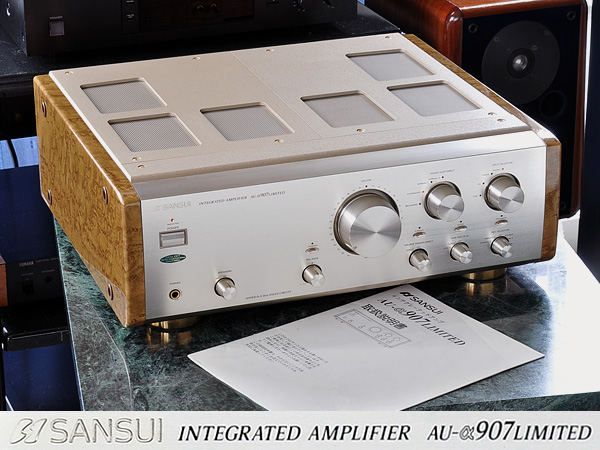
My fully modified and upgraded AU-D11 II is only bested (by a very small margin), by an AU-α907Limited - if that helps?
 
Oh man . I passed on that one .kept it for 6 -7yrs.
Alphas arent my type .
Poor me .
I have my eyes set on the 707x for the reviews i was getting that it was clean clear neutral like the alphas but also had the velvetty beauty of the vintage sui.
 
Exactly. Thats why i am waiting for response from phonomac to enlighten me on this. As i have now both 707x and 907x decade. I will soon upload innerds of both amps.

I haven't heard a 707X so I can't comment on sound quality differences. If you can recreate the schematic for the revised equalizer in the 707X I'll be glad to take a look at it. However, I wouldn't get too excited about removing a trimmer from the equalizer section in the AU-D11 II. The DC gain of the equalizer is 56 dB, around 620, so a typical drifted offset of 50 mV at the output is equivalent to an input offset of 80 uV, not enough to cause distortion in the differential pair FET, and the output is AC-coupled so it isn't going to reach anywhere else in the amplifier.

The equalizer in the au-D707X may be like that in the G90, which eliminates the trimmer, but also eliminates the op-amp and the all-discrete design that is left isn't that sophisticated. Most of the later ones keep the op-amp, eliminate the trimmer and rely on the AC-coupled output to keep the rest of the amplifier out of trouble.

On the subject of the power amplifier sections of these amps I've already indicated to @quadklipsh that I will never understand why the AU-D11 II was called a D-series, or a Mk2 of anything. It is the first Sansui amplifier to use the bridged output ground-free configuration, and all of the later ones stem from this design. In the cases of the G90X, G99X, and a707/907 DR, KX, MR, MRX in all instances the power amp sections are cost-reduced versions of the AU-D11 II with components removed from critical locations in the amplifiers (and some others added where they just don't make sense).

So I'm not in any hurry to spend my money finding out what the later amps sound like - I'm very happy with mu AU-D11 II thank you :music:
 
The equalizer in the au-D707X may be like that in the G90, which eliminates the trimmer, but also eliminates the op-amp and the all-discrete design that is left isn't that sophisticated.

I believe that you are right. The equalizer boards used in the AU-D707X is the same as that used in the AU-G90X. This is why i think that to repair the AU-D707X the service manual for the AU-G90X would be good, but better to also have at hand that for the AU-D11 II.

On the subject of the power amplifier sections of these amps I've already indicated to @quadklipsh that I will never understand why the AU-D11 II was called a D-series, or a Mk2 of anything.

My interpretation is that "AU-D" means that they use some version of the diamond differential stage in the amplifier stage. But some units have this circuitry despite of not having a D anywhere in the model number. (examples: G90, the AU-X1, BA-F1 and there are others). But as far as I know the AU-D prefix means IT DOES have a diamond differential scheme in the early portion of the power amplifier section.
I have no clue about the "II" sufix.

In the cases of the G90X, G99X, and a707/907 DR, KX, MR, MRX in all instances the power amp sections are cost-reduced versions of the AU-D11 II with components removed from critical locations in the amplifiers (and some others added where they just don't make sense).

The power amplifier "main board" is exactly the same among the AU-D707X , AU-G90X and the AU-D11 II. But i do not know if they removed or added any components. Unfortunately I can not take a look at my AU-D707X Decade untill January 2019 when I return to Bangkok. I would like to see what are the differences in the quality of the components that you mention and any other critical circuit differences with respect to the AU-D11 II.
I have compiled a table with the various boards used in several of these amplifiers, and there is a very large degree of similarity. (please see attached file, which I hope it is useful). I would expect the sound quality to be very similar among all these since they share many of the boards.
 

Attachments

I haven't heard a 707X so I can't comment on sound quality differences. If you can recreate the schematic for the revised equalizer in the 707X I'll be glad to take a look at it. However, I wouldn't get too excited about removing a trimmer from the equalizer section in the AU-D11 II. The DC gain of the equalizer is 56 dB, around 620, so a typical drifted offset of 50 mV at the output is equivalent to an input offset of 80 uV, not enough to cause distortion in the differential pair FET, and the output is AC-coupled so it isn't going to reach anywhere else in the amplifier.

The equalizer in the au-D707X may be like that in the G90, which eliminates the trimmer, but also eliminates the op-amp and the all-discrete design that is left isn't that sophisticated. Most of the later ones keep the op-amp, eliminate the trimmer and rely on the AC-coupled output to keep the rest of the amplifier out of trouble.

On the subject of the power amplifier sections of these amps I've already indicated to @quadklipsh that I will never understand why the AU-D11 II was called a D-series, or a Mk2 of anything. It is the first Sansui amplifier to use the bridged output ground-free configuration, and all of the later ones stem from this design. In the cases of the G90X, G99X, and a707/907 DR, KX, MR, MRX in all instances the power amp sections are cost-reduced versions of the AU-D11 II with components removed from critical locations in the amplifiers (and some others added where they just don't make sense).

So I'm not in any hurry to spend my money finding out what the later amps sound like - I'm very happy with mu AU-D11 II thank you :music:

Thanks for explaining. I just digged out 907x from my storage to see the difference. I got surprised to see that equalizer section is different with trim pots present. But not like Au- D11ii (ill post picturs .. You'll confirm). Power amp is section of both amps is same.except output devices.i got more impessed by 907x. Unfortunately 907x requires repair and extensive servicing. Thanks for inputs.
 
I have no clue about the "II" sufix.
The 'II' suffix in AU-D11 II is because there is another model called the 'AU-D11' which is based on an earlier design, and doesn't have the innovations present in the AU-D11 II - which is quite different. ;) (although visually they look very alike).
 
Oh man . I passed on that one .kept it for 6 -7yrs.
Alphas arent my type .

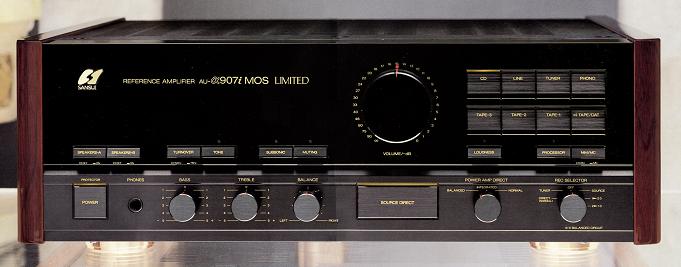
From memory, you didn't have the 907 Limited - you had the 907i MOS LIMITED

i.e. this one:

au-alpha907imoslimited.JPG


Not this one:

eb587c95dcaaa34e98fb4e3ef32ee618.jpg
 
Yup . Ur damn right on.
But we get the idea they are all voiced similarly. So whats the point.
Would the d11II be much different?
 
Different amplifiers can have a different presentation of the stereo image, some with it somewhat 'bunched up' in the middle, and others with it more spread out across the soundstage. If you close your eyes while listening you can visualise being in a much larger room from all the small sounds in the background. Some (like the AU-D11 II) will have the ability to make you jump with a sudden sound so realistic that you can't help yourself. With some (like the AU-α907Limited) the imaging is so realistic that you can even visualise the performers. And follow the sound of their singing for example, as it 'beams' left and right as the singer moves his or her head. It is true that up in this rarified atmosphere of TOTL Sansui's there isn't much to tell them apart, once they are made to work properly again, after 30-40 years of use and abuse.

It is this airy, floaty, wonderfully detailed sound that I lust after - and any amplifier that can do this well immediately becomes my favourite. :bowdown:
 
Last edited:
Yup thats the idea .
Seldom do i play tracks of such high fidelity recordings .
Generally what i get is around 320 kbps. And what you are saying comes with good recordings no less than 1411kbps.
Or well recorded originals.
I do get that 3d sound from my 9500 sometimes when harmony is right.
 
....My interpretation is that "AU-D" means that they use some version of the diamond differential stage in the amplifier stage. But some units have this circuitry despite of not having a D anywhere in the model number. (examples: G90, the AU-X1, BA-F1 and there are others). But as far as I know the AU-D prefix means IT DOES have a diamond differential scheme in the early portion of the power amplifier section.

The diamond differential circuit was introduced with the AU-819/919, then used in the AU-719. The D amps also use it, as do most of the X series and alpha series. Just out of interest the D9 and D11 (original version) also use feedforward, as does the X11.


The power amplifier "main board" is exactly the same among the AU-D707X , AU-G90X and the AU-D11 II. But i do not know if they removed or added any components. Unfortunately I can not take a look at my AU-D707X Decade untill January 2019 when I return to Bangkok. I would like to see what are the differences in the quality of the components that you mention and any other critical circuit differences with respect to the AU-D11 II.
I have compiled a table with the various boards used in several of these amplifiers, and there is a very large degree of similarity. (please see attached file, which I hope it is useful). I would expect the sound quality to be very similar among all these since they share many of the boards.

You cannot tell from the board number whether or not they are the same. You also need the build number (or stock number in Sansui-speak). For example, the F-4296 main board is 00765101 in the D11 II, 00816401 in the G90, 00828201 in the G99 ...and so on. These all represent different build states (component deletion or changed values) across the amplifiers.

The most significant differences in the power stages of these amps occur on the driver boards F-4266/4267 (for which you also need to know the build numbers). The AU-D11 II uses cascoded driver stages where the voltage swing is greatest :thumbsup:, but the cascode is deleted from the G90 and G99 (and many of the others):whip:Some of the later ones bring the cascode back for the input differential stage which is OK but I'd sooner see it in the output section of the driver board.
 
You cannot tell from the board number whether or not they are the same. You also need the build number (or stock number in Sansui-speak). For example, the F-4296 main board is 00765101 in the D11 II, 00816401 in the G90, 00828201 in the G99 ...and so on. These all represent different build states (component deletion or changed values) across the amplifiers.

Thanks for bringing this up. According to what you explained there are important differences. Unfortunately there is little documentation about the japanese domestic market units. I really appreciate your comment.
 
Some of the later ones bring the cascode back for the input differential stage which is OK but I'd sooner see it in the output section of the driver board.
Hello Pete,
I would like to know in which ones have you seen this. I will apreciate if you can expand your comment a bit.
I am trying to see if this is true for the AU-D707X, AU-D907X(and their decade versions). Taking a look at the pictures posted by http://amp8.com it appears that these have cascode driver stages too. But i see the following differences : The driver boards in these have a zener diode instead of the constant current diode of the AU-11II. C4 and C6 are nor installed in them either. Resistor values are different also which may have to do with different mains. Other than that they are a circuit layout very similar to that in the AU-D11 II. Do you know if this is correct?
 
Apart from the fact that I am phonomac and not Pete you will find a discussion of the cc diode vs zener issue in post #10 of my AU-D11 II thread here http://www.audiokarma.org/forums/index.php?threads/refurbishing-and-upgrading-the-au-d11-ii.789344/

The early D11 II seemed to use the cc diode while later versions changed to a zener (without doing the job properly since they omitted the smoothing cap across the zener).

The alpha907DR and KX for example use cascoded FETs in the input differential stage, but no cascode in the driver stage.
 
I am sorry for confusing your user name with another user (pete_mac). Thank you for clarifying your point about the circuit topology. I will try to take a look at the alpha-907DR. I had read the thread about the constant current diode (very useful) and I read this other thread which also talks about this issue. The AU-D707X models share some similarities with the AU-G90X and some with the AU-D11 II.
Thanks again!!
 
Guys ...may i know the bias values of the four set of transistors on the AUD707x.
Mine are set at 20.02 +- 0.01
I haven't seen a Service Manual for the AU-D707X however, the very similar design AU-D11 II values are 20mV at the test points. If I owned an AU-D707X I would be happy to leave the bias set for 20mV.
 
Last edited:
After a month iv found my bias to be 20.1 20.2 , 20.1 and 20.3.
Dc offsets are 0.0 after 15 minutes.
Is that a sign of good health ?
Occasional slurring even when paused tends to be there . I think its
the old caps . Or the switches.
Shojam's guidance is highly appreciated.
 
Back
Top Bottom