• The move to the new server is done. There are some software and database maintenance updates in process. This has us passing the hat around to help out. We appreciate any donations. Seriously, even a dollar helps. The payment page may be found here - https://www.audiokarma.org/support.html

Testing audio cables

John Tyler

New Member
I'm wondering if there's a way to test the audio quality of RCA cables. Is an app or way that can tell the difference in quality of the audio if I'm using for the sound coming thru the speakers? If I'm using a cheap Radio Shack set, then using a custom made set I made to compare them? Is it just a listening test or is there a way to measure this on a scale?
 
Register to hide this ad
There are instruments to see the signals (Oscilloscopes), and to analyze the distortion and freq response.

Also, a computer can measure those things through the sound card. You can even measure the distortion of the sound card itself, so you can substract that from the measurements you do.

There is a software called Visual Analyzer (NO AFFILIATION) that can measure THD

Also, RMAA (Right Mark Audio Analyzer) (NO AFFILIATION) is a software dedicated to this tests, check the web site if interested. It will perform a serie of audio tests and capture the results with your sound card.

If you want to compare 2 cables, you can run the tests directly from the sound card output to the sound card input, without any other device in between, connecting the output to the input with your different wires. Any difference in the tests results will be caused by the wire. But a 2 wires can have a different performance in some applications, and similar in other application, so perhaps is better to test your whole setup, and then replace just those RCA, and do another test to the whole system. RMAA allows to record a CD or an audio file with the tests, and play the test in any device you want to measure, capturing the line output with the sound card (not speaker output, you can burn a sound card connecting it to a speaker output) PLEASE READ THE SOFTWARE INFO.

But if it sounds OK, it's OK. And if it sounds bad, it's not OK.
 
Last edited:
There's a quote attributed to Daniel Von Recklinghausen, who was the chief engineer for H.H. Scott and later Vice President of Research and Development for KLH. "If it measures good and sounds bad, -- it is bad. If it sounds good and measures bad, -- you've measured the wrong things."

Let your ears be the main guide as to what sounds good or bad.
 
Last edited:
I'm giving Visual Analyzer a try. Just downloaded last night. Only issue is the test computer its running on doesn't even have a soundcard. Its a chipset.
 
Interesting! I'd be curious to see if there is any difference at all really. I mean, between a properly working, decent quality RCA and one that is really expansive (and comes with all the superlatives to account for that price). You might have guessed I'm a bit skeptical.. But testing will tell!

Some tips on testing in general:
— Make sure you have a totally controlled environment, in which the different subjects (cables) are tested under exactly the same circumstances. Same music, some devices, same volume, same room temperature, same programs running on the computer in the background etc.
— Repeat your tests, at least 10 times, preferably over several sessions. Then check to see if the differences in outcome between the repeated tests of the same cable are small enough to be sure any difference between the cables is not just a function of inaccuracies.
— See if you can make it a (single) blind test. This is the situation in which you do not know which cable you are testing right now. It helps to rule out any (sub conscious) systematic difference you might bring in to the test yourself. Of course, you do need some kind of 'marking' system, so you will later on be able to couple the findings to the subjected cable.

I'll leave it at that for now ;-)

 
Theory say there will be measurable differences based the nature of the cable construction and materials. There is test equipment that can measure those differences. Whether the OPs can I don't know.

The only point of contention is at what point do measured differences actually cause a perceivable difference.

The answer to that can only be "it depends" because not only is there the magnitude of differences relative to the cables, there are multiple variables beyond the cables.
 
The purpose of this hobby, for me anyways, is to listen to music. I listen to music with 2 ears and only 2 ears not with any instruments. So I go with my ears.

Also measurements have a flaw that I don't see mentioned very often. The flaw is that the measurement(s) do not correlate 100% with what I'm hearing and what I'm feeling. For example 4 ohms measured on anything vs 8 ohms what does it mean? How does it translate to what I'm hearing. Also there are numerous, I'd say almost infinite other measurements that have not been conceive of yet nor any instrument made yet to better correlate what is measured to what I'm hearing and feeling.

No measurement of anything I know of tests equipment with my gear, in my room, with my listening preferences. So to take any measurement as gospel is a false gospel. At best it's a guideline to what I should listen too.

Measurements, especially pertaining to cables, are nothing more than marketing and accounting language.
 
Interesting! I'd be curious to see if there is any difference at all really. I mean, between a properly working, decent quality RCA and one that is really expansive (and comes with all the superlatives to account for that price). You might have guessed I'm a bit skeptical.. But testing will tell!

Some tips on testing in general:
— Make sure you have a totally controlled environment, in which the different subjects (cables) are tested under exactly the same circumstances. Same music, some devices, same volume, same room temperature, same programs running on the computer in the background etc.
— Repeat your tests, at least 10 times, preferably over several sessions. Then check to see if the differences in outcome between the repeated tests of the same cable are small enough to be sure any difference between the cables is not just a function of inaccuracies.
— See if you can make it a (single) blind test. This is the situation in which you do not know which cable you are testing right now. It helps to rule out any (sub conscious) systematic difference you might bring in to the test yourself. Of course, you do need some kind of 'marking' system, so you will later on be able to couple the findings to the subjected cable.

I'll leave it at that for now ;-)
I'll definitely control the surroundings for an objective test and repeat it
 
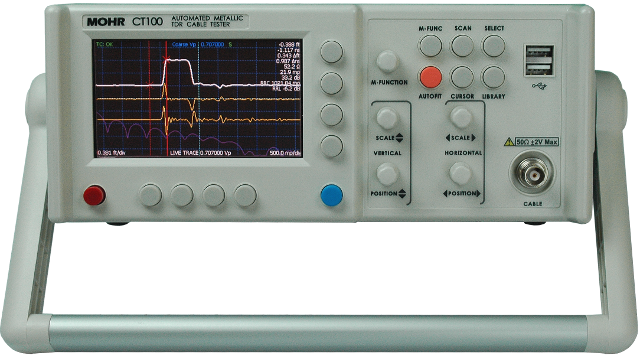
TDR

CT100_front_640x362.png
 
I've seen posts testing the wire using osilloscope; I have a Tenma I'll pull out on the weekend.
I have a tone generator app running off a spare cellphone I don't use. Is there a standard set of tones to go through for testing the signal sent though it, like a hi fi test record goes through ranges on pink noise, brown for example?
 
Usually a square wave can show a couple of things. A 1KHz square is a standard test. A 10KHz square wave is a challenging test, you can see if the signal keeps square before and after the cable. But you need a load to test a cable. Preferably similar to the load your amp gives to the same cable.

But a cell phone for sure has some trouble creating a square wave. It can serve to compare the signal at the input and output of the cable, but it won't be a sharp square wave.
 
The app i have doesn't make square waves. I'll have to look into that.
So i've sent different signals through the wires. What should i look for when comparing different wires?
 
..well, for starters: any systematic difference.

If you find any, the next step would be to compare both cables to the 'clean' signal. The one least deviating from the original signal would seem the best.
 
The app i have doesn't make square waves. I'll have to look into that.
So i've sent different signals through the wires. What should i look for when comparing different wires?
I use 2 apps for android, both can make square waves : "TestTone app" and "ToneGen"

In a square wave, you want to see the "angles" not ringing, and how sharp they are. Search for info about "square wave testing", to see the meaning of each deviation from an ideal square wave. ( https://sound-au.com/articles/squarewave.htm )

In a sine wave, the distortion is not easy to see (if you can see it , it's way too high). You should connect it to a THD measurement device, like the mentioned Visual Analyzer software in the THD mode. (your measurements will be limited to the sound card bandwidth and sound card distortion)

How are you "capturing" the signal passing through the wires? What's your setup? (anyway, take this as a learning experience, don't expect laboratory accuracy)
 
Personally, I think your concern has you putting the "Cart" before the "horse".

Rather than being interested in the calibre of carry of sound, how about improving the source of the sound gear and going that direction.

If you are going with poor level of sound production, no amount of improved wires is really going to make an appreciative degree of improvement with the level of equipment you've mentioned. IMO


Q
 
Last edited:
Personally, I think your concern has you putting the "Cart" before the "horse".

Rather than being interested in the calibre of carry of sound, how about improving the source of the sound gear and going that direction.

If you are going with poor level of sound production, no amount of improved wires is really going to make an appreciative degree of improvement with the level of equipment you've mentioned. IMO


Q
If it's about improving actual sound quality I can only agree. But as I understand it, this is more about experimenting, learning, discovering etcetera. Very different angle ;-)
 
True, that's why he's asking. As you pointed out, "there are very different angles". And in the past, have been endless discussion on cables and the inherent value of them on AK...ad nauseam. Some really heated up, I might add.

However, if the gauge is decent, say 12 or thicker, and the wire runs are not too long, no amount of better cable will improve the end result if the source is of lesser value. Just suggesting that he'd prob notice a greater distinction with better gear. Most have started with first time equipment, and later gone on to higher quality gear.

Q
 
If it's about improving actual sound quality I can only agree. But as I understand it, this is more about experimenting, learning, discovering etcetera. Very different angle ;-)
This is an experiment. I'm just using that I have on hand to see how good my wires are.
 
Personally, I thuink your concern has you putting the "Cart" before the "horse".

Rather than being interested in the calibre of carry of sound, how about improving the source of the sound gear and going that direction.

If you are going with poor level of sound production, no amount of improved wires is really going to make an appreciative degree of improvement with the level of equipment you've mentioned. IMO


Q
What gear is suggested for a better result?
 
Back
Top Bottom