• The move to the new server is done. There are some software and database maintenance updates in process. This has us passing the hat around to help out. We appreciate any donations. Seriously, even a dollar helps. The payment page may be found here - https://www.audiokarma.org/support.html

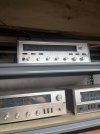
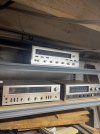
The 250, 500a and 1000 Sansui tube receivers

Carbsandcaps

Super Member
Somehow I always end up with same brands at the same time when I get a new project. Before this it was trio/kenwood. Anyway the 250 still needs to be rebuilt and may end up being my shop radio. The 1000 is one if not the best receiver I’ve ever heard, I’ve never owned a 1000a so I can’t compare the sound but looks wise I think the 1000 has it beat by a mile. It has power for days from the 25e5 tubes and is also one of the best looking out there. My only gripe is that the stereo light relay is annoyingly sensitive and loud. All around Sansui makes some really nice stuff.
 

Attachments

  • IMG_3940.jpeg
    IMG_3940.jpeg
    111.7 KB · Views: 34
  • IMG_3939.jpeg
    IMG_3939.jpeg
    94.9 KB · Views: 34
Register to hide this ad
That is a nice trifecta of Sansui tube receivers. I'm curious if you have any issues with the 1000 that are inherent in the design. It has long been my understanding that the 1000 had some problems - notably heat dissipation - which prompted a significant redesign resulting in the 1000A being offered. The 1000 is a rarity, no doubt. I probably see 4 or 5 1000A's around for every "non-A".
 
That is a nice trifecta of Sansui tube receivers. I'm curious if you have any issues with the 1000 that are inherent in the design. It has long been my understanding that the 1000 had some problems - notably heat dissipation - which prompted a significant redesign resulting in the 1000A being offered. The 1000 is a rarity, no doubt. I probably see 4 or 5 1000A's around for every "non-A".

I haven’t noticed anything. It does use oddball output tubes which use a 25v heater so they tend to get hot it also has a plate cap on to so there’s always a risk of a zap. They use a failure prone style of potentiometer to adjust bias. The leads literally fall off, I had it happen on the 500 causing
it to almost immediately red plate. It also uses the line voltage, straight from the wall to power the output heaters so if a heater fails or shorts it can short out the outlet or put 120v on the chassis installed a 3 prong plug to take care of that.
 
Gotta love the idiosyncrasies of that old tube gear. Safe design standards? Nah, we don't need any of that foolishness. I have a Sansui Q-3535 tube power amp from 1958 here I'm slowly restoring. Uses 4 EL34 outputs and has absolutely massive iron on it. I have to be honest, it makes me a little bit nervous, as I know it would never pass modern UL requirements. Once it's done, it'll be on a power strip that always gets switched off after use.
 
You’re absolutely right in that one! I do side projects at work when I get a few minutes and I work on a metal bench. For whatever reason it’s grounded so I put whatever I’m working on on cardboard. I’ve gotten shocked more times than I can count from touching the bench and a hot chassis. Sometimes it’ll even blow the breaker. All you have to do is switch the plug around and the neutral goes to the chassis but the plugs were unidirectional! Can you imagine the lawsuits today!
 
Gotta love the idiosyncrasies of that old tube gear. Safe design standards? Nah, we don't need any of that foolishness. I have a Sansui Q-3535 tube power amp from 1958 here I'm slowly restoring. Uses 4 EL34 outputs and has absolutely massive iron on it. I have to be honest, it makes me a little bit nervous, as I know it would never pass modern UL requirements. Once it's done, it'll be on a power strip that always gets switched off after use.

To make yourself feel better, think about this... the fuse is rated for what, 3A or 4A? So you have a maximum power of way under 500W before the fuse can blow. If you set the amplifier on a surface that would not start a fire if it had a 500W heating element on it (like say a scrap piece of quartz counter top material), you haven't got too much to worry about besides the amplifier self destructing and a little smoke. Yes a burned up amp is rare, but a few simple fire related precautions sure don't hurt. Another thing that helps is sacrificial 1/4W 10 ohm metal film cathode resistors on the output tubes, which will fuse open if a tube shorts, thus preventing any further damage.
 
You’re absolutely right in that one! I do side projects at work when I get a few minutes and I work on a metal bench. For whatever reason it’s grounded so I put whatever I’m working on on cardboard. I’ve gotten shocked more times than I can count from touching the bench and a hot chassis. Sometimes it’ll even blow the breaker. All you have to do is switch the plug around and the neutral goes to the chassis but the plugs were unidirectional! Can you imagine the lawsuits today!

Get an isolation transformer, and then ground the chassis when you're doing tests. Seriously, it might end up saving your life!
 
There appear to be at least two versions of 1000, an earlier one with internal similarities to SM-80, and a later one more toward 1000A.
 
@maxhifi, good advice there, and I was figuring on setting the unit on a leftover slab of marble I have here once it's in-situ. I'm really more concerned with shock hazards than a potential fire from this amp, but the latter certainly crossed my mind. I have an isolation transformer on the bench, so worries there. I still get a bit uncomfortable working around 400-500 volts, no matter how many precautions I take.
 
@maxhifi, good advice there, and I was figuring on setting the unit on a leftover slab of marble I have here once it's in-situ. I'm really more concerned with shock hazards than a potential fire from this amp, but the latter certainly crossed my mind. I have an isolation transformer on the bench, so worries there. I still get a bit uncomfortable working around 400-500 volts, no matter how many precautions I take.

Regarding shock hazards, first of all if there's a capacitor connecting the chassis to the 117V power supply, make sure its a safety cap and not some regular one. A leaky cap in that position can give you a tingle.

Secondly, nobody should ever be too comfortable working around 400V, but you can develop good work practices to mitigate risks. For example, when workint on the amp, after turning the amp off, measure the B+ voltage has gone to zero before touching anything. Put a sleeve of insulation on your meter probe so only the very tip is exposed. Inspect the wiring to make sure there's good distance between component leads carrying voltage and those that don't. Ground the chassis during test and measurements. Never substitute a larger fuse than stock. And etc.

Tube amps are lots of fun, I'm curious to read how you like your Sansui once it's up and running. And start searching for Matsushita 6CA7 tubes, I know if it were my Sansui I wouldn't relax until it was tubed with proper Japanese 6CA7 tubes :)
 
The two versions of 1000 I've seen both used the 25E5 sweep tubes used in the SM-80. The 1000A indeed used 7591.

I missed my chance to buy one of those when they were cheap on eBay. I think a 1000 is a really neat amp, especially since so few vintage amps used sweep tubes, and sweep tubes have a lot of advantages over normal output tubes.
 
I have The early 1000 and SM-80, the SM-80 I keep as an unrestored but working original time capsule. The 1000 I cobbled into working before the internet and it's recources were available.
 
It's funny, I never realized the 1000 used sweep tubes for outputs. And I've never seen an SM-80 in person, only a couple of pictures here and there. I had a 1000A on the bench for a while years ago, but it wasn't mine to keep. I remember being fairly impressed with it's sound. Build wise, it had a lot crammed into it and was difficult to work on.
 
0
It's funny, I never realized the 1000 used sweep tubes for outputs. And I've never seen an SM-80 in person, only a couple of pictures here and there. I had a 1000A on the bench for a while years ago, but it wasn't mine to keep. I remember being fairly impressed with it's sound. Build wise, it had a lot crammed into it and was difficult to work on.

It's kind of innovative for the time. Sweep tubes have large cathodes, and can pass a lot of current compared to an ordinary audio tube. They're very popular among the DIY crowd, and I'm curious how they fared in a commercial application. I guess we will never know why they moved to the 7591A, but could be marketing or a little extra power. One other huge advantage now is that it's an amp you can get a set of NOS output tubes for without paying an arm and a leg.
 
Last edited:
It's funny, I never realized the 1000 used sweep tubes for outputs. And I've never seen an SM-80 in person, only a couple of pictures here and there. I had a 1000A on the bench for a while years ago, but it wasn't mine to keep. I remember being fairly impressed with it's sound. Build wise, it had a lot crammed into it and was difficult to work on.

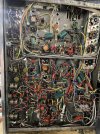
Don’t worry the 1000 is crammed too!
 

Attachments

  • IMG_3418.jpeg
    IMG_3418.jpeg
    240.2 KB · Views: 17
Back
Top Bottom